





Ashoka University Hosts Group Captain Shubhanshu Shukla at the Great Ideas Seminar 2026
At the Great Ideas Seminar 2026, on 22 May 2026, India’s first ISS astronaut, Group Captain Shubhanshu Shukla, took students on the journey of a lifetime, and reminded us that science is as much about adaptability as it is about discovery.
 2
2

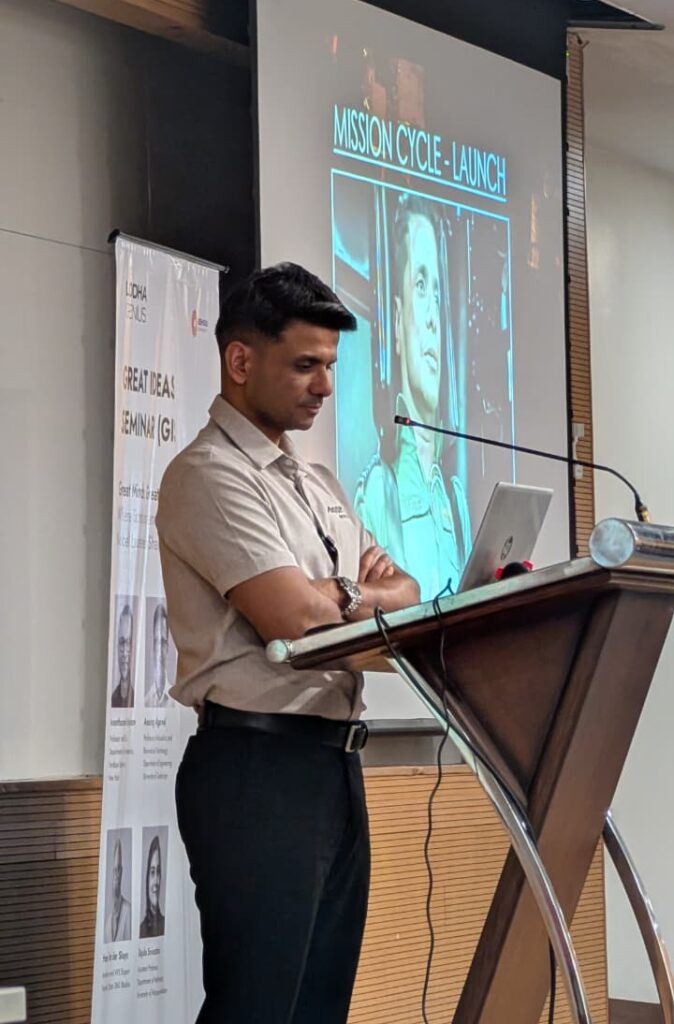
In a packed auditorium of school students, a man with the quiet authority of someone who has seen Earth from 400 kilometres above it begins with a laugh.
“I always dreamed of being a gymnast – I tried, but I never quite had the talent for it. In space, though? I was incredible.”
The laughter of school students that follows is immediate and warm. But Group Captain Shubhanshu Shukla, callsign “Shux,” Indian Air Force test pilot, the first Indian to set foot aboard the International Space Station, lets the joke breathe for only a moment before offering a reflection that feels much larger than the punchline: you flourish when there is nothing holding you back.
On 22 May 2026, Shukla delivered this year’s talk at the Great Ideas Seminar 2026, an on-campus engagement organised by the Lodha Genius Programme (LGP) — a joint initiative between the Lodha Foundation and Ashoka University, Sonipat. The LGP nurtures India’s brightest young minds from Grade 9 to Grade 12, fully funded across multiple years. For a room full of teenagers who dream in equations and constellations, this was not merely a talk. It was a transmission from another world (literally).
From Lucknow to Low Earth Orbit
Shukla was born in Lucknow and commissioned into the Indian Air Force in 2006. He accumulated over 2,000 hours of flight experience on jets like the Su-30 MKI and MiG-29 before being selected as one of India’s Gaganyaan astronaut-designates in 2020. Then came Axiom Mission 4 (Ax-4): a private human spaceflight to the International Space Station, launched on June 25, 2025, aboard SpaceX’s Crew Dragon. He served as mission pilot, alongside Commander Peggy Whitson of the US, and mission specialists from Poland and Hungary.
After completing the mission, he returned to Earth and to a rehabilitation programme that would slowly remind his body what gravity felt like.
At the seminar, he did not dwell on the heroics of launch or the glamour of orbit. Instead, he took the students somewhere more interesting: inside the messiness of real science.
The Space Ballerina Problem
Among the seven India-specific microgravity experiments Shukla conducted aboard the ISS was a study on edible microalgae – specifically, how strains of Spirulina and Synechococcus grow under space conditions. The research, designed by Indian scientists at the Department of Biotechnology, aimed to assess whether microalgae could one day serve as a sustainable food and life-support system for long-duration missions. The design of the experiment on Earth had been meticulous. But space, as it turns out, is an extraordinary editor of assumptions.
To collect samples from the algae pouches, Shukla needed to draw liquid into a syringe. On Earth, if an air bubble gets trapped in a syringe, the fix is simple: invert the pouch and the bubble rises; squeeze gently and it exits. In microgravity, bubbles have no reason to go anywhere. There is no up. Surface tension holds them exactly where they are, stubborn as stones.
The solution his team arrived at was elegantly absurd. Shukla had to spin fast enough to act as a centrifuge himself, to force the liquid to the tip of the syringe and push the bubble out. Each of the 36 samples required four or five rotations. Over the course of the experiment, he spent approximately three hours twirling in the middle of the ISS, a one-man centrifuge. Colleagues, jokingly, called him the space ballerina.
He embraced the title. And in recounting it to the auditorium, he made the deeper point land quietly: the experiment had been designed by some of India’s finest scientists over months of careful laboratory work, tested and validated on the ground, cleared for spaceflight. And then a bubble got in the way, and the solution was a man doing pirouettes.
“Trivial problems happen every day in space,” he said, “which you might have experienced on Earth – you just find innovative solutions.” The difference is that in space, you cannot go back to the lab. You are the lab.
The View from 400 Kilometres
Between experiments, Shukla would find a window. “I try to savour every moment, just sitting by the window and looking down,” he said. There is a particular kind of seeing that only becomes possible when you are far enough away. The borders that define nations on maps are invisible from orbit. What remains is the curve of the planet, the thinness of the atmosphere, the shimmer of the ocean.
He said he had to realign when he returned — that everything shifts, physically and inwardly, and that coming back to ordinary life requires a deliberate process of readjustment, not unlike the rehabilitation programme his body underwent after splashdown.
Toward the end of his talk, Shukla returned to the joke with which he had begun: the gymnast who found grace in weightlessness and offered it as something more than a punchline.
In space, with no gravity pulling you down, the body reconfigures. You stop walking and start floating. You stop being earthbound and start being something else. The constraint that had always prevented the gymnast from flourishing was removed, and in its absence, he was — in his own words — incredible.
“Sky was never the limit,” he said. “Not for you, not for me. And not for Bharat.”
For students still deciding who they want to become, this was more than inspiration. It was a demonstration. Here was a man who had spent years preparing – not for the journey itself, but for the problems the journey would produce.
Science, he seemed to be saying, is not just about having the right answers. It is about finding new ones when unexpected problems emerge.
Written by Ankita Rathore, Manager, Ashoka Global Research Alliances