









Event Calendar

The Wound of Passion/Ishq ki chot
- This event has passed.
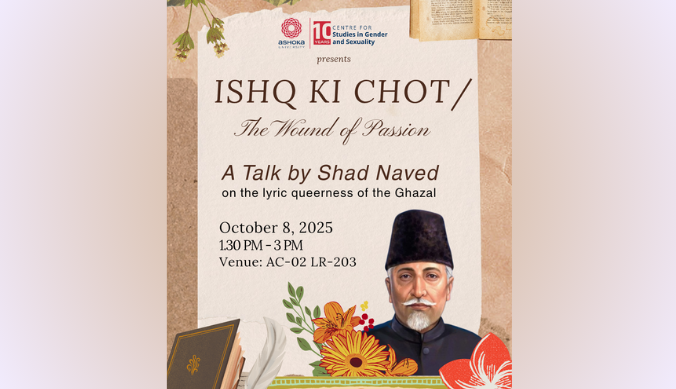
CSGS invites you to “The Wound of Passion/Ishq ki Chot” — a talk by Prof. Shad Naved.
A passion “mediated” by physicality led poets to contemplate the “absolute” unity of passion with the unseen divine. This literary schema for passion (or ishq) was recorded in lyrical couplets across vast territories of Eurasia and Africa, wherever the ghazal came to be written in the last millennium. Modern hermeneuts argue that medieval mysticism (Sufism) can be recognized in the plurilingual ghazal. Other voices, such as Abul Kalam Azad in his early writings, recognized the historical reality of mystical passion through a primary, earthly queerness.
Professor Naved will speak about Azad’s celebrated essay on Sarmad, the seventeenth-century poet-martyr, who, when gazed upon by a “Hindu boy” in Mughal India, became a symbol for both the passion of renunciation and the renunciation of passion as recorded in the ghazal and popular memory in the subcontinent. While modern hermeneuts have read this as an event “internal” to mysticism, Azad, as a prescient reader of lyric queerness, recognized the fullest linguistic and earthly significance of passion.
Professor Naved’s book 'The Ghazal Eros: Lyric Queerness in History' forms the foundation of this exploration, placing queerness at the heart of the ghazal’s evolution.
ðŸ—“ï¸ October 8, 2025, 1:30 PM
📠AC-02 LR-203
This talk is part of ISHQ: Issues in Society, History and Queerness, a flagship lecture series by CSGS.
Shad Naved teaches literature and translation at Dr. B.R. Ambedkar University Delhi. His latest book, The Ghazal Eros: Lyric Queerness in History, is a comparative study of the ghazal in two major languages (early Urdu and Indo-Persian) of the subcontinent. It recognizes a lyric queerness around which the ghazal developed from its earliest antecedents in classical Arabic to the colonial period in India. Recently, he has also written on the reception of Neruda in India, historical time and age in LGBTQ history, and antifascism in Georg Lukács’s work from the 1930s. He is currently translating Sharar’s nineteenth-century Urdu historical novel Flora Florinda, set in Al-Andalus, into Spanish and English.