





Female Legislators and Forest Conservation: In Conversation with Professor Bipasha Maity
In this blog, we are in conversation with Professor Bipasha Maity, Associate Professor of Economics at Ashoka University, on her recently published research on Female Legislators and Forest Conservation in India. She shares the motivations and challenges behind the study and offers an intersectional perspective on forest conservation-related decision-making in Indian state legislatures.
 2
2 
In this in-depth conversation with the Research and Development Office, Professor Bipasha Maity, Associate Professor of Economics at Ashoka University, discusses her recently published research, “Female Legislators and Forest Conservation in India.” Her work examines the impact of female political representatives in India’s state legislatures on forest conservation, using a regression discontinuity design to isolate causal effects.
1. Professor, in your recently published research paper “Female legislators and forest conservation in India” you study the impact of female political representatives in India’s state legislatures on forest conservation. Tell us more about your motivation behind studying the intersection of gender and environmental conservation.
There is substantial qualitative evidence that indicates that women often hold preferences toward environmental conservation that differ from men’s. For example, the 2022 World Values Survey data shows that 61 per cent of Indian women support environmental protection even at the cost of economic growth, whereas this number for men is 55 per cent.
Post-independence history of India also underlines strong participation of women in environmental movements. One such example is the Chipko movement, which was largely led by women. Despite these patterns, robust quantitative evidence in economics establishing this relationship has remained limited. This gap motivated my co-authors and me to examine the link between female political representation and environmental conservation more systematically.
2. Tell us more about the key problem your research aims to address. What key message does it hold for society and everyday life?
Economic literature broadly confirms that women in governance are more likely to invest in the policies that promote development, improve welfare, especially for women and children. These include improved healthcare, reduction in infant/maternal mortality, and better access to safe drinking water.
Recent research also indicates that female legislators can contribute positively to economic growth. My research further builds on this literature as it examines whether female legislators also play a role in environmental conservation. This question is important because economic growth and environmental protection are often seen as two conflicting aspects. Our research findings underline that female legislators, particularly those from historically marginalised communities can help promote a more sustainable path of development. This holds significance for India, where both rapid economic growth and environmental sustainability are equally important.
3. A sharp regression discontinuity design (RDD) is used for analysis. Can you explain in simple terms why this approach gives us more trustworthy causal evidence than simply comparing male and female-led constituencies? If you could help our readers understand in layman terms what this method is and how it helped?
A simple comparison between male-led and female-led constituencies can be misleading because the two types of constituencies may already differ in many ways which may also be difficult to measure/quantify. For example, constituencies that elect women may be wealthier, already prefer leadership from a particular gender or have overall different voter preferences. If we simply compare outcomes across all male- and female-led constituencies, we cannot tell whether differences are caused by the leader’s gender or by these underlying and often unobservable differences.
A sharp regression discontinuity design (RDD) helps solve this problem by focusing only on “close” elections – cases where a female candidate barely won against a male candidate, or barely lost. In these situations, the outcome is almost like a toss of a coin: the constituencies on either side of the “narrow” margin are usually very similar in terms of demographics, political preferences, development levels, and other characteristics. The key difference is that one ended up represented by a woman and the other by a man. In practice, how “narrow” a margin is to be considered is determined by data-driven algorithms. RDD is widely considered one of the strongest methods for identifying causal effects in real-world observational data, especially when randomised experiments are impossible.
4. What were the biggest data challenges in combining forest cover data with Indian state election data across such a long time period?
Data availability in India has improved significantly over the past few years. For our study, we referred to publicly available data from The Socioeconomic High-resolution Rural-Urban Geographic Platform for India (SHRUG). It provides spatially detailed data at the village, town, and assembly constituency levels. It also tracks these geographic units consistently over time. The latter was significantly valuable for our analysis as it allowed us to combine satellite-based forest cover data with election data at the assembly constituency level over a long time period. Maintaining consistency in geographic boundaries across years is often a major challenge in Indian data, so the SHRUG platform greatly improved the reliability and feasibility of the analysis.
5. What is the most interesting and remarkable finding of the study that you’d like to underline here?
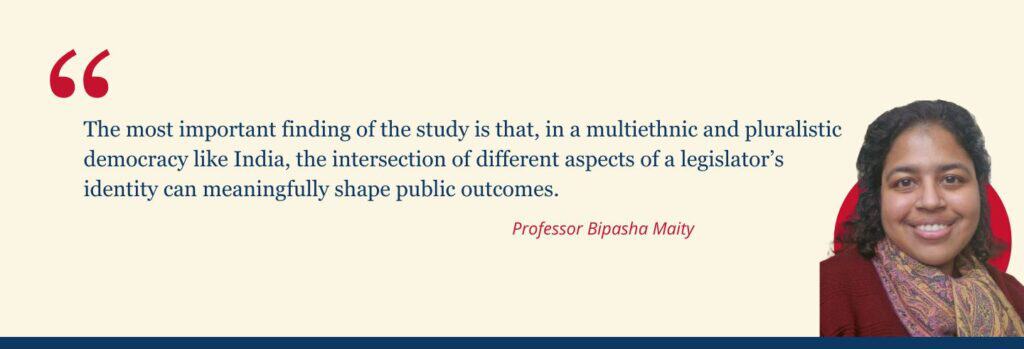
I believe the most important finding of the study is that, in a multiethnic and pluralistic democracy like India, the intersection of different aspects of a legislator’s identity can meaningfully shape public outcomes. Our research shows that it is not only a legislator’s gender, but also their caste identity, that can influence environmental conservation outcomes. In particular, we find that female legislators from historically marginalised communities are associated with stronger conservation outcomes and more likely to invest in public goods and welfare-enhancing policies that directly benefit citizens.
Forest-cover growth tends to rise over the course of a female legislator’s term, with gains driven primarily by women elected from reserved constituencies. What does that tell us about how environmental change actually happens?
This finding suggests that environmental change is often gradual and closely tied to how well elected representatives understand the long-term needs and vulnerabilities of their constituents. A large body of social science research has shown that climate change and environmental degradation disproportionately affect women and children. However, women and children from historically marginalised communities are likely to face an even greater burden because they often have fewer resources and adaptation strategies available to cope with these challenges. Since forest conservation is an important mechanism for mitigating climate-related risks, it is possible that female legislators from reserved constituencies are more attuned to these vulnerabilities and therefore place greater emphasis on environmental protection. There have also been several anecdotal examples of female legislators, especially from reserved constituencies, supporting conservation efforts. Our study contributes by systematically documenting this relationship using rigorous quantitative evidence, rather than relying only on individual case studies or anecdotes.
6. Drawing on your research findings, what could be the key policy takeaways for the country’s forest governance, climate strategy, and its commitments under COP26?
One important policy takeaway from this research is that institutional and social contexts matter greatly in shaping sustainable development outcomes. Different countries have distinct historical experiences and institutional structures, so policies related to environmental governance and climate action must be understood within their specific social and political contexts.
In India, our findings suggest that the intersection of gender and caste is particularly important. The study indicates that strengthening forest governance and environmental conservation is not simply about increasing the number of women in positions of political power. It also matters which women are represented in these positions and which communities they come from and seek to represent. This has broader implications for India’s climate strategy and its commitments under COP26. Policies aimed at climate adaptation, forest conservation, and sustainable development may be more effective when they incorporate inclusive political representation and ensure that historically marginalised communities have a meaningful voice in governance.
7. How would you describe Ashoka University’s role in your research journey? How do you see it contributing to your ongoing/upcoming research projects?
I am grateful to the Centre for Climate Change and Sustainability (3CS) at Ashoka University for the funding and institutional support that helped bring this project to fruition. The centre brings together faculty members from multiple disciplines, creating an environment that actively encourages interdisciplinary research. Since this project lies at the intersection of economics and political science, 3CS played an important role in supporting intellectual exchange across disciplines broadly. Such interdisciplinary engagement is extremely valuable, especially for research on complex issues like climate change, governance, and inequality, where insights from multiple fields can significantly strengthen the quality and relevance of the work.
Edited by Ramyani Kundu and Priyanka (Research and Development Office)
This blog has been adapted from the original research article, linked here.
Note: Non-technical summaries of this research can be found on Project Syndicate and Ideas for India.