





From Social Stress to Brain Inflammation: Decoding the Immune Pathways of Chronic Stress
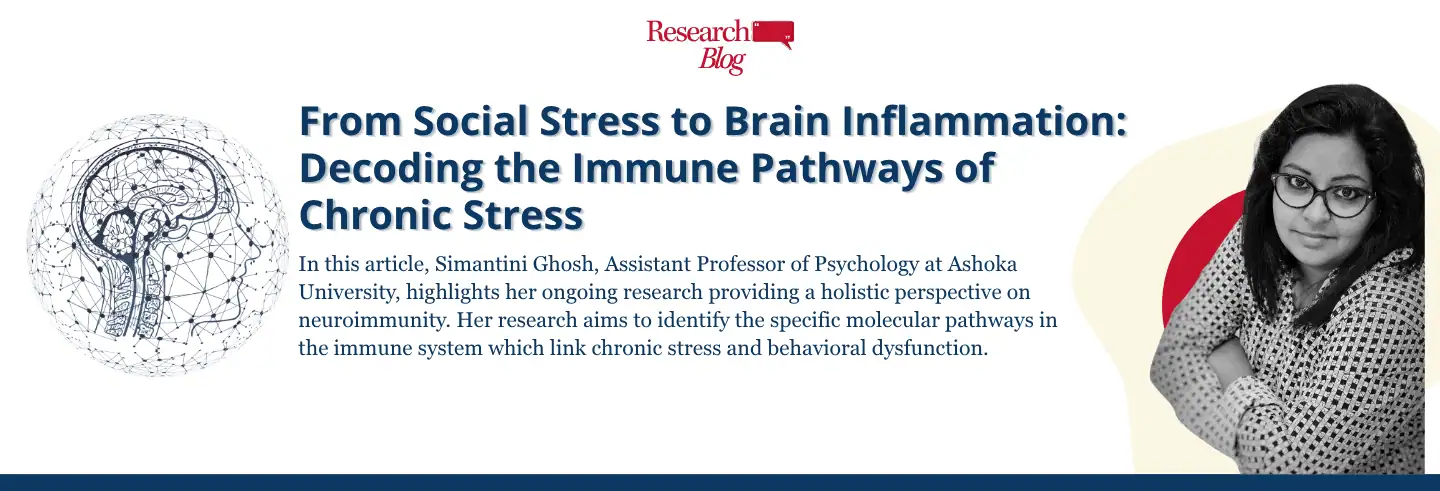
In this article, Simantini Ghosh, Assistant Professor of Psychology at Ashoka University, highlights her ongoing research providing a holistic perspective on neuroimmunity. Her research aims to identify the specific molecular pathways in the immune system which link chronic stress and behavioral dysfunction.

 3
3 
Simantini (Simi) Ghosh, Assistant Professor of Psychology at Ashoka University, discusses her research spanning three publications: from a foundational 2021 study to two more recent research papers in 2026. Together, these works establish a novel mechanistic framework in the field of neuroimmunity.
Stress and Immunity
Stress-related psychiatric disorders such as anxiety, depression, and PTSD are usually studied through psychological or neurotransmitter-based frameworks. Yet evidence consistently suggests that these conditions also activate the body’s peripheral immune response. What is not well understood is exactly how the innate immune system of the body, the same danger-sensing machinery involved in infection and tissue injury, plays a role here.
A central unanswered question in neuroscience has therefore been: how does psychosocial stress become biologically embedded in the brain?
Professor Simantini Ghosh’s research program addresses this question through the study of the NLRP3 inflammasome, a key innate immune complex that regulates production of interleukin-1β (IL-1β), one of the major inflammatory molecules implicated in psychiatric disorders. The NLRP3 inflammasome is part of a class of innate immune receptors that are pattern recognisers, identifying typical biochemical signatures of damage or structures that are part of pathogen architecture- which tells the immune system there is a danger to the body, as response must be mounted and defense activated. Till very recently, their connection to brain dysfunction was not clearly understood at all. Through the last decade or so, it has become quite clear that sustained activation of the NLRP3 inflammasome is present in many acute or chronic neurological disorders such as stroke or dementia, as well as lifestyle disorders such as diabetes. However, their role in psychological dysfunctions related to stress is still a mystery, as well as the molecular mechanism of how they bring about any changes, while there is enough theory base to hypothesise that they do play an important role.
Across three studies, Simi’s lab systematically mapped how chronic psychosocial stress activates canonical and non-canonical inflammasome pathways, producing neuroinflammation, blood-brain barrier dysfunction, synaptic loss, and behavioural pathology.
Tracing the Molecular Mechanism
The goal of this work was not simply to show that stress correlates with inflammation — this is already known. Instead, the research sought to identify a specific molecular mechanism through which chronic stress activates one of the oldest innate immune signalling pathways and drives behavioural dysfunction.
Across the studies, the team identified successive upstream regulators of inflammasome activation. The 2021 study demonstrated that Bruton’s Tyrosine Kinase (BTK) acts as an upstream regulator of the canonical NLRP3 inflammasome pathway in stress pathology. They subsequently showed that psychosocial stress also activates the non-canonical Caspase-11/Gasdermin-D pathway, previously unlinked to chronic stress research. Most recently, the team identified TRIM21 — an E3 ubiquitin ligase not previously associated with psychiatric stress — as a critical upstream regulator connecting psychosocial stress to Gasdermin-D–mediated IL-1β release, neurovascular dysfunction, and behavioural impairment.
Together, these studies move the field beyond descriptive associations between stress and inflammation by identifying causal molecular pathways linking chronic stress to immune dysregulation in the brain and body.
A Multi-Pronged Experimental Strategy
The research employed multiple rodent models of chronic stress, including predator-odor stress, physical restraint stress, and repeated social defeat stress, a paradigm that captures important aspects of prolonged psychosocial adversity relevant to human conditions.
To establish mechanistic rigor, the studies combined multiple orthogonal approaches. Behavioural outcomes were assessed using a broad battery of paradigms examining anxiety, fear learning and extinction, working memory, cognitive flexibility, and social behaviour. At the molecular level, the work integrated pharmacological inhibition, siRNA-mediated gene knockdown, cytokine analyses, synaptic imaging, blood-brain barrier assays, and ex vivo immune-cell experiments.
The studies also incorporated proof-of-concept intervention experiments using FDA-approved compounds including Ibrutinib, a BTK inhibitor used in leukemia treatment, and Disulfiram, traditionally used in alcohol dependence treatment.
The Convergent Results
Together, the studies demonstrate that chronic psychosocial stress recruits multiple components of the brain’s innate immune danger-sensing machinery.
The 2021 study identified BTK as a previously unrecognised upstream regulator of NLRP3 inflammasome activation in stress pathology. Inhibition of BTK significantly reduced neuroinflammation and anxiety-like behaviour, establishing a causal relationship between innate immune signalling and behavioural dysfunction.
The subsequent study demonstrated for the first time that psychosocial stress activates the non-canonical Caspase-11/Gasdermin-D pathway. Blocking this pathway reduced IL-1β release, attenuated anxiety-like behaviour, improved working memory, facilitated fear extinction, and reduced synaptic loss. Importantly, combined inhibition of canonical and non-canonical inflammasome pathways produced substantially stronger rescue effects than targeting either pathway alone, suggesting that multiple inflammatory systems converge to sustain stress pathology.
Professor Simantini Ghosh’s lab’s most recent work identified TRIM21 as a critical molecular link connecting psychosocial stress to Gasdermin-D pore formation, IL-1β release, blood-brain barrier disruption, and behavioural dysfunction. TRIM21 knockdown restored blood-brain barrier integrity, rescued synaptic density, reduced inflammatory signalling, and normalised behaviour.
Across studies, female animals consistently exhibited stronger inflammatory responses and more severe behavioural pathology, highlighting important sex differences in stress-induced neuroimmune activation.
Bridging Neuroimmunology and Psychiatry
This body of work contributes to a growing shift in neuroscience and psychiatry: the recognition that chronic stress and mental health disorders are deeply intertwined with innate immunity and inflammatory signalling.
By identifying BTK, Caspase-11, Gasdermin-D, and TRIM21 as upstream regulators of stress-induced inflammasome activation, these studies provide a novel mechanistic framework linking psychosocial stress to neuroinflammation, neurovascular dysfunction, and behavioural pathology.
The work is also translationally significant. Several compounds used in these proof-of-concept studies are already FDA-approved for other medical conditions, raising the possibility that immune-targeted approaches may eventually complement existing psychiatric treatments. More broadly, the PBMC-based cellular models developed in this work create a pathway toward biomarker and mechanistic studies in human patients, helping bridge laboratory neuroscience with clinically relevant mental health research.
Edited by Simran Wadan (Research and Development Office)
This blog has been adapted from these original research articles:
Tiwari, S., Mohammed, Z., Atta, S. R., Tiwari, A., Yadav, E., Kaushik, S., Chopra, A., Singh, I., & Ghosh, S. (2026). A Trim21-GSDMD axis links psychosocial stress to IL-1β-driven neuroinflammation and blood-brain barrier dysfunction in a rat model of repeated social defeat. ACS Chemical Neuroscience, 17(7), 1345–1361. https://doi.org/10.1021/acschemneuro.5c00993
Tiwari, S., Mohammed, Z., Tiwari, A., Yadav, E., Atta, S. R., Kaushik, S., Chopra, A., Singh, I., & Ghosh, S. (2026). The caspase 11/gasdermin D pathway is a key driver of stress-induced neuroinflammation and behavioural dysfunction in rats. Neurochemistry International, 195, Article 106139. https://doi.org/10.1016/j.neuint.2026.106139
Ghosh, S., Mohammed, Z., & Singh, I. (2021). Bruton’s tyrosine kinase drives neuroinflammation and anxiogenic behaviour in mouse models of stress. Journal of Neuroinflammation, 18(1), Article 289. https://doi.org/10.1186/s12974-021-02322-9