






How Immigrant Mobility Helps Local Labour Markets Adjust to Automation
Professor Ronit Mukherji, Assistant Professor of Economics at Ashoka University, in his recently published paper, co-authored with Dr. Anand Chopra (University of Liverpool) examines how the mobility of low skilled immigrant workers can offset the adverse effects of automation on local labour markets. In his paper, a shift share IV approach is undertaken to estimate the impact of robots in local labour markets.


 0
0 
Introduction:
In this article, Professor Ronit Mukherji, Assistant Professor of Economics at Ashoka University, illustrates the role of low-skilled immigrant mobility in helping local labour markets adjust to the pressures of automation. He talks about his recently published paper, titled ‘Automation and local labour markets: Impact of immigrant mobility‘, co-authored with Dr Anand Chopra (University of Liverpool). This research uses a shift-share instrumental variable approach to demonstrate that immigrant workers are significantly more responsive to robot exposure than their native counterparts. The research also identifies human capital accumulation as an additional factor for native workers being slower to migrate in response to automation.
Background
Automation is reshaping labour markets across the world. Industrial robots can improve productivity, but they can also reduce demand for workers performing routine manual tasks. These effects are not evenly spread across places. A region with many robot-exposed industries, such as manufacturing, may face sharper job and wage pressures than a region whose economy is less dependent on such work.
When local labour demand falls, workers and communities adjust in different ways. One important channel is mobility. Workers may leave affected regions, or potential movers may avoid them. This matters because migration can reduce pressure on the remaining workers. However, not all workers are equally mobile. Understanding who moves, who stays, and who benefits is central to understanding automation’s local consequences.
Aim
This study examines how U.S. local labour markets adjusted to industrial robot adoption between 1990 and 2015. It focuses on low-skilled immigrants because immigrants are often more geographically mobile than native-born workers. Their location choices may influence how strongly local shocks affect others.
The paper asks two questions. First, do low-skilled immigrants respond more strongly than low-skilled native-born workers to robot exposure? Second, does their mobility reduce some of the negative effects of automation on native-born workers? The aim is to connect two debates that are usually discussed separately: automation and immigration.
Strategy/Approach
The study uses U.S. commuting zones, which are local labour markets defined by where people live and work. It combines data on industrial robot adoption with Census and American Community Survey data on population, migration, employment, wages and education.
To measure exposure to automation, the paper uses each region’s historical industry structure. Regions that had more workers in industries that later adopted robots heavily are treated as more exposed. To separate the effect of robots from other local economic changes, the analysis uses robot adoption in five European countries – Denmark, Finland, France, Italy and Sweden – as a source of variation in global robotics trends. The study also accounts for Chinese import competition, computerisation, and local demographic and industrial characteristics.
Results and Conclusion
The results show that low-skilled immigrants are much more responsive to robot exposure than low-skilled native-born workers. An additional robot per thousand workers reduces the growth of the low-skilled immigrant population by about 5.5 percentage points, compared with about 1 percentage point for low-skilled natives.
This response mainly reflects movement within the United States. Low-skilled immigrants are less likely to enter robot-exposed local labour markets and more likely to leave them. The evidence does not suggest that international migration is the main channel. Instead, immigrants already in the country reallocate across regions in response to changing job opportunities.
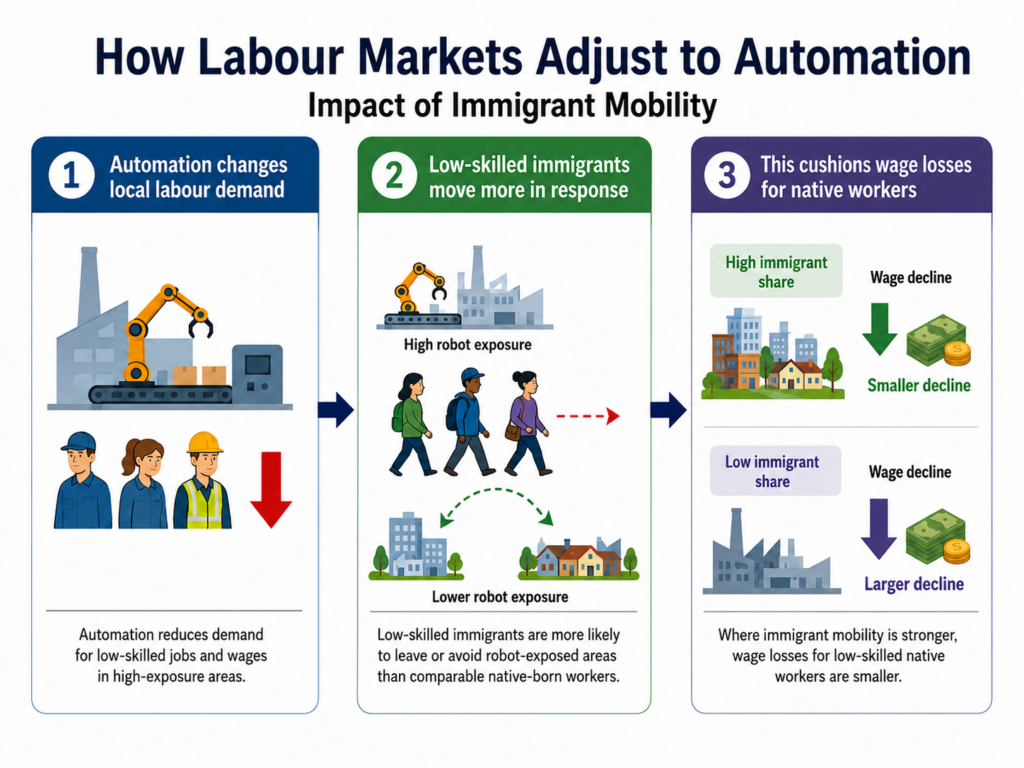
Robot exposure also reduces employment and wages for low-skilled workers, with larger losses for immigrants. One reason is that low-skilled immigrants are more concentrated in routine manual jobs, which are more vulnerable to robots. However, this is not the whole story. The evidence suggests that low-skilled immigrants are both more exposed to automation and more responsive to it.
The key finding is that immigrant mobility can cushion native-born workers. In regions with a larger low-skilled immigrant population, wage losses for low-skilled natives after robot adoption are smaller. The average employment effects are less clear, but some groups, including older low-skilled natives and workers in certain service sectors, appear to benefit more.
The paper also shows that education is another adjustment channel. Young native-born individuals in robot-exposed areas are more likely to enrol in college, suggesting that some people respond to automation by delaying labour market entry and accumulating skills.
Impact/Benefits/Bird’s-eye View
The broader message is that labour markets adjust to automation not only through job losses, wage changes or retraining, but also through mobility. Low-skilled immigrant mobility can act as a form of insurance for local labour markets by reducing the intensity of automation shocks for some native-born workers.
This has important policy implications. Job losses are often used to justify restrictions on low-skilled immigration, but the study shows that mobile immigrant workers may help local economies absorb technological change. Policies on automation, migration, regional adjustment and education should therefore be considered together rather than in isolation.
Edited by Ramyani Kundu and Priyanka (Research and Development Office)
This blog has been adapted from the original research article: Chopra and R. Mukherji, Labour Econ. 100, 102868 (2026), available here: https://doi.org/10.1016/j.labeco.2026.102868