





‘None of us is truly free unless all of us are free.’
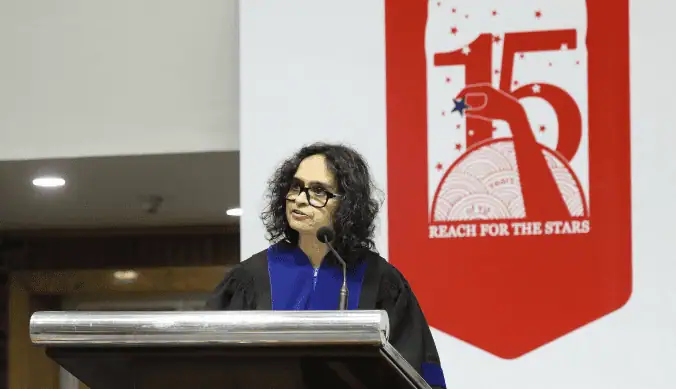
Professor Shailaja Paik delivers the keynote address at YIF's 15th Convocation.
 3
3

Professor Shailaja Paik, the Charles Phelps Taft Distinguished Research Professor of History at the University of Cincinnati and a 2024 MacArthur Fellow, delivered the keynote address at the 15th Convocation of the Young India Fellowship on 27th June, 2026. Professor Paik’s scholarship in Critical Caste Studies has shaped how caste, gender and structural inequality are understood as intersecting forces. Her work examines who gets access to education, dignity and a voice in democratic life.
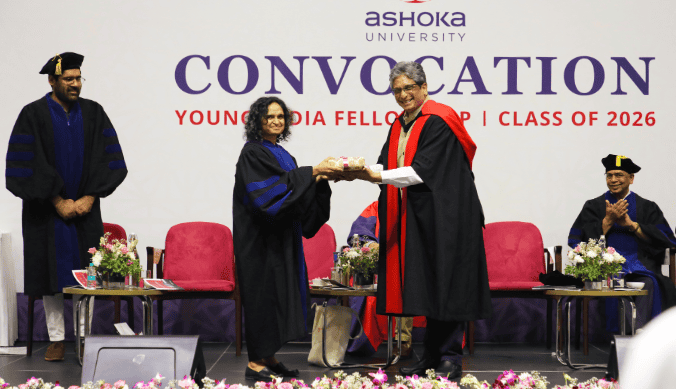
Her connection to Ashoka predates the university itself. She recalled meeting Pramath Sinha, chairperson of the Board of Trustees of Ashoka and founding dean of YIF, while she was on a fellowship at Yale in 2011 as he was touring American universities to shape his ideas for a liberal arts institution in India. Addressing the graduating class of 2026 on the state of the world they are inheriting, wars, ecological crisis, democratic fragility, and deepening inequality among them, she offered the fellows a framework she called the four Rs: reflect, re-examine, re-imagine and reconstruct. Her address that afternoon centred on the first of these — reflect — as she shared four reflections drawn from her own life.
‘The first reflection, invest in people, drew on the fellows’ own experience of the YIF programme: mango shakes at Fuel Zone, late-night Maggi at Kit Kat, thalis at the dhaba, all sites where students from STEM, the humanities and the social sciences worked alongside each other on grounded, practical projects. She argued that this exposure to different disciplines and different lives is the actual substance of a liberal arts education, not an incidental benefit of it, and she pressed the fellows not to look away from the harder subjects that exposure raises. ‘You will encounter difficult questions of caste, gender, sexuality, labor, violence, exclusion, and belonging,’ she said, ‘but you must not turn away from them because they will be uncomfortable, politically inconvenient, or socially unpopular.’
Her second reflection turned to focus, effort and consistency, drawing on her own career: years of research pursued without the promise of recognition, sustained instead by conviction in the work itself. She spoke about visa uncertainty during her early years in the United States, and recalled talking to a colleague who questioned how she would sustain her career under such pressure.
Responding to her colleague, she’d said, ‘My life is larger than the tenure system, larger than the H-1B work visa, and much, much larger than the green card.’ The MacArthur Fellowship arrived only after that long, uncertain period. She had never worked towards it, and refused to let its absence, or its arrival, define her sense of her own worth.
The third reflection, on risk and courage, acknowledged the very different paths that had brought the fellows into the same room, from vernacular-medium schools to elite convents, from first-generation learners to those who arrived with structural advantages already in place. She asked the graduates to hold both truths honestly: their own bravery in arriving here, and the uneven ground many of them started from. ‘None of us is truly free unless all of us are free,’ she said, returning to a line she called old but urgent.
Her closing reflection, on being and becoming, pushed back against a culture that measures a life only by achievement. She urged the fellows to protect time for friendship, rest, curiosity and wonder alongside their professional ambitions, closing with a call to keep becoming more courageous, more rigorous, and more fully human.