


Other links:


Other links:




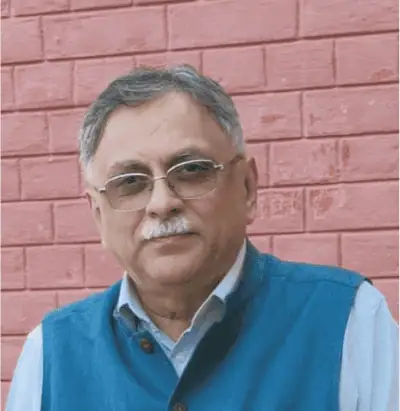
Visiting Professor of History, Ashoka University
Ph.D. (University of Delhi)
Amar Farooqui has been Professor in the Department of History, University of Delhi, and is currently Visiting Professor of History at Ashoka University. He has been a Fellow at the Nehru Memorial Museum & Library, New Delhi. He was Member-Secretary of the Indian Council of Historical Research, and presided over the Modern India Section of the Indian History Congress at its Platinum Jubilee Session. His areas of specialization are colonialism and narcotics, princely states, and urban history. He is a member of the editorial board of Social Scientist.
Books
1. Governors of Empire: The East India Company’s Chief Functionaries in India, Aleph, 2025.
2. The Colonial Subjugation of India, Aleph, 2022.
3. The Establishment of British Rule: 1757-1813, A People’s History of India–Vol.23, Tulika, 2014.
4. Zafar and the Raj: Anglo-Mughal Delhi, c.1800-1857, Primus, 2013.
5. Sindias and the Raj: Princely Gwalior, c.1800-1850, Primus, 2011.
6. Opium City: The Making of Early Victorian Bombay, Three Essays Collective, 2006.
7. Smuggling as Subversion: Colonialism, Indian Merchants and the Politics of Opium: 1790-1843, new edition (revised and updated), Lexington/Rowman & Littlefield, 2005.
8. Early Social Formations, revised edition, Manak, 2002.
Edited Volumes
1. Pushing the Boundaries of South Asian History: Essays in Honour of Dwijendra Narayan Jha, Primus, Delhi, 2024 (co-edited with Jaya S. Tyagi and S.Z.H. Jafri).
2. India, The Portuguese and Maritime Interactions, Vol.I, Science, Economy and Urbanity; Vol.II, Religion, Language and Cultural Expressions, Primus, 2019 (co-edited with Pius Malekandathil and Lotika Varadarajan).
Articles (selected)
1. ‘Princes, Anachronism and the Anti-Democratic Impulse’, Dhruv Raina, ed., Histories of the Sciences and the Politics of History: Essays in Honour of S.Irfan Habib, Primus, 2025, pp.66-102.
2. ‘The Opium Trade’, Oxford Research Encyclopedia of Asian History, Oxford University Press (online), 2021.
3. ‘Gandhi’s Spiritual Politics: Austerity, Fasting and Secularism’, Studies in History
36, 2 (2020), pp.178-205.
4. ‘Architecture as Power, 1803–1912’, Narayani Gupta, ed., A Work of Beauty: The
Architecture and Landscape of Rashtrapati Bhavan, Publications Division, 2016, pp.20-43.
5. ‘The Global Career of Indian Opium and Local Destinies’, Almanack, Guarulhos, São Paulo, 14 (Sept./Dec. 2016), pp.52-73.
6. ‘Archival Sources Relating to Indian Opium Merchants of the Nineteenth Century’, Studies in People’s History, 2, 1 (2015), pp.126-35.
7. ‘Divide and Rule’?: Race, Military Recruitment and Society in Late Nineteenth Century Colonial India’, Presidential Address, Modern India Section, 75th Session of the Indian History Congress, Delhi, 2014.
8. ‘Opium, the East India Company and the “Native” States’, in Harald Fischer-Tiné and Jana Tschurenev, eds., A History of Alcohol and Drugs in Modern South Asia: Intoxicating Affairs, Routledge, 2013, pp.45-61.
9. ‘Narcotrafficking, Princely Ingenuity and the Raj: The Subjugation of the Sindia State, c. 1843-44’, Waltraud Ernst and B. Pati, eds., India’s Princely States: People, Princes and Colonialism, Routledge, 2007, pp.49-67.
10. ‘Opium and the Trading World of Western India in the Early Nineteenth Century’, in James Mills and Patricial Barton, eds., Drugs and Empires: Essays in Modern Imperialism and Intoxication, 1500-1930, Palgrave Macmillan, 2007, pp.83-100.
11. ‘Colonialism and Competing Addictions: Morphine Content as Historical Factor’, Social Scientist, 32, 5-6 (2004), pp.21-31.
12. ‘Towards Dussehra 1831: The Revolt of Lallaji Patel’, The Indian Economic and Social History Review, 35, 2 (1998), pp.147-77.
13. ‘Opium Enterprise and Colonial Intervention in Malwa and Western India, 1800-1824’, The Indian Economic and Social History Review, 32, 4 (1995), pp.447-73.
14. ‘Urban Development in a Colonial Situation: Early Nineteenth Century Bombay’, Economic and Political Weekly, 31, 40 (l996), pp.2746-59.
Recent Book Reviews
1. Review of Documents on Economic History of British Rule in India: Northern India in the Late Nineteenth Century—Quality of Life, Volume I, Part I (A–C), 1860s–1870s; Part II (A–C), 1880s–1890s, eds., Amiya Kumar Bagchi and Arun Bandopadhyay, Indian Historical Review, 53, 1 (2026).
2. Review of Nuskha-i Hafeezuddin Ahmad by Hafeezuddin Ahmad introduced by Ather Farouqui, Economic and Political Weekly, 59, 50 (2024).
(2025): Indian History Congress Award for Best Book on Non-Indian History published in India (Governors of Empire)
Strategies of Imperial Control
Imperialism and Nationalism
The Great Revolt, 1857-59
Indian Civilizations
Social Formations of the Ancient and Medieval World

