


Other links:


Other links:




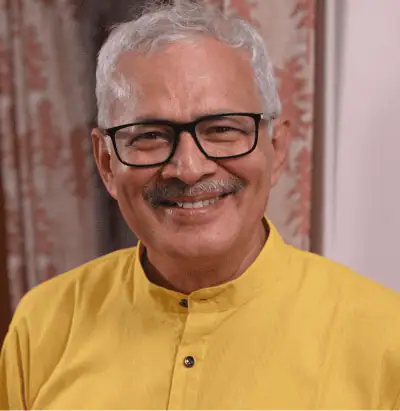
Head of Department, Chemistry, Ashoka University
PhD, Indian Institute of Science, Bangalore
Professor V. Chandrasekhar studied chemistry and obtained his PhD degree in 1982 from the Indian Institute of Science, Bangalore, and did postdoctoral work at the University of Massachusetts, Amherst, Massachusetts, USA. After briefly working at the Research and Development section of the Indian Petrochemicals Corporation at Vadodara as a Senior Research Officer, he joined the Department of Chemistry at the Indian Institute of Technology Kanpur in 1987, where he was a full professor from 1995 until his superannuation in November 2023. He served for an additional month at IIT Kanpur as a professor. He served as the Head of the Department of Chemistry, IIT Kanpur (2008–10), and as the Dean of Faculty Affairs, IIT Kanpur (2011–12). He also worked at the Tata Institute of Fundamental Research, Centre for Interdisciplinary Sciences, Hyderabad, as a Senior Professor/Dean (2012–14) and Director (2014–17), and at the National Institute of Science Education and Research (NISER), Bhubaneswar, India, as a Centre Director of the Tata Institute of Fundamental Research, Hyderabad (2017-23). He is currently a visiting Distinguished Professor at the Tata Institute of Fundamental Research, Hyderabad.
Professor Chandrasekhar’s research interests are in molecular materials, inorganic rings and polymers, main-group organometallic chemistry, and polynuclear metal assemblies. He has been a recipient of the S. S. Bhatnagar Award of the Council and Scientific Industrial Research, India, and the Friedrich-Wilhelm-Bessel Research Award of the Alexander von Humboldt Foundation, Germany.
Prof. Chandrasekhar is an elected Fellow of the Indian Academy of Sciences, Bangalore, the National Academy of Sciences, Allahabad, the Indian National Science Academy, New Delhi, and the World Academy of Sciences, Trieste, Italy. He is currently the President of the Chemical Research Society of India and the Asian Chemical Editorial Society. He has been on the editorial board of several journals, including Organometallics. He is on the editorial board of Dalton Transactions as an Associate Editor. His research work is documented in 460+ publications.
1. An unsymmetric imino-phosphanamidinate ligand and its Y(III) complex: synthesis, characterization, andcatalytic hydroboration of carbonyl compounds. Anga, S.; Acharya, J.; Chandrasekhar, V.J. Org. Chem. 2021, 86, 2224-2234.
2. Azide-coordination in homometallic dinuclear lanthanide (III) complexes containing nonequivalent lanthanide metal Ions: zero-field SMM behavior in the dysprosium analogue Kumar, P.; Biswas, S.; Swain, A.; Acharya, J.; Kumar, V.; Kalita,P.; Gonzalez, J. F.; Cador, O.; Pointillart, F.; Rajaraman, G.; Chandrasekhar, V. Inorg. Chem. 2021, 60, 8530-8545
3.Synthesis, structure, and zero-field SMM behavior of homometallic Dy2, Dy4, and Dy6 complexes. Kumar, P.; Swain, A.; Acharya, J.; Li, Y.; Kumar, V.; Rajaraman, G.; Colacio, E.; Chandrasekhar, V. Inorg. Chem. 2022, 61, 11600-11621.
4. Highly efficient and well-controlled ROP and copolymerization of cyclic esters using a cesium complex. Sagar, S.; Karmakar, H.; Nath, P.; Sarkar, A.; Chandrasekhar, V.; Panda, T. K. Chem. Commun. 2023, 59, 8727-8730.
5. Field Induced Single Ion Magnet Behavior in CoII Complexes in a Distorted Square Pyramidal Geometry. Dey, A.; Ali, J.; Moorthy, S.; Gonzalez, J. F.; Pointillart, F.; Singh, S. K.; Chandrasekhar, V. Dalton Trans., 2023, 52, 14807–14821.
6. Regioisomers containing triarylboron-based motifs as multi-functional photoluminescent materials: from dual-mode delayed emission to pH-switchable room-temperature phosphorescence. By: Arumugam, R.; Muhammed M.; Akkarakkaran, T.; Kannan, R.; Banerjee, D.; Sudhakar, P.; Soma, V. R.; Thilagar, P.; Chandrasekhar, V. Chemical Science, 2024, 15, 18364-18378.
7. Crafting tailored well-defined block copolymers of cyclic esters with an organomagnesium initiator. Nath, P.; Sagara, S.; Ray, A.; Karmakar, H.; Sarkar, A.; Chandrasekhar, V. Panda, T. K. Chem. Commun. 2025, 61, 2341-2344.
8.Thermal monomerization unlocks 3/2 ↔ 5/2 spin crossover in a kinetically trapped high-spin Fe(III) dimer. Dey, B.; Titis, J.; Mehta, S.; Mondal, A.; Chandrasekhar, V. Dalton Trans. 2026, 55, 1274-128.
• Shanti Swarup Bhatnagar Award (2003)
• Friedrich-Wilhelm-Bessel Award of the Alexander von Humboldt Foundation Germany (2003)
• CRSI Medal (2002)
• Homi Bhabha Fellowship for excellence in research (1999-2000)
• Indian National Science Academy Young Scientist Medal (1989)
• Fellow of the Indian Academy of Sciences, Bangalore (2003)
• Fellow of the Indian National Science Academy, Delhi (2007)
• Fellow of the National Academy of Sciences, Allahabad (2007)
• Fellow of the Academy of the Developing World, Trieste, Italy (FTWAS) (2009)
• Lalit Kapoor Chair Professor, IIT Kanpur (2006-09)
• J. C. Bose National Fellow, Department of Science and Technology, New Delhi (2007)
• Chemical Research Society of India Silver Medal (2011)
• INSA-Golden Jubilee Medal in Chemical Sciences (2013)
• SASTRA-CNR Rao Award (2015)
• INSA Professor Mihir Chowdhury Memorial Medal (2019)
• NASI Prof. N. R. Dhar Memorial Lecture Award (2019)
At IIT Kanpur: All basic and advanced courses in Inorganic and Organometallic Chemistry; Courses on Modern spectroscopy in the structural elucidation of inorganic and organometallic compounds. At TIFR Hyderabad: Basic chemistry of transition metal and lanthanide complexes; Inorganic Chemistry; Applications of Structural Methods in Chemistry


