





The Future of Memory
Professor Gopalkrishna Gandhi and Professor Rudrangshu Mukherjee open InHERITs Shobita Punja Memorial Lecture Series with a dialogue on inheritance, forgetting and what heritage means today.
 1
1

Project InHERIT, Ashoka University’s heritage initiative funded by the Helen Hamlyn Trust and housed within the Young India Fellowship, opened its new lecture series this month with a conversation between Gopalkrishna Gandhi, Distinguished Professor of History and Politics at Ashoka, and Rudrangshu Mukherjee, the university’s Chancellor and a professor of history, titled ‘The Future of Memory.’ The series is held in memory of Dr Shobita Punja, an art historian and pedagogue who shaped the study of Indian heritage across four decades. With Bachelors, Masters and Doctoral degrees in Art History, Ancient History and Arts Education, Dr Punja was and is a pedagogue who has left an indelible imprint on Indian arts heritage and culture.
Professor Mukherjee opened the conversation by describing memory as the faculty that gives a person context and direction, the thing that allows someone to say where they come from before they can say where they are going. From there, the conversation moved through the different ways memory can fail or be made to fail: through the ordinary erasure of age, through a historian’s selective forgetting, and now, both speakers agreed, through a newer kind of interference: artificial intelligence. Professor Mukherjee spoke of artificial intelligence as a second disruptive force alongside what he called a human’s ‘natural cunning’, one capable of manufacturing plausible versions of the past that compete with the true one.
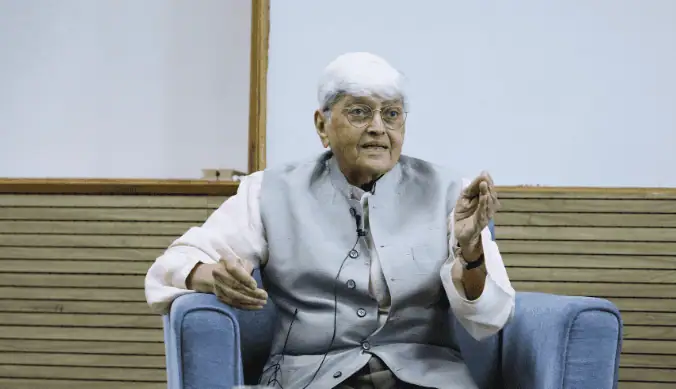
Professor Gandhi pressed on what heritage actually consists of today. He argued against limiting it to monuments and archives, pointing instead to lullabies through childhood, recipes passed through kitchens and generations, and the stories grandparents pass down before anyone in a family can read or write. On the question of who bears responsibility for preserving this, he was direct: the state cannot be allowed to hold that responsibility alone, since its idea of what counts as heritage will always be partial and often political.
He drew on his own experience restoring colonial-era statues removed from Kolkata’s streets and cataloguing and displaying them, an act he described as a private undertaking rather than an official one.
Both professors returned repeatedly to the idea that heritage is inseparable from vulnerability. Its intangible parts, memory chief among them, decay or get distorted in ways that stone and text do not. Yet they resisted a purely defensive framing of the subject. Professor Gandhi closed by questioning whether heritage should be understood as something that wins or loses at all, suggesting that truth does not need to defeat falsehood to remain true. Professor Mukherjee agreed, adding that heritage, properly understood, cannot be defeated because it does not depend on triumph to exist.
The conversation set the tone that Project InHERIT hopes to carry through the rest of the series: unresolved, personal, and unwilling to settle for easy answers. Further conversations in the Shobita Punja Memorial Lecture series will be announced through the InHERIT team in the coming months.
‘There’s a difference between heritage and the inheritance of blind tradition. You must be able to distinguish between that which is fresh and that which is stale. That itself is our heritage,’ said Gopalkrishna Gandhi.