





AI-ML Driven Biomarker Discovery from Confocal Microscopy Data to Enable Targeted Cancer Therapy
The research aims to investigate how modulation of mitochondrial structure and function helps a normal cell decide whether it will turn into a cancer cell, and regulates a cancer cell's ability to respond to treatment. The collaborators include Dr Partha Pratim Chakravorty (IIT, Kharagpur) and Dr Jaydip Bhaumik (TMC, Kolkata). Dr Atul Tattai, Max Hospital (Delhi); PI: Kasturi Mitra.
 0
0

Cancer remains a major healthcare burden worldwide. Not all patients respond to the standard cancer chemotherapeutics. Therefore, cancer needs to be treated and managed at the level of individual cancer patients, where they develop in different genetic and environmental milieus. We want to build AI-based predictive modelling to guide targeted/personalised cancer therapy. Cancer has long been known as a genetic disease. In the last 2 decades or so, a major focus of cancer studies has been on cancer cell metabolism, and testing if drugs used in metabolic diseases (e.g. Diabetes) can be repurposed for cancer therapy.
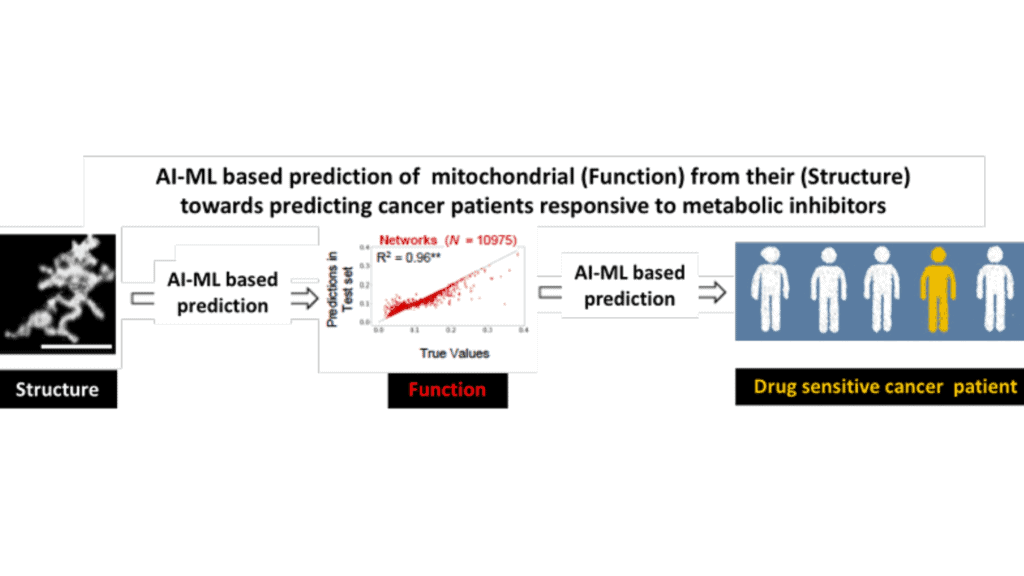
Studies show that repurposing of the antidiabetic drug Metformin for cancer therapy would require a personalised approach. Our lab undertakes translational research endeavors integrated with our fundamental science endeavors on quantitative biology. We are interested in utilizing the power of AI-ML to identify cancer patients who would benefit from drugs like Metformin that primarily works by modulating the cellular organelles called mitochondria.
Mitochondria are the powerhouse of the cells and a central player in cell metabolism, alterations in which are considered a major hallmark for cancer. Mitochondria can be of various structures and can support various distinct functions in cell metabolism.
Mitochondrial structure and function are altered in cancer cells, and thus, efforts are underway to study how such alterations impact the energy metabolism of cancer cells. It has also been proposed that mitochondrial alterations can be potentially employed as cancer ‘biomarkers’ to diagnose or assess disease progressions. We quantify the changes in mitochondrial structure-function and study their inter-relationships in tumorigenic and non-tumorigenic cells to identify novel cancer biomarkers.
Expected outcomes and impact:
The impact of the proposed project is to develop personalised or targeted cancer therapy by repurposing metabolic inhibitors. Using AI-ML approaches, the research team has been able to predict specific mitochondrial function from mitochondrial structural features we extracted from confocal micrographs of our cancer related studies. The researchers aim to further extend this approach towards identifying the specific mitochondrial structures in tumor cells from cancer patients (obtained from collaborating hospitals), which makes them sensitive to any specific metabolic drug owing to specific mitochondrial function. Cancer patients with such cells will be expected to show favorable chemotherapeutic outcomes with inclusion of the specific metabolic drug in their chemotherapy.