





Ashoka University’s Professor Shraddha Karve and Her Team Win Innovation Award at the 2025 Vivli AMR Global Data Challenge
Shraddha Karve, Assistant Professor (Research) at the Koita Centre for Digital Health, and her team have been awarded the Innovation Award at the 2025 Vivli AMR Global Data Challenge. Professor Karve and her collaborators examined the impact of air pollution on antifungal resistance using extensive surveillance data.

 3
3

Professor Shraddha Karve, along with her collaborators, has been awarded the Innovation Award (Grand Prize) at the 2025 Vivli AMR (Antimicrobial Resistance) Surveillance Data Challenge. Vivli is a non-profit organisation working to advance human health through the insights and discoveries gained by sharing and analysing data.
The prestigious data challenge, funded by Johnson & Johnson, Paratek, Pfizer, and a U.S. National Institutes of Health award, aims to encourage the re-use of surveillance data available in the Vivli AMR Register to develop innovative tools and solutions to address Antimicrobial Resistance, a significant global public health threat.
This year marked the third edition of the annual challenge, with a total of 58 multidisciplinary teams participating, consisting of members from 22 different countries. The challenge presented an opportunity for these multi-disciplinary teams to work on high-quality industry AMR surveillance data, addressing key questions related to antimicrobial resistance.
The distinguished panel of judges at the challenge selected six winners and one honourable mention. This Vivli edition presented two Grand Prizes: the AMR Global Leadership Award and the AMR Visionary Award.
Professor Shraddha’s team received the AMR Global Leadership Award Grand Prize. The team was led by George Priya Doss Chandrakumar (Vellore Institute of Technology), and its other team members included Vasundhara Karthikeyan (Georg-August Universität Göttingen), Shraddha Karve (Ashoka University), and Sree Haryini Sivasubramanian (Vellore Institute of Technology). The AMR Visionary Award Grand Prize was awarded to Claire Vania (St. Jude Children’s Research Hospital) and Anushruti Gupta (Johns Hopkins University).
Professor Karve’s team examined the impact of air pollution on resistance to fluconazole in C. glabrata using Pfizer’s SENTRY dataset (ATLAS_Antifungals) from the United States and Europe, along with the KEYSTONE, ATLAS_Antibiotics, GEARS, PLEA (Study I), GASAR (Study III), and PLEA (Study II) datasets. Their time-series analysis shows that time-lag effects play a crucial role in predicting resistance trends.
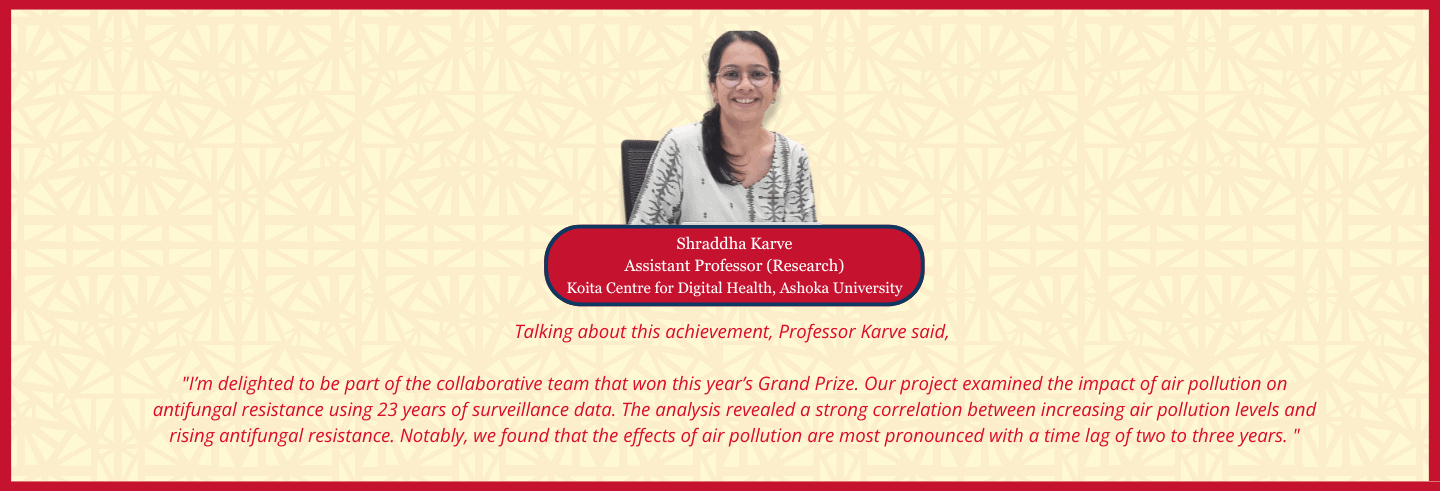
Talking about this achievement, Professor Karve said, “I’m delighted to be part of the collaborative team that won this year’s Grand Prize. Our project examined the impact of air pollution on antifungal resistance using 23 years of surveillance data. The analysis revealed a strong correlation between increasing air pollution levels and rising antifungal resistance. Notably, we found that the effects of air pollution are most pronounced with a time lag of two to three years.”
Professor Karve’s award-winning project at the Vivli AMR Data Challenge highlights the significant role of air pollution in antifungal resistance. It also highlights the importance of long-term data-driven analyses in the given field.