





Catching Biology in the Act: From a Bacterial Transcription Handoff to a Small Molecule Against Parkinson’s
In this article, Abhishek Mazumder, Assistant Professor of Research (Biology) at Ashoka University, discusses three recent studies from his group and their collaborators. Together they illustrate how single-molecule fluorescence can capture biological events that remain hidden in bulk experiments — from bacterial gene expression to the aggregation of a protein linked to Parkinson’s disease.


 1
1

About the Lab
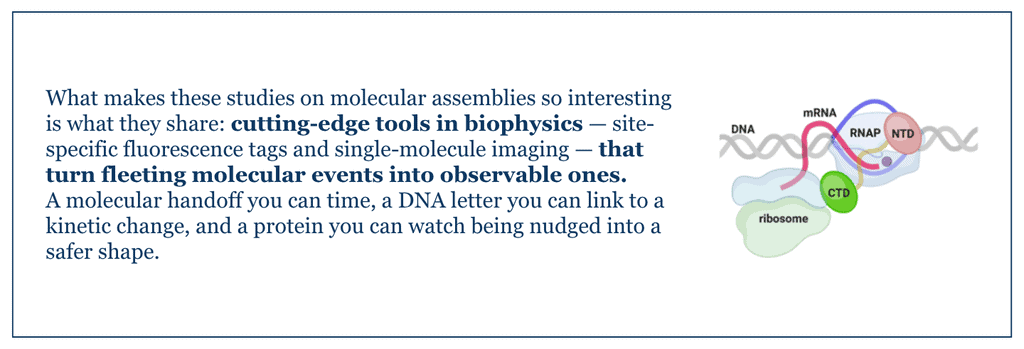
The Mazumder Lab at Ashoka develops advanced fluorescence strategies, including single-particle tracking and single-molecule FRET, to follow structural changes of molecular assemblies in real time, and increasingly inside living cells. By integrating molecular engineering, high-resolution microscopy, and quantitative analysis, the group exposes transient states, kinetic pathways, and hidden populations that conventional methods cannot resolve. Their current focus areas span gene regulation, antibiotic resistance, and neurodegenerative disease.
An Unresolved Question in Bacterial Transcription
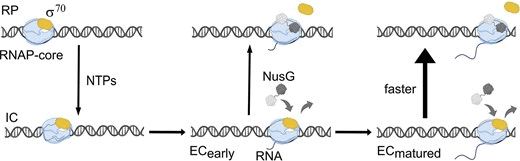
Reflecting on one of his recently published research papers, Professor Mazumder explains that every living cell must continuously convert genetic instructions into proteins. This process begins with transcription, where an enzyme called RNA polymerase (RNAP) reads the DNA and produces a corresponding RNA. In bacteria, RNAP requires a helper protein called the sigma factor (σ70) to locate the correct starting points on the DNA. Once RNAP has begun moving along the gene, a stage called elongation, σ70 was long assumed to detach automatically. However, recent evidence reveals that σ70 frequently remains bound to the moving RNAP, causing it to halt along the way, and disrupting the efficient production of RNA. How bacteria resolve this problem has remained poorly understood.
The research team aimed to identify whether any dedicated protein factors actively remove σ70 from elongating RNAP complexes, and if so, to characterise the mechanism and timing of this removal. Understanding this transition is important because errors in managing the switch between transcription initiation and elongation can affect the expression of virtually every gene in the cell, with consequences for bacterial physiology and, by extension, for the broader biology of gene regulation shared across all domains of life.
Experimental approach
Led by graduate student Pratip Mukherjee, a team of researchers used two single-molecule fluorescence techniques to observe individual transcription complexes in real time. Fluorescence Correlation Spectroscopy (FCS) tracked the diffusion behaviour of fluorescently labelled σ70 to quantify what fraction of elongating complexes retained it at each stage of transcription. Single-molecule Total Internal Reflection Fluorescence microscopy (smTIRF) then measured the precise rates at which σ70 dissociated from individual, surface-immobilised complexes — with and without candidate elongation factors present.
Findings
The experiments revealed that, without any accessory factors, σ70 was retained in over 96% of early elongation complexes — confirming that its lingering is the rule rather than the exception. The addition of the elongation factor NusG caused σ70 retention to fall sharply, to around 35%. Crucially, this displacement became faster and more efficient the longer the RNA transcript grew, suggesting that NusG’s eviction activity is tuned to the progression of the elongation complex. An associated elongation factor NusA, by contrast, had no detectable effect. This study, conducted in collaboration with Dr. Krishnananda Chattopadhyay (CSIR-IICB) and Dr. Mahipal Ganji (IISc, Bengaluru), has been published in Nucleic Acids Research (Mukherjee et al., 2026).
A Single-Molecule Platform Linking DNA Sequence to Protein Behaviour
In parallel, Professor Mazumder contributed to a landmark study from the Achillefs Kapanidis group at the University of Oxford developing SPIN-Seq — a method that simultaneously measures protein–DNA interactions and reads the underlying DNA sequence at the single-molecule level. The work, accepted at Nature Communications (Hazra et al., 2026), showed that small sequence differences can shift RNAP’s kinetics by factors of three or more — variation that bulk experiments average away. The Mazumder Lab plans to adapt this strategy to survey much larger stretches of functional sequence space, one molecule at a time.
How a Small Molecule Tames a Protein Implicated in Parkinson’s
In another collaborative study — this one with Krishnananda Chattopadhyay’s laboratory at CSIR-IICB, published as a Cover Article in the Journal of Physical Chemistry Letters (Paul et al., 2026) — the team showed how a naturally occurring small molecule, Protoporphyrin IX, prevents the toxic aggregation of α-synuclein, the protein whose misfolding drives Parkinson’s disease. It works by compacting the protein’s structure, denying it the extended shape it needs to clump. Central to the experiment was a fluorescently labelled α-synuclein engineered in the Mazumder Lab: acridon-2-ylalanine — an unnatural amino acid whose fluorescence reports on the local environment — was inserted at a precise position to act as a molecular sensor.
The Impact
Together, these three studies show what becomes visible when cutting edge tools are employed to understand biology — a switch that decides whether a bacterial gene fires on cue, a way to connect how single-letter changes in DNA alter how its protein partner behaves, and a natural compound that stops a Parkinson’s-linked protein from clumping. Each is a foothold for developing the next generation of antibiotics, high-throughput single-molecule screening pipelines, and neurodegeneration therapies.
Edited by Simran Wadan and Priyanka (Research and Development Office)
This blog has been adapted from these original research article,
Mukherjee, P., Alim, S., Shahu, S., Mondal, S., Chattopadhyay, K., Ganji, M., & Mazumder, A. (2026). Single-molecule experiments reveal NusG displaces transcription initiation factor σ70 from mature elongation complexes. Nucleic Acids Research, 54(2), gkag001. https://doi.org/10.1093/nar/gkag001
Hazra, J. P., Andrews, R., Turner, P., Zhao, Q., Steuer, H., El-Sagheer, A. H., Mazumder, A., El Sayyed, H., Kümmerlin, M., Brown, T., & Kapanidis, A. N. (2025). Unraveling single-molecule reactions via multiplexed in-situ DNA sequencing. Biorxiv. https://doi.org/10.1101/2025.11.27.690701 [Now Accepted in Nature Communications].
Paul, S., Chatterjee, S., Acharya, T., Mazumder, A., & Chattopadhyay, K. (2026). Protoporphyrin IX attenuates liquid–liquid phase separation of α-synuclein by inducing its compaction. The Journal of Physical Chemistry Letters, 17(22), 6156–6164. https://doi.org/10.1021/acs.jpclett.6c00339