





Central Facilities
 0

High-End Research Instruments
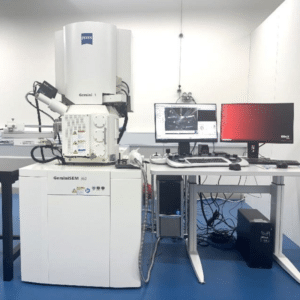
1. FE-SEM Instrument: ZEISS (Gemini SEM 360
It is equipped with the Secondary Electron (SE) Detector, Backscattered Electron (BSE) Detector, Energy Dispersive X-ray Spectroscopy (EDS), Scanning Transmission Electron Microscopy (STEM) and a Gold Sputter Coater.
2. Bruker D8 VENTURE Single-Crystal X-ray Diffractometer
A state-of-the-art single-crystal X-ray diffractometer equipped with the latest IµS DIAMOND II microfocus source and PHOTON III single-photon-counting detector, enabling high-speed, high-precision structure determination of small molecules, coordination compounds.
First time in India.
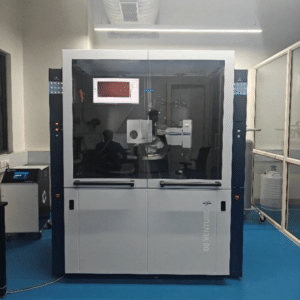
The Bruker D8 VENTURE at Ashoka University is a state-of-the-art single-crystal X-ray diffractometer equipped with the latest IµS DIAMOND II microfocus source and PHOTON III single-photon-counting detector, enabling high-speed, high-precision structure determination of small molecules, coordination compounds, MOFs, and macromolecules. The system supports low-temperature (80 K) and high temperature (500K) measurements and is configured with a precision KAPPA goniometer for complete and accurate data acquisition across diverse crystal systems.
Configuration
- Incoatec IµS DIAMOND II microfocus dual X-ray source (Mo Kα 0.7107 Å, Cu Kα, λ = 1.5418 Å) offering high intensity and beam stability.
- Four-circle KAPPA goniometer for precise sample orientation and complete reciprocal-space coverage.
- Bruker PHOTON III photon-counting detector with zero readout noise, fast acquisition, and high dynamic range.
- Oxford Cryostream 700+ temperature controller supporting 80–500 K for low- and high-temperature experiments.
- Compact and accessible instrument enclosure with excellent sample visibility and compatibility with advanced optics.
- APEX5 software suite for strategy generation, automated data collection, integration, structure solution and refinements.
- Bruker DIFFRAC.EVA software for powder XRD analysis
Applications
- High-precision structure determination of organic, inorganic, coordination, and organometallic compounds and macromolecules.
- Absolute configuration and chirality determination using Cu radiation.
- Analysis of polymorphs, solvates, co-crystals, and structurally disordered materials.
- Structure solution of weakly diffracting, solvent-rich, and very small fine crystals.
- Temperature-dependent crystallographic studies including phase transitions, disolvation studies of solvates and porous materials containing solvents in pores e.g. MOFs and COFs
- Macromolecular crystallography studies.
- Complementary powder XRD analysis using Bruker DIFFRAC.EVA software for phase identification, crystallinity assessment, and comparison of bulk and single-crystal characteristics using capillary mounting.
- Support for multidisciplinary research across chemistry, materials science, biology, and physics.
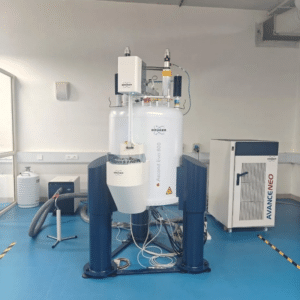
3. Bruker Ascend Evo 600 MHz NMR Spectrometer
The instrument has broader applications in Chemistry as well as Biology. Examples include
- Organic and medicinal chemistry
- Catalysis and materials chemistry
- Metabolomics and biomolecular purposes
Magnet System
- Magnet Type: Superconducting NMR magnet (Ascend Evo series)
- Magnetic Field Strength: 14.1 Tesla (corresponding to 600 MHz for ¹H)
- Bore Size: Standard bore 54 mm.
- Operating Temperature: ~4.2 K (liquid helium cooled)
- Magnet Mode: Persistent mode (superconducting current loop)
Spectrometer Console
- Console Type: Bruker Avance NEO
- RF Channels: Typically, 2–4 channels
- ¹H / ¹³C / Broadband / ²H lock
- Frequency Range: Multi-nuclear capability (¹H, ¹³C, ¹⁵N, ¹⁹F, ³¹P, etc.)
- Digital Receiver: High-resolution multi-channel digitization
- Gradient System: Z-gradient (optional XYZ gradients)
Variable Temperature (VT) System
- Temperature Range: ~ −150 °C to +150 °C
- Controlled gas flow (N₂/air)
Suitable for:
- Reaction monitoring
- Dynamic NMR
- Phase transition studies
Automation and Sample Handling
- Auto-sampler: Sample Case / BACS system (optional)
- Automation Features:
- Auto-tuning (ATM)
- Auto-shimming
- Auto-lock
- Queue-based acquisition (iCON-NMR)
Software
- Acquisition & Processing: Bruker TopSpin
- Automation: iCON-NMR
- Features:
- 1D and 2D experiments
- Quantitative NMR (qNMR)
- Advanced processing (FT, phase, baseline, integration)
Applications
- Organic and medicinal chemistry
- MOFs and materials chemistry
- Drug discovery and pharmaceuticals
- Metabolomics and biomolecular NMR etc.