





Convocation 2026: A Heartfelt Celebration of the Journeys of the Graduating Class
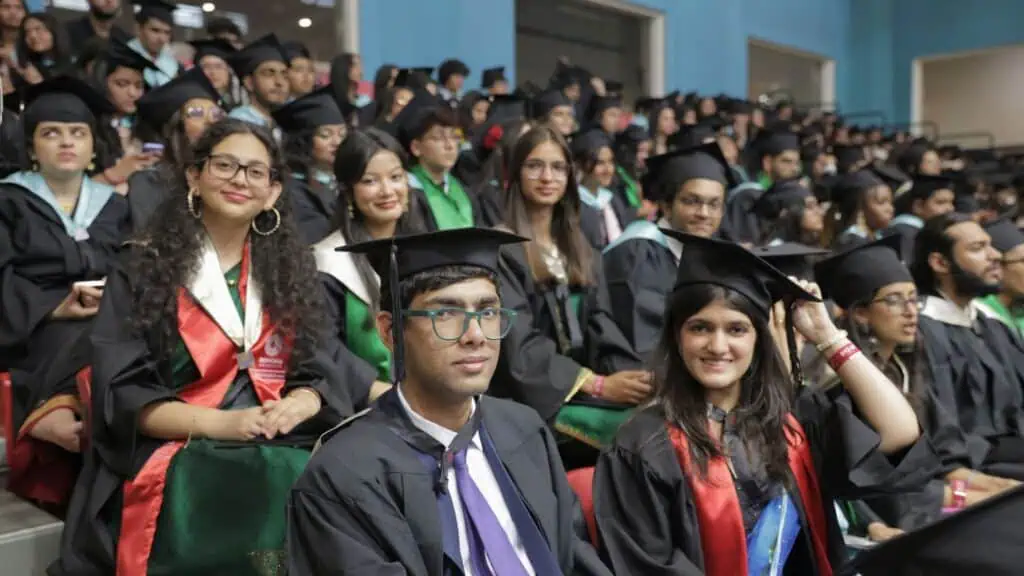
Ashoka University’s Convocation Ceremony 2026 brought together faculty, families, and loved ones of the graduating students as they crossed an important milestone in their journeys.
 0
0

In a moment of great pride and joy, Ashoka University’s Convocation Ceremony 2026 brought together faculty, families, and loved ones of the graduating students as they crossed an important milestone in their journeys. The event was a celebration of their journeys and new beginnings, while reflecting on their personal growth as they prepare themselves for a world beyond Ashoka.
The ceremony officially commenced with the lighting of the ceremonial lamp, a symbolic act representing the dispelling of darkness and the ushering in of the light of knowledge and wisdom, by the esteemed dignitaries – Professor Rudrangshu Mukherjee, Professor Somak Raychaudhury, Dr Pramath Raj Sinha, and Chief Guest, Group Captain Shubhanshu Shukla.
Declaring the Convocation open, Professor Rudrangshu Mukherjee, Chancellor, congratulated the graduating students and their families, describing the occasion as one of the proudest and most celebratory moments in the life of a university.
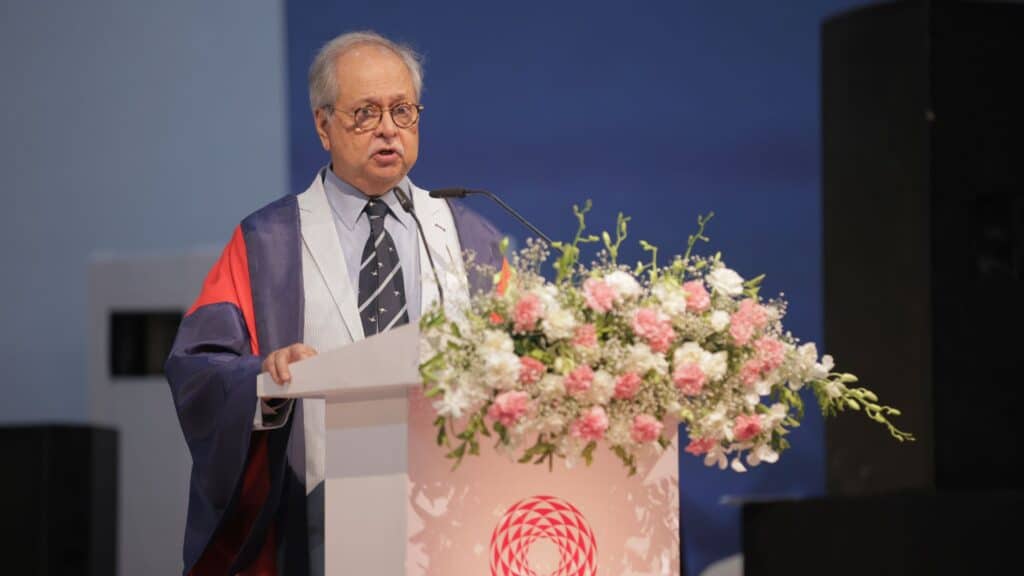
Addressing the students, Professor Rudrangshu said, ‘Ashoka has been your launching pad. Don’t keep your feet on the ground. Now go forth and explore the infinite unknown, but avoid the black holes.’
The Convocation also marked an emotional milestone for the university community as it was the final graduation ceremony attended by Professor Somak Raychaudhury in his capacity as Vice-Chancellor of Ashoka University. Acknowledging his contribution to the institution, Professor Mukherjee expressed gratitude for his leadership during a crucial juncture in its history. ‘It is indeed our good fortune that Professor Raychaudhury will remain associated with Ashoka as a scientist, as a professor, and as a builder of the university’s science programme,’ he added.
Professor Somak Raychaudhury, Vice-Chancellor, welcomed the graduating class, describing the day as a celebration not just of degrees, but of their journeys. ‘The curiosity that has led you to keep asking harder questions, the resilience you have shown in the face of challenges, episodes of doubt, and the courage underlying your evolution and growth to where you are today,’ he said, adding, ‘This is where your journey with Ashoka finds its fullest expression, and where I hope a lifetime of learning and meaningful impact begins.’
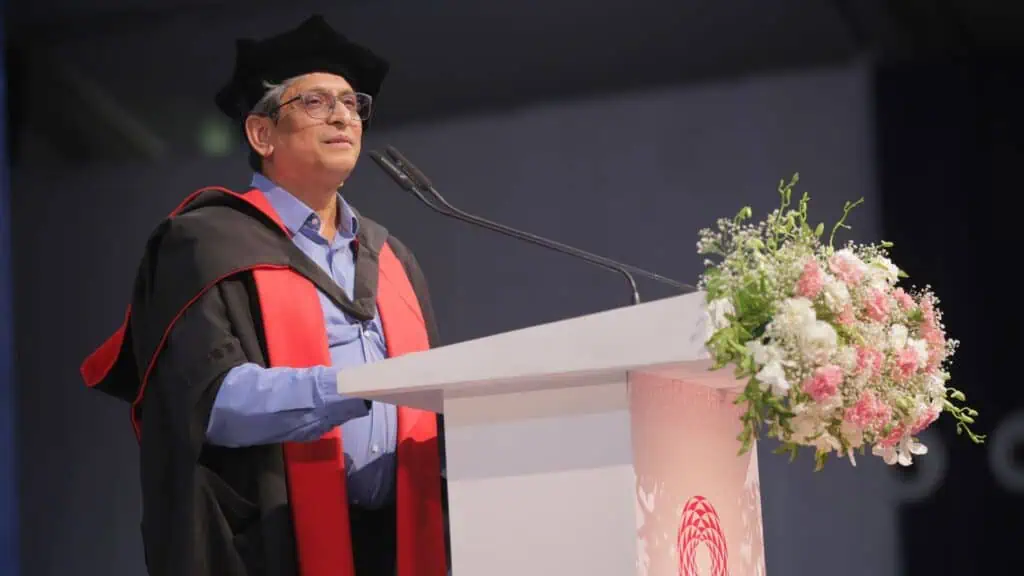
Reflecting on Ashoka’s growth and milestones, Professor Raychaudhury highlighted that this year marked the graduation of the country’s first cohort of students completing the four-year undergraduate honours programme under the National Education Policy (NEP) 2020. More than 360 students graduated with a four-year honours degree, while 128 students graduated with a four-year honours degree with research, making them among the first such cohort from an Indian university.
He also celebrated the growth of undergraduate research and doctoral education at Ashoka, saying, ‘I am also very proud of the fact that our PhD programme comes of age today. We have nearly 220 PhD scholars in residence, and for the first time, 15 doctoral students will cross this stage to receive their degrees. This is our largest cohort of PhDs so far’. Highlighting Ashoka’s growing academic and global footprint, he also spoke about the launch of two new schools, the Vachani School of Advanced Computing and the RK Damani School of Natural and Mathematical Sciences, both made possible through the extraordinary generosity of the founders.
Speaking directly to the graduating students, he said, ‘You inherit everything that has been built, and you will be the custodians of everything that is still to come. The world needs minds that are rigorous and restless, compassionate and courageous. Ashoka has built you to be exactly that.’
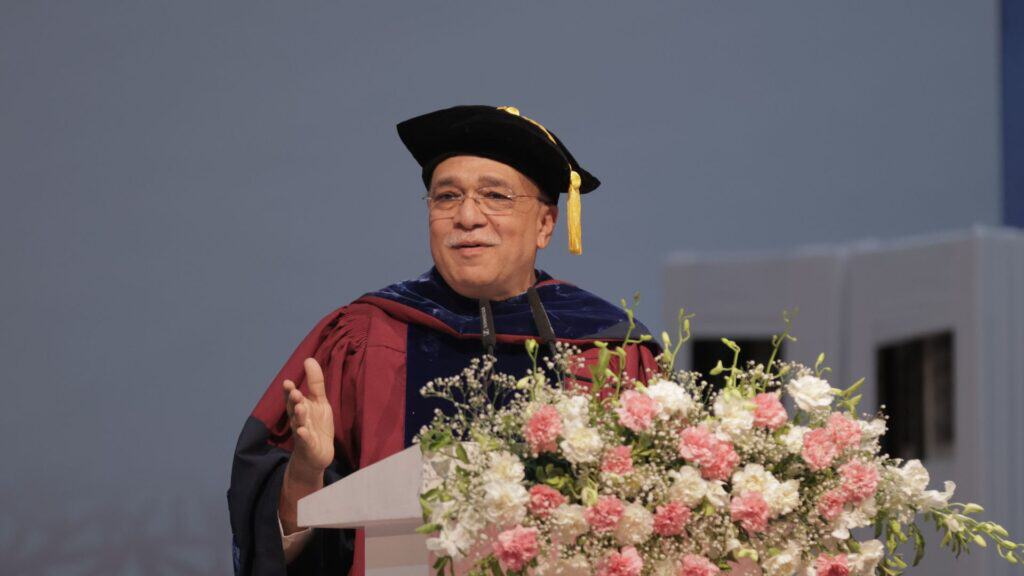
Pramath Raj Sinha, Founder & Chairperson, Board of Trustees, also congratulated the graduating class and described the Convocation as a deeply special moment for the university community, especially as it marked the graduation of the first cohort of the four-year undergraduate programme.
In one of the most heartfelt moments of the ceremony, the Chairperson invited faculty members, staff, and finally the families of the graduating students to stand and be acknowledged by the audience. As students turned towards their parents and loved ones, the hall erupted in applause for those who had supported them throughout their journeys at Ashoka.
‘Convocations are very important occasions for universities, and not just because degrees are being handed out, but because this is an occasion where, for a few hours, everyone who believed in you and in your journey comes together in one place,’ said Pramath Raj Sinha. Addressing the graduating class, he added, ‘Class of 2026, you are graduating at a time when the world is changing really fast. People who will make a difference in this century will be the ones who can keep seeking new knowledge, keep doing interesting things, and keep stretching themselves into unfamiliar territory. Some of it may even be extraterrestrial. Our chief guest today represents exactly that spirit.’
Introducing the Chief Guest, the Chairperson spoke about Group Captain and Gaganyatri Shubhanshu Shukla’s remarkable journey from a school student in Lucknow, fascinated by a fighter aircraft, to becoming astronaut number 634, the 634th human being in history to travel to space, the first Indian to travel to the International Space Station, and only the second Indian to travel to space since Rakesh Sharma in 1984.
Speaking on Shukla’s extraordinary achievement, Chairperson said, ‘For a long time, countries like ours were told to admire scientific achievement happening elsewhere. That era is clearly ending, and it is people like Shux who are helping create that future. Despite all the technology, training, and complexity, he still speaks with a sense of wonder.’ He further added, ‘The world increasingly belongs to people who can connect fields, adapt quickly, and keep growing their curiosity across disciplines.’
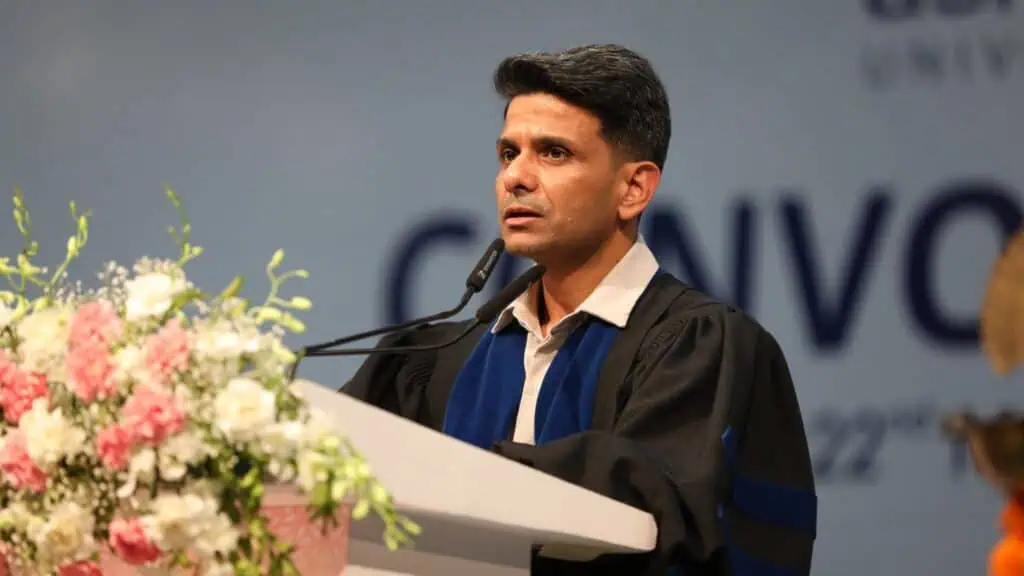
Delivering the keynote address, Chief Guest Group Captain and Gaganyatri Shubhanshu Shukla shared a deeply personal and inspiring speech that blended humour, vulnerability, life lessons, and reflections from his journey to space.
He recounted defining moments from his life and career, from backing out of a handwriting competition as a child because of self-doubt, to dreaming of sitting in a fighter aircraft cockpit for ‘five or maybe ten minutes’, to struggling with chemistry in school before later understanding it while conducting experiments aboard the International Space Station.
Drawing lessons from these experiences, he encouraged students to embrace uncertainty, remain curious, dream bigger, and continue moving forward even when they feel afraid or unprepared.
Summarising his message to the graduating class, he left students with six lessons from his journey: ‘Always walk into the building. Make your dreams bigger. Stay curious. Push through the hatch even if ungracefully. Ask the question, if not you, who? And when the time comes, let yourself be caught.’
The awarding of degrees was the highlight of the ceremony, with the graduating students taking the stage amidst applause, cheers, and emotional celebrations from their families, friends, and faculty members.
Adding a musical interlude to the ceremony, members of Vistaar, Ashoka University’s music society, presented a soul-stirring performance. Through songs such as Arz-e-Niyaz, Mausam, and Pinha, they captured the emotions that students navigated over their four-year journeys, change, bittersweet farewells, reflection, and hope for the future.
The ceremony concluded with the Ashoka Oath led by Chancellor Professor Rudrangshu Mukherjee, followed by a heartfelt vote of thanks by Pro-Vice Chancellor Venkat Eshwara, who acknowledged the behind-the-scenes contributions of faculty, staff, operations teams, and families whose support made the students’ journeys possible.
Convocation 2026 was not only a celebration of academic achievement but also of curiosity, resilience, friendship, growth, and possibility, a moment marking both the culmination of one journey and the beginning of another.’