









Event Calendar

Call for Papers – Securing Insecurity: Paradoxes of Precarious Protection
- This event has passed.
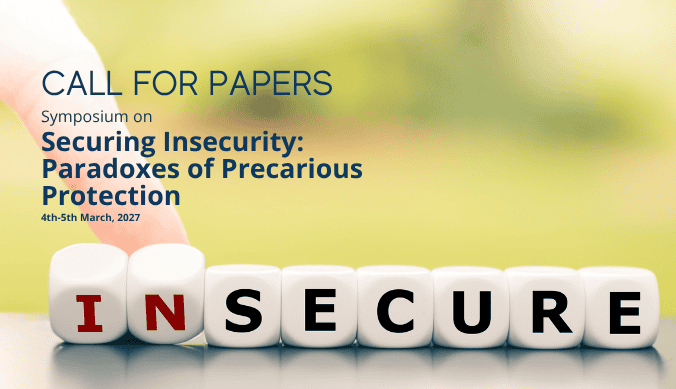
The Department of International Relations, Ashoka University, invites submissions for the symposium “Securing Insecurity: Paradoxes of Precarious Protection” taking place on 4th-5th March 2027, at Ashoka University in Sonipat (near New Delhi), India. We particularly welcome submissions from postdoctoral scholars and early-career researchers.
Description:
Contemporary world politics is structured by profound contradictions. International institutions coexist alongside renewed assertions of national sovereignty, protectionism, and revanchist nativism. Capital, data, and technology move across borders with unprecedented speed, while human mobility is increasingly stratified, surveilled, and restricted. Supply chains create potent forms of interdependence, yet they have simultaneously become instruments of coercion, extraction, and geopolitical vulnerability. The most consequential threats confronting political communities, including climate change, pandemics, food and energy insecurity, ecological extraction, and supply-chain disruptions, are transnational, interconnected, and resistant to territorial containment. Yet the institutions and practices through which security is pursued remain predominantly state-centric, militarised, and territorially bounded. The result is a widening disjuncture between the planetary and transnational character of contemporary insecurity and the national frameworks through which it is interpreted and governed.
We are also delighted to announce that we will be joined by three incredibly distinguished scholars, Professor Catarina Kinnvall and Professor Stefano Guzzini, whose work has indelibly shaped the discipline and who have kindly offered to deliver the Symposium’s opening, closing and special addresses.
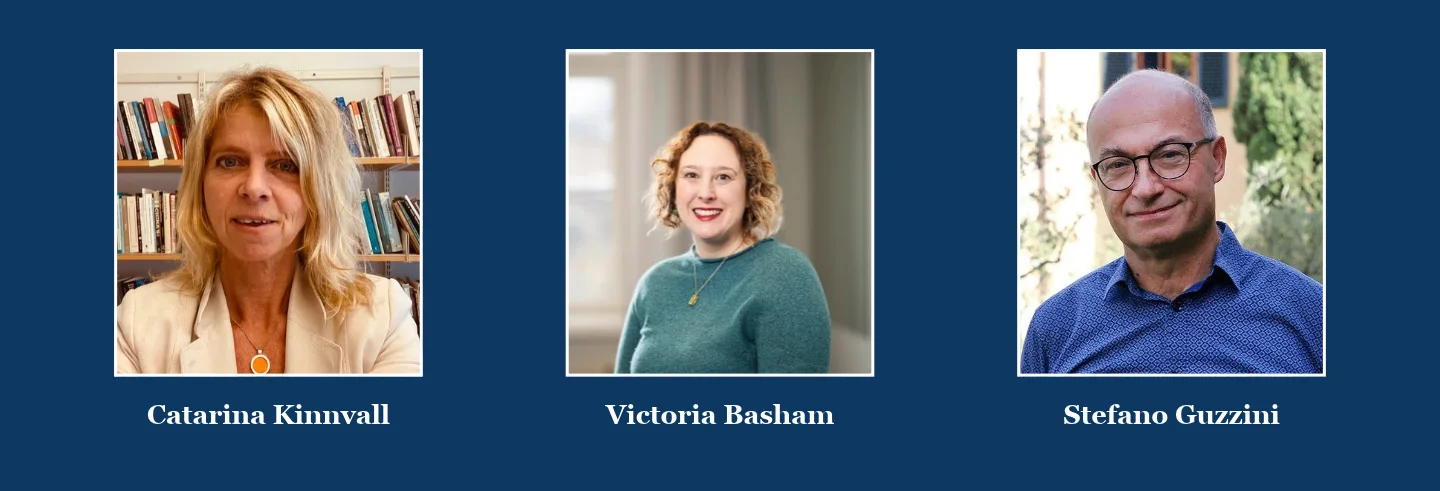
Catarina Kinnvall is Professor at the Department of Political Science, Lund University, Sweden. Her research interests involve international relations, political psychology and critical security studies, with a particular focus on emotions, gender, migration and populism in South Asia and Europe. She is the author of numerous books and articles such as Climate Hazards, Disasters, and Gender Ramifications, Ontological Insecurity in the European Union, and Anxiety, fear, and ontological security in world politics : Thinking with and beyond Giddens. Professor Kinnvall has also served as the former President of the International Society of Political Psychology (ISPP), the former Editor-in-Chief of the journal Political Psychology and as the co-editor of the Palgrave Series in Political Psychology.
Victoria Basham is Professor of International Relations at Cardiff University, UK. For over two decades, she has researched military culture and how and why liberal democratic societies prepare for war. Professor Basham’s research is centered on how gender, sexuality, racialisation, and social class shape people’s understandings and experiences of war and violence and has been published in journals spanning various disciplines including Security Dialogue, International Political Sociology, Review of International Studies and she is also the author of War, Identity and the Liberal State: Everyday Experiences of the Geopolitical in the Armed Forces. Professor Basham has also co-founded the journal, Critical Military Studies, and co-edits the Edinburgh University book series, Advances in Critical Military Studies. She is also the current Vice Chair of the British International Studies Association, having previously been the President of the European International Studies Association.
Stefano Guzzini is Chair of Political and Social Theory at the European University Institute. His research focuses on international theory, social and political theories of power and recognition, critical security studies, approaches to foreign policy analysis, and interpretivist methodology. His award-winning research has been published in ten languages and includes stellar works such as The Return of Geopolitics in Europe? Social Mechanisms and Foreign Policy Identity Crises (Cambridge UP, 2012, translated into Brazilian Portuguese), and Power, Realism and Constructivism (Routledge, 2013) which won the 2014 ISA Best Book Award in the Theory Section. Professor Guzzini is also the recipient of two ISA Distinguished Scholar Awards and has served as the editor of the Journal of International Relations and Development, International Theory, and as President of the Central and East European International Studies Association.
This symposium begins from a central conceptual proposition: insecurity is increasingly becoming a form of stability. Insecurity can no longer simply be treated as a temporary interruption of an otherwise stable political order. Persistent threats, emergencies, and vulnerabilities have become routine features of governance and everyday life. Order is maintained through the continuous anticipation, management, and displacement of insecurity. The paradox, therefore, is that contemporary security practices may stabilise the very conditions of insecurity they claim to resolve. The symposium seeks theoretical, empirical, and interdisciplinary contributions that examine the paradoxes through which insecurity is produced, governed, normalised, and contested. Rather than merely identifying additional objects of security, it invites scholars to ask how persistent insecurity has become politically productive, institutionally embedded, and materially uneven, and what this transformation demands from the study and practice of security.
Contributors may engage with, but are not limited to, the following questions:
- How do contemporary (in)security practices manage, redistribute, or stabilise insecurity rather than eliminate it?
- How can we understand the paradox of a state that remains materially powerful while becoming increasingly inadequate as the sole framework through which security is conceptualised?
- How are vulnerability and exposure to threat differentiated across gender, race, caste, class, disability, and geographical location?
- How do anxiety, alienation, and fear shape political responses to geopolitical, ecological, and technological transformation?
- Does the distinction between war and peace remain analytically useful under conditions of sanctions, proxy warfare, cyber operations, infrastructural disruption, and grey-zone conflict?
- How are threats made visible, sensible, and politically compelling through images, sound, spectacle, popular culture, and digital platforms?
- Can security be reimagined through care, solidarity, and interdependence rather than through threat, exclusion, and violence?
- What might post-security, demilitarised, decolonial, or utopian approaches contribute to a field so frequently structured by crisis, emergency, and anticipation?
Submissions:
Please submit your abstract (maximum 500 words) via the following form by 25th October, 2026. We expect to send out decisions by mid-November.
Some funding is available for travel, accommodation, and meals. Decisions on the allocation of funding will be made on the basis of availability and participants’ funding statements.
We look forward to your proposals,
Natallia Khaniejo and Ananya Sharma, Department of International Relations.