









Event Calendar

Computer Science Seminar
From Compute to Human Flourishing: Artificial Intelligence, Human Agency, & Future of Universities
- This event has passed.
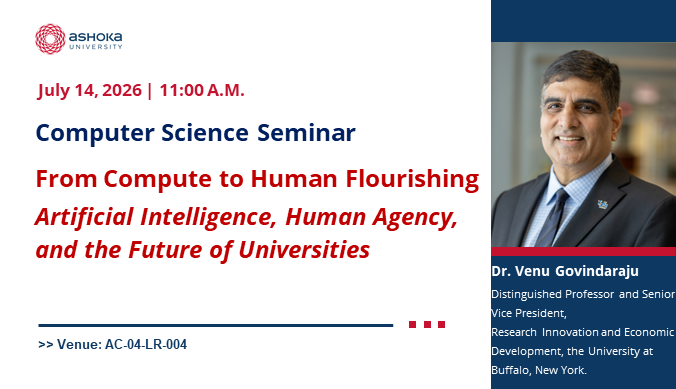
Abstract: Artificial intelligence is transforming research, education, and society at an unprecedented pace. Yet the most important questions are no longer about what AI can do, but about what humans, universities, and public institutions must continue to do.
Drawing on four decades of experience in artificial intelligence, from pioneering postal automation and biometric identification to leading the National AI Institute for Exceptional Education and Empire AI, we present a human-centered perspective on the next era of AI.
The talk unfolds in three parts. First, we explore how advances in compute become meaningful only when they create trusted public infrastructure that improves lives. Second, we argue that the future is not Humans versus Agents, but human agency amplified by increasingly capable AI systems. Finally, we examine why AI is making universities more important than ever by returning education to its first principles: cultivating judgment, curiosity, ethical reasoning, and communities of inquiry.
Rather than viewing AI as a replacement for human capability, this talk presents a vision in which technology expands capability, universities cultivate judgment, and together they
advance human flourishing.
About the Speaker: Dr. Venu Govindaraju is Distinguished Professor and Senior Vice President for Research, Innovation and Economic Development at the University at Buffalo, State University of New York. With a prolific career spanning over three decades, Dr. Govindaraju has led research projects totaling nearly $100 million, holds six patents, and has authored close to 500 refereed scientific papers. He is the principal investigator of the National AI Institute for Exceptional Education at UB, a prestigious $20 million initiative funded by the National Science Foundation and the Institute of Educational Sciences.
Dr. Govindaraju is a Fellow of the American Association for the Advancement of Science (AAAS), Association of Computing Machinery (ACM), International Association of Pattern
Recognition (IAPR), Institute of Electrical and Electronics Engineers (IEEE), and National Academy of Inventors. In 2024, he received the University at Buffalo President’s Medal and was named “Person of the Year” by the Council of Heritage and Arts of India for his contributions to AI.