









Event Calendar

Ecologies of Heritage: Revitalisation and Relationality in Assam\’s Silk Belt.
SOA Research Scholars’ Colloquium
- This event has passed.
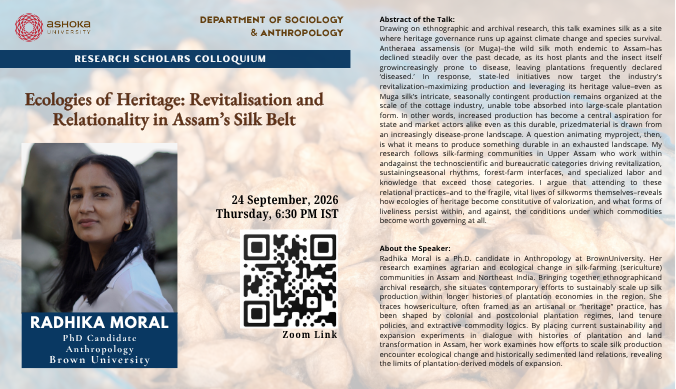
Abstract: Heritage: Revitalisation and Relationality in Assam's Silk Belt.” Abstract of the Talk: Drawing on ethnographic and archival research, this talk examines silk as a site where heritage governance runs up against climate change and species survival. Antheraea assamensis (or Muga)–the wild silk moth endemic to Assam–has declined steadily over the past decade, as its host plants and the insect itself grow increasingly prone to disease, leaving plantations frequently declared ‘diseased.’ In response, state-led initiatives now target the industry's revitalization–maximizing production and leveraging its heritage value–even as Muga silk’s intricate, seasonally contingent production remains organized at the scale of the cottage industry, unable to be absorbed into large-scale plantation form. In other words, increased production has become a central aspiration for state and market actors alike even as this durable, prized material is drawn from an increasingly disease-prone landscape. A question animating my project, then, is what it means to produce something durable in an exhausted landscape. My research follows silk-farming communities in Upper Assam who work within and against the technoscientific and bureaucratic categories driving revitalization, sustaining seasonal rhythms, forest-farm interfaces, and specialized labor and knowledge that exceed those categories. I argue that attending to these relational practices–and to the fragile, vital lives of silkworms themselves–reveals how ecologies of heritage become constitutive of valorization, and what forms of liveliness persist within, and against, the conditions under which commodities become worth governing at all.
About the Speaker: Radhika Moral is a Ph.D. candidate in Anthropology at Brown University. Her research examines agrarian and ecological change in silk-farming (sericulture) communities in Assam and Northeast India. Bringing together ethnographic and archival research, she situates contemporary efforts to sustainably scale up silk production within longer histories of plantation economies in the region. She traces how sericulture, often framed as an artisanal or “heritage” practice, has been shaped by colonial and postcolonial plantation regimes, land tenure policies, and extractive commodity logics. By placing current sustainability and expansion experiments in dialogue with histories of plantation and land transformation in Assam, her work examines how efforts to scale silk production encounter ecological change and historically sedimented land relations, revealing the limits of plantation-derived models of expansion.