









Event Calendar

Economics Department Weekly Seminar | Garima Siwach | 23rd September 2026 | 1:40 PM
- This event has passed.
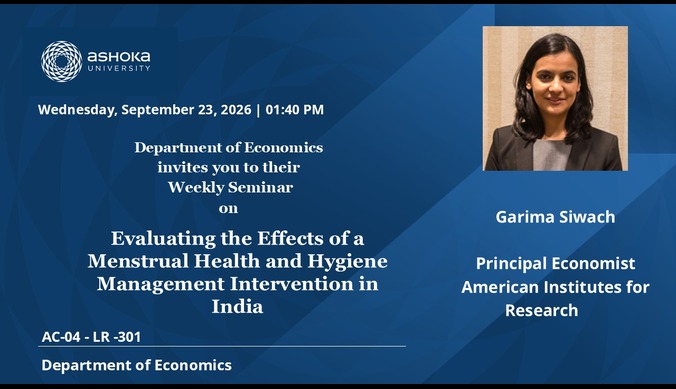
Abstract: In India, limited knowledge, inadequate access to hygienic products and persistent stigma hinder effective menstrual health and hygiene (MHH) management. This study documents adolescents’ menstruation experiences in government schools in Tamil Nadu and evaluates Happy Periods, a non-governmental organization (NGO)-led MHH intervention that simultaneously targets multiple drivers of poor MHH. Specifically, the NGO provides menstruation-focused education to both boys and girls and distributes reusable sanitary pads to girls. Using pre- and post-program data from approximately 1,300 adolescents in 105 schools and a quasi-experimental design, we examine the menstruation landscape in the study setting and the impacts of Happy Periods. At baseline, students exhibited substantial gaps in menstruation knowledge and restrictive attitudes towards menstruation. The intervention improved knowledge among both girls and boys, increased girls’ usage of reusable menstrual products, and reduced students’ regressive attitudes surrounding menstruation. However, it had no detectable effects on girls’ school absenteeism or well-being, outcomes that may require longer exposure to additional/repeated intervention activities and/or greater passage of time to change. Our study demonstrates the scope for a bundled, relatively light-touch intervention to tackle a complex issue hindering the wellbeing of girls, women and other menstruating individuals in countries around the world.