









Event Calendar

PhD Thesis Pre-submission Seminar
TRACE: Trustworthy, Reliable Accountability with Cryptographic Evidence for Privacy-Preserving Compu
- This event has passed.
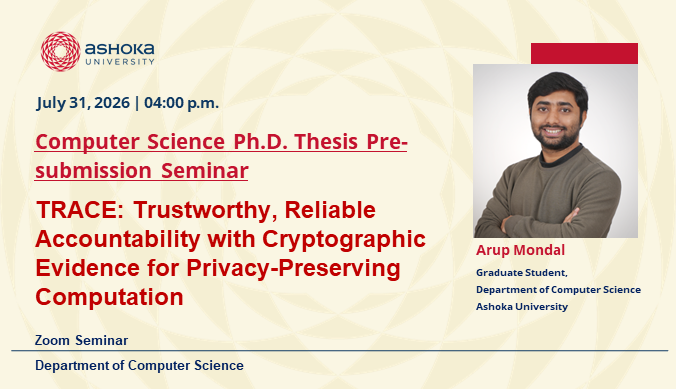
Dear All,
The Department of Computer Science invites you to the Ph.D. Thesis Pre-submission Presentation by our student.
Title: TRACE: Trustworthy, Reliable Accountability with Cryptographic Evidence for Privacy-Preserving Computation
Abstract: Modern cryptographic systems are increasingly deployed in large-scale, decentralized, and trust-constrained environments, where strong privacy guarantees are essential for protecting users and minimizing trust assumptions. Techniques such as threshold cryptography and end-to-end encryption are now integral to financial infrastructures, decentralized systems, and communications platforms. While these mechanisms effectively safeguard confidentiality and correctness, the former also complicates accountability: authorized participants may misuse their legitimate cryptographic capabilities — often through collusion — while deliberately concealing their actions using advanced cryptographic tools. As cryptographic systems intersect more directly with economic incentives, legal frameworks, and societal norms, the inability to attribute liability has emerged as a fundamental challenge.
This thesis studies accountability as an intrinsic cryptographic objective in privacy-preserving computation. It investigates whether cryptographic systems can be designed to detect and attribute misuse by authorized and potentially colluding participants — however, this must be done without weakening core security guarantees such as decentralization, confidentiality, and end-to-end encryption. The thesis makes several contributions toward this goal. First, it introduces traceable threshold encryption schemes that enable the public identification of at least one member of a malicious decryption quorum, even in fully decentralized settings without trusted authorities. These constructions are motivated by applications such as encrypted mempools in blockchain systems, where validator collusion can lead to premature disclosure of transaction data and financial exploitation. Second, the thesis extends accountability to high-throughput environments by developing traceable batched threshold encryption both in privately and publicly traceable settings, showing that efficiency and scalability can coexist with strong traceability guarantees. Third, it proposes encryption mechanisms that compel decrypting parties to generate cryptographic evidence of misuse, yielding durable and publicly verifiable audit trails even when adversaries coordinate via multiparty computation. Finally, the thesis applies these ideas to end-to-end encrypted messaging, designing lightweight and narrowly scoped tracing mechanisms that enable originator identification upon legitimate user reporting while preserving other aspects of end-to-end encryption.
The resulting designs provide practical pathways for deploying privacy-preserving computation in real-world settings where misuse must be addressed, enabling post hoc investigation and enforcement without undermining decentralization, scalability, or end-to-end security. Overall, this thesis demonstrates that strong privacy guarantees need not come at the expense of meaningful accountability.
About the Speaker: Arup Mondal is a PhD student in the Department of Computer Science at Ashoka University, advised by Dr. Debayan Gupta. His research focuses on the theory and design of secure cryptographic schemes, with a particular focus on applied and verifiable cryptography.
We look forward to your active participation.