









Event Calendar

Physics Colloquium | The Extraordinary Science of the Ordinary World
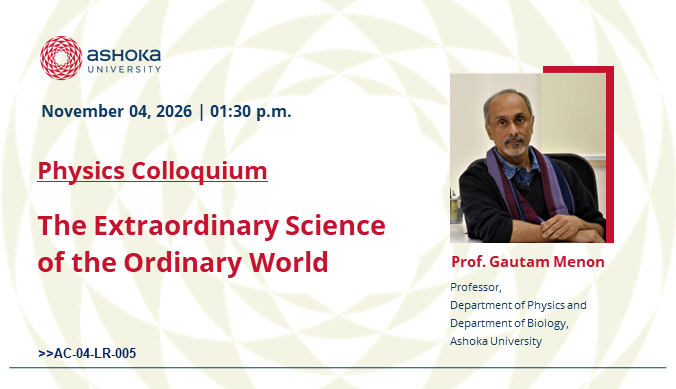
Abstract: The French Nobel prize winner in Physics in 1991, Pierre-Gilles de Gennes (1932-2007), holds a position in science that is, in many ways, unique. He presided over the creation of a new field, that of “soft matter”, intersecting physics, chemistry, biology, applied mathematics and engineering. This is the science of the every-day world, of materials as diverse as shaving foam, ink, sand, plastics and soap. But he also thought about education more broadly, including the need to move away from a culture of abstract mathematics in science as well as the importance of teaching the joy of science to young people, emphasising that science is deeply human, intuitive, and driven by curiosity. Despite his fame in scientific circles, and the accessibility of the topics he worked on – the Nobel Prize committee called him "The Newton of our time" – de Gennes is not otherwise widely known, a gap I'll address.
About the Speaker: Prof. Gautam Menon is a Professor of Physics and Biology at Ashoka University. He served as Dean (Research) at Ashoka between 2022 and 2025 and was also Director of Ashoka’s Centre for Climate Change and Sustainability (3CS) during that period. He is a Commissioner on the Lancet Commission on “Strengthening the use of Epidemiological Modelling of Pandemic Diseases”, a co-author of the “Lancet Commission on a Citizen-centred Health System for India” and a member of the WHO “Technical Advisory Group on Embedding Ethics in Health and Climate Change Policy.”
His research work, spread over approximately 100 papers, is in the broad areas of physics, biophysics and epidemiology. Currently, he works on a number of biophysical problems including nuclear architecture, axonal transport, collective cell migration and cell adhesion. The modelling of infectious disease and its implications for public policy is a long-standing interest. His group has developed BharatSim, India’s first ultra-large-scale agent-based model for disease spread. His research has been funded by the European Union, the BMGF, CEFIPRA and the WHO, as well as the DBT, DST and DAE in India. He has lectured in universities and scientific conferences around the world and in India, including in the USA, Canada, France, Germany, Switzerland, Singapore, the Netherlands and the UK.
He serves on the scientific review committees of several international and national agencies, including the Human Frontier Science Program and the Wellcome Trust-DBT India Alliance, as well as on a number of national committees. He was a Member of the Expert Group (Education) for the Science, Technology and Innovation Policy of India (2020).
We look forward to your active participation.