









Event Calendar

Physics Seminar
Nonequilibrium Liquid Crystals: Phase Behaviour, Activity, and Defect Dynamics
- This event has passed.
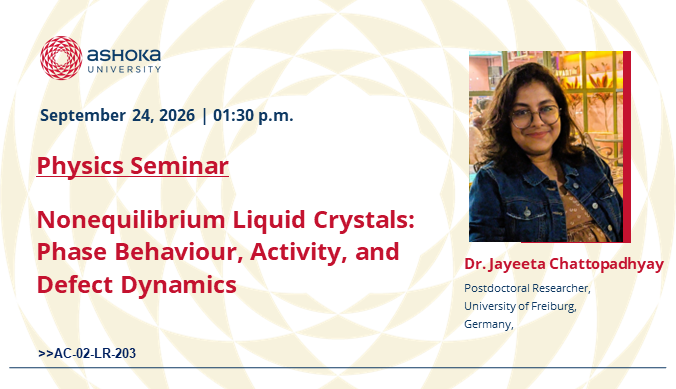
Abstract: Many soft-matter systems operate far from equilibrium, where continuous energy input or interactions with their environment can drive spontaneous organization,
phase separation, pattern formation, and collective motion. Liquid-crystalline systems provide a useful platform for studying these effects because orientational order couples directly to particle shape, chirality, activity, and flow. Examples include rod-like colloids and cytoskeletal systems such as microtubule–motor mixtures.
In this talk, I will discuss my work on nonequilibrium behaviour in liquid-crystalline systems using both particle-based and continuum approaches. At the particle level, I will focus on how particle shape, chirality, and activity influence phase behaviour and collective organization. In particular, I will introduce a minimal two-temperature model, in which nonequilibrium driving is generated by maintaining a temperature difference between different constituents of the system. I will show how this simple driving mechanism can induce phase separation and promote liquid-crystalline ordering even for rods with aspect ratios (length/diameter) below the Onsager threshold.
I will then move to a continuum description of active and passive nematics, where the coupling between orientational order and fluid flow becomes important. Using nematohydrodynamic equations, I will show how hydrodynamic coupling modifies topological defect dynamics, suppresses defect recombination, and alters defect-mediated phase transitions.I will conclude by outlining how these ideas motivate my current and future research in nonequilibrium soft matter, including responsive colloids, adaptive soft materials, and collective organization in complex soft-matter systems.
About the Speaker: Jayeeta Chattopadhyay is a postdoctoral researcher at the University of Freiburg, Germany, working in computational soft matter and nonequilibrium statistical physics. She received her PhD in Physics from the Indian Institute of Science, Bangalore, and subsequently worked as a postdoctoral researcher at the Niels Bohr Institute, University of Copenhagen, Denmark. Her research focuses on liquid crystals, active matter, responsive colloids, and collective phenomena in nonequilibrium systems using particle-based simulations, continuum modelling, and statisticalmechanical approaches.
We look forward to your active participation