









Event Calendar

Psychology and Cognitive Sciences Colloquium
From Brain to Culture: Rethinking the Science of Aesthetic Experience
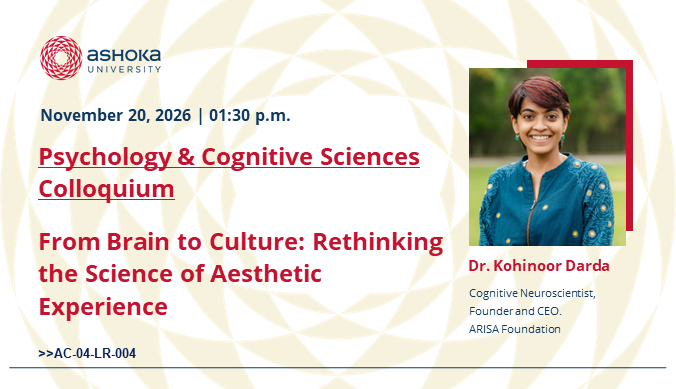
Abstract: How does the brain perceive and respond to art? And how much of what we know about aesthetic experience is shaped by the cultural contexts in which we study it?
This talk traces a research journey from the neuroscience of action perception to the study of dance, aesthetics, and cultural influences on aesthetic experience. Beginning with fMRI research investigating how the brain processes movement and action, I will explore how these questions extend to dance, where movement becomes an expressive and aesthetic experience shaped by expertise, familiarity, and context.
Moving from neuroimaging to behavioural approaches, the talk will examine broader questions in cross-cultural empirical aesthetics: How do cultural backgrounds, artistic traditions, and prior experiences influence what we perceive, appreciate, and find meaningful? What can studying diverse artistic traditions, including Indian classical dance, tell us about the generalisability of existing theories of aesthetic experience?
Finally, drawing on ongoing work at ARISA Foundation, I will consider how empirical aesthetics can move beyond conventional laboratory settings to engage with artists, communities, and everyday environments. Through research, education, and community-based initiatives, this work explores how community-based approaches can both strengthen the science of aesthetics and expand its relevance to society. The talk ultimately asks what a more inclusive, context-sensitive, and culturally informed science of aesthetic experience might look like.
About the Speaker: Dr. Kohinoor Darda is a cognitive neuroscientist and founder and CEO of the ARISA Foundation, a Pune-based non-profit bridging art, science, and society. With a PhD from Bangor University and postdoctoral experience across the UK, Australia, and the USA, her work examines how context and culture shape human experience, social interaction, and engagement with art, and how aesthetic experiences can be designed for transformation. Through ARISA, she leads research, education, and community initiatives that use art to advance mental health awareness, neuroliteracy, and interdisciplinary collaboration, making knowledge more accessible, inclusive, and grounded in real-world contexts.
We look forward to your active participation.