









Event Calendar

Psychology and Cognitive Sciences Seminar
Examining Social Intelligence as a Personal Resource in the Job Demands-Resources Model
- This event has passed.
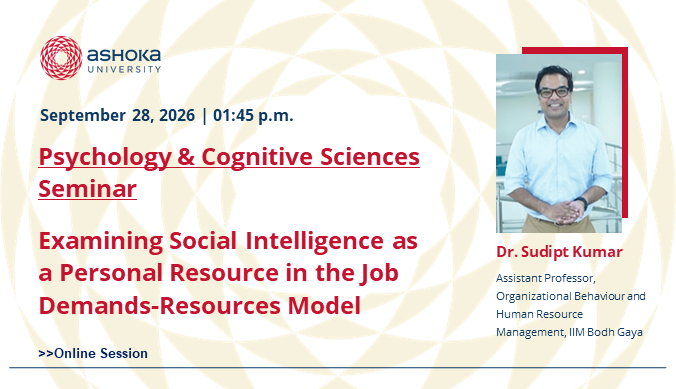
Abstract: The Job Demands–Resources (JD-R) model establishes that personal resources positively contribute towards employee well-being and work engagement. Their role attains particular significance in resource-constrained non-governmental organizations (NGOs) operating in developing economies, where employees often balance the needs of grassroots beneficiaries with the expectations of international donor agencies. When organizational resources are limited, the ability to understand and respond effectively to diverse social situations becomes especially valuable. In this regard, this study examines social intelligence (SI) as a personal resource, focusing on how employees’ ability to interpret social cues and adapt to different situations shape their perceptions of job demands and their use of relational support as a job resource. This perspective extends the JD-R model by highlighting how SI helps employees manage demanding work environments and remain engaged in their work. 218 employees from various Indian NGOs participated in this study. Data was gathered through self-administered questionnaires. The study employed Partial Least Squares Structural Equation Modeling (PLS-SEM) to analyze the data and test the proposed hypotheses regarding the impact of SI on perceptions of job demands and resources, as well as its effects on psychological well-being and work engagement.The results demonstrate that SI as a personal resource significantly influences employees; perceptions of job demands and resources. Furthermore, SI was found to have a direct and positive effect on psychological well-being and work engagement. These findings underscore the pivotal role of SI as a personal resource in enhancing the job outcomes of employees in the NGOs. This study contributes to the broader literature on organizational management, especially within the context of NGOs in emerging economies. The findings suggest that by fostering SI among employees, organizations can achieve improved job outcomes. The cross-sectional design of this study is a limitation, emphasizing the need for longitudinal research to further validate these findings over time. Keywords: Social Intelligence, Psychological Well-being, Work Engagement, Job Demands- Resources, Nonprofit Organizational Management.
About the Speaker: Dr. Sudipt Kumar is an Assistant Professor in the Organizational Behaviour and Human Resource Management area at the Indian Institute of Management Bodh Gaya. He has an interdisciplinary academic background, with a PhD in Management from the Vinod Gupta School of Management, Indian Institute of Technology Kharagpur, and master’s degrees from the Tata Institute of Social Sciences, Mumbai, and the Indian Institute of Technology Bombay. Dr. Kumar has taught courses such as Talent Acquisition, Learning and Development, Research Methods, and Social Entrepreneurship at both postgraduate and undergraduate levels. His research has been published in leading journals in Organizational Behaviour and Human Resource Management, including Personnel Review, Journal of Managerial Psychology, Acta Psychologica among others. His recent publications examines social intelligence, neurodiversity, and talent acquisition in work organizations. Before joining IIM Bodh Gaya, Dr. Kumar served at O. P. Jindal Global University, where he held several academic and leadership positions. He was the Programme Director for Industrial and Organizational Psychology and also served as Assistant Dean for Internships and Placements at the Jindal Institute of Behavioural Sciences.
We look forward to your active participation.