









Event Calendar

Psychology and Cognitive Sciences Seminar
Motor Behavior to Brain Connectivity: Understanding Neurodevelopmental Outcomes
- This event has passed.
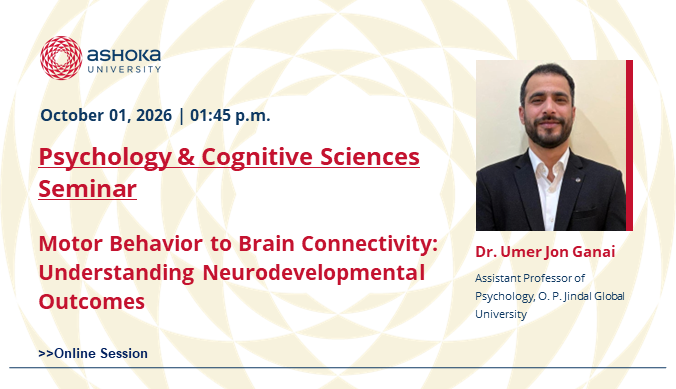
Abstract: Early detection and diagnosis of autism spectrum disorder (ASD) remain challenging, as conventional approaches have focused largely on social and communication domains that may become more apparent later in development. Motor behavior, on the other hand, offers a complementary window into neurodevelopment. In this talk, I will discuss my work on ASD through this lens, spanning early detection and diagnosis, prediction, and underlying mechanisms. Gait provides an accessible window into early motor differences. A cost-effective, non-intrusive, pose-estimation-based algorithm was developed to objectively quantify gait in children with ASD and typically developing (TD) children. Children with ASD showed atypical gait patterns, and machine learning (ML) models achieved up to 82% accuracy in distinguishing ASD from TD children based on gait features. These findings highlight gait as a potential behavioral marker of ASD and demonstrate the potential of ML for developing objective and scalable approaches to early detection and diagnosis. Building on this behavioral perspective, early motor and language development were examined in relation to broader neurodevelopmental traits and brain organization. In a large sample of early adolescents, poor motor coordination was associated with both autism traits and attentiondeficit/hyperactivity disorder (ADHD) symptoms, while delayed speech was associated with autism traits and delayed independent walking with ADHD symptoms. Bayesian mediation analyses further examined whether resting-state functional connectivity linked early developmental characteristics with later neurodevelopmental outcomes. Several cortical and cortico-subcortical networks showed modest but meaningful indirect effects, suggesting potential neural pathways through which early developmental characteristics may relate to later neurodevelopmental traits. Overall, these findings illustrate how motor behavior can provide a complementary perspective on neurodevelopment by linking observable behavioral differences with computational approaches to prediction and underlying patterns of brain organization. I will conclude with recent work and future directions that extend this framework to broader questions in ASD and related neurodevelopmental conditions.
About the Speaker: Dr. Umer Jon Ganai received his Ph.D. in Psychology from the Department of Humanities and Social Sciences at the Indian Institute of Technology Kanpur (IIT Kanpur), India. His doctoral research focused on the early detection and diagnosis of autism spectrum disorder. He was awarded the Mitacs Globalink Research Fellowship to conduct research at McMaster University, Canada, where he investigated intracortical myelination and explored the use of artificial intelligence to enhance statistical power in clinical neuroimaging. His research interests span cognitive neuroscience, cognition, neuroimaging, machine learning, and graph network theory, with a broader focus on understanding the relationships among cognition, behavior, and the brain. His research has been published in reputed journals, including British Journal of Clinical Psychology, Psychological Medicine, Scientific Reports, PLOS One, as well as in the IEEE/CVF Computer Vision and Pattern Recognition (CVPR). His other works are currently under revision at Developmental Cognitive Neuroscience, Brain and Cognition, Proceedings of the National Academy of Sciences, and IEEE Transactions on Affective Computing. His current research projects examine intracortical myelination in neurodevelopmental disorders, neural correlates of cognitive disengagement, the double empathy problem, the effects of cognition on gait, the neural signature of mind blanking as a distinct state of consciousness, and cultural biases in large language models (LLMs). Dr. Ganai has been working as an Assistant Professor of Psychology for over two years. He previously served as an Assistant Professor of Psychology at UPES, Dehradun, and currently serves as an Assistant Professor of Psychology at the Jindal School of Psychology & Counselling, O. P. Jindal Global University, India. Currently he teaches courses including Quantitative Research Methodology and Statistics for Psychological Sciences. His previous teaching experience includes courses such as Development Across the Lifespan, Introduction to Psychology, Psychology Laboratory, Foundations of Cognitive Psychology, and Experimental Psychology.