









Event Calendar

Psychology & Cognitive Sciences Seminar
Measuring the Everyday: Mixed Methods, Social Identity, and the Reproduction of Inequality
- This event has passed.
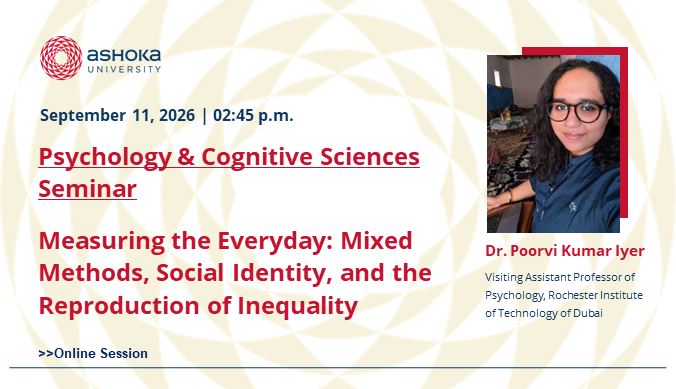
Abstract: This talk traces my journey through psychology and research over the past fifteen years. I begin with what first drew me to the field, then turn to my PhD and its contributions, before mapping the emerging streams of work that now shape my agenda. All of it centres on the study of social identity with the use of both qualitative and quantitative methods. I focus on two of these streams. The first asks how social identity performance contributes to the perpetuation and reproduction of social inequality. The second asks how we operationalise social identity and bring its abstractions into the laboratory, where we can examine behaviour and measure its impact on preferences across a range of domains. Looking ahead, I will set out where these strands are heading – from operationalising identity performance at scale, to the intergenerational transmission of obligation, to how people resist the identities they are expected to perform. Together I aspire to form a coherent body of applied research across South Asia and beyond, and grounded in social psychology while bridging neighbouring disciplines.
About the Speaker: Poorvi Iyer is a Visiting Assistant Professor of Psychology at Rochester Institute of Technology of Dubai. She recently completed a three-year postdoctoral appointment as Research Officer in Experimental Games at the Department of Methodology, LSE, where she also holds a PhD in Social Research Methods. She additionally holds an MSc in Behavioural Economics from Erasmus University Rotterdam. A consistent thread running through her work is the study of social identities, pursued across two streams: the performance of identity under social scrutiny, and the relationship between identity and economic preferences. Her research focuses in particular on the micro-social mechanisms through which caste and gender hierarchies are reproduced in everyday life in India, drawing on the concept of maryada to examine how context, audience, and reputational concerns shape behaviour.