









Event Calendar

SOA Colloquium
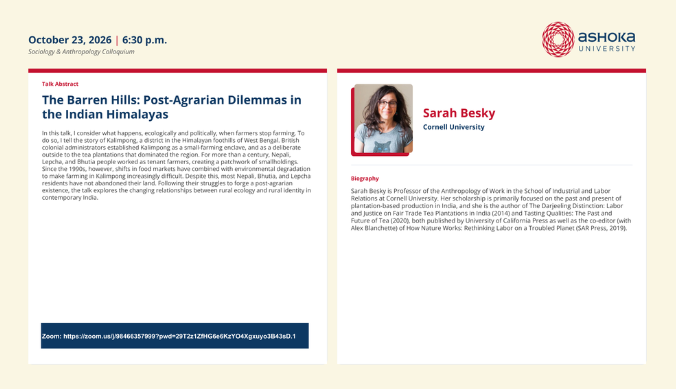
The Barren Hills: Post-Agrarian Dilemmas in the Indian Himalayas
The Barren Hills: Post-Agrarian Dilemmas in the Indian Himalayas
In this talk, I consider what happens, ecologically and politically, when farmers stop farming. To do so, I tell the story of Kalimpong, a district in the Himalayan foothills of West Bengal. British colonial administrators established Kalimpong as a small-farming enclave, and as a deliberate outside to the tea plantations that dominated the region. For more than a century, Nepali, Lepcha, and Bhutia people worked as tenant farmers, creating a patchwork of smallholdings. Since the 1990s, however, shifts in food markets have combined with environmental degradation to make farming in Kalimpong increasingly difficult. Despite this, most Nepali, Bhutia, and Lepcha residents have not abandoned their land. Following their struggles to forge a post-agrarian existence, the talk explores the changing relationships between rural ecology and rural identity in contemporary India.
Sarah Besky is Professor of the Anthropology of Work in the School of Industrial and Labor Relations at Cornell University. Her scholarship is primarily focused on the past and present of plantation-based production in India, and she is the author of The Darjeeling Distinction: Labor and Justice on Fair Trade Tea Plantations in India (2014) and Tasting Qualities: The Past and Future of Tea (2020), both published by University of California Press as well as the co-editor (with Alex Blanchette) of How Nature Works: Rethinking Labor on a Troubled Planet (SAR Press, 2019).