





Fast and Furious: Heuristic Decision Making under Intense Time Pressure
In this article, Supriya Ray, Associate Professor of Psychology and Cognitive Science, at Ashoka University talks about heuristic decision making under time pressure.
 0
0 

Throughout our lives, we frequently encounter situations requiring a choice from multiple alternatives. For instance, a student must carefully determine which course to enrol in within a specific period, just as a job seeker must cautiously select a company before a deadline. These decisions are typically driven by expectation; we gravitate toward the option that appears most rewarding. The student selects a subject that offers better career prospects, while the job seeker chooses a company that offers a higher salary and better perks.
However, some scenarios demand split-second timing. In cricket, a batsman facing a 140 km/h bouncer delivery has less than half a second to choose between hitting a hook shot or ducking down to avoid the ball. Similarly, on the road, when approaching an intersection at a yellow light, a driver must quickly choose whether to slow down to a stop or speed up to cross the intersection.
Imagine a courtroom scenario where both the prosecutor and the defence attorney stack up and submit evidence to the judge. The judge evaluates which stack contains more evidence and decides accordingly.
Neuroscientists have established that in certain areas of our brains, tiny cells called neurons gather information in favour of each option. This causes increase in the electrical activity. When the neurons’ activity arrives at a threshold a decision is made. This can be theorised by a sequential sampling model in decision-making, which states that information from noisy sensory evidence from the environment are accumulated sequentially, at a regular time interval, for alternative options (say, either A or B) to arrive at a decision.
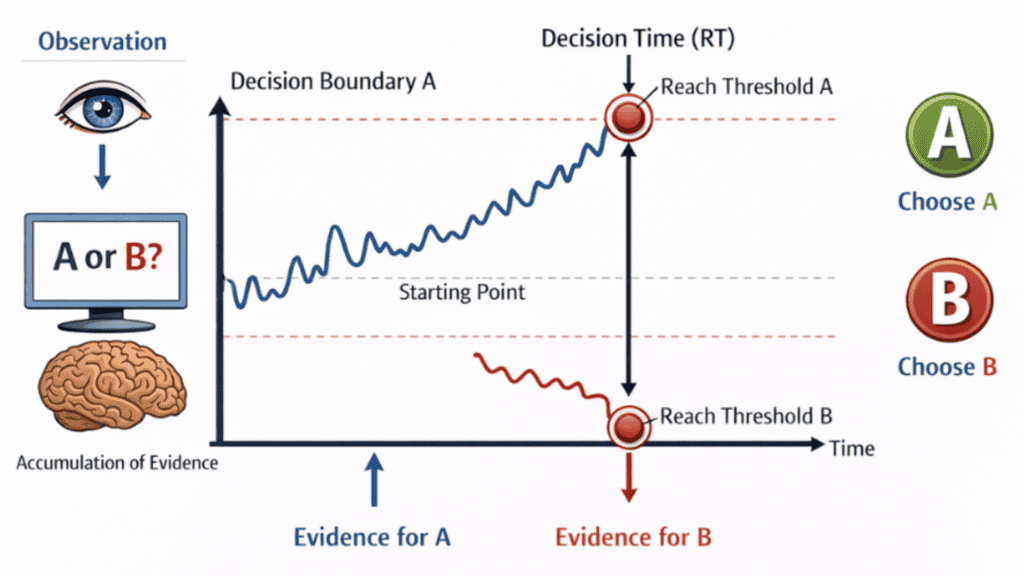
At the heart of the decision making process there is a “Speed-Accuracy Trade-off”. The idea is that the faster we try to make a choice, the more likely we are to make a mistake; on the other hand, if accuracy is emphasized we take longer to arrive at a decision. To make a decision under time pressure, we often rely on mental shortcuts known as “heuristics”. Instead of performing a slow, exhaustive search for the perfect answer, we focus on a small, relevant subset of information to reach a “good enough” conclusion quickly. While these shortcuts are sometimes dismissed as irrational or error-prone, they are actually highly efficient “rules of thumb” that save significant time and effort. In many complex or uncertain environments, using less information can even lead to more accurate results than trying to analyse every single detail—a phenomenon called the “less-is-more effect”.
Cognitive scientists can study these internal processes by monitoring brain waves with tools like electroencephalography (EEG). By observing patterns such as the “central parietal positivity” (CPP), researchers can track how evidence builds up in the brain and identify the exact moment a decision is reached. This allows them to distinguish between a slow, careful accumulation of evidence and a fast, shortcut-based heuristic strategy.
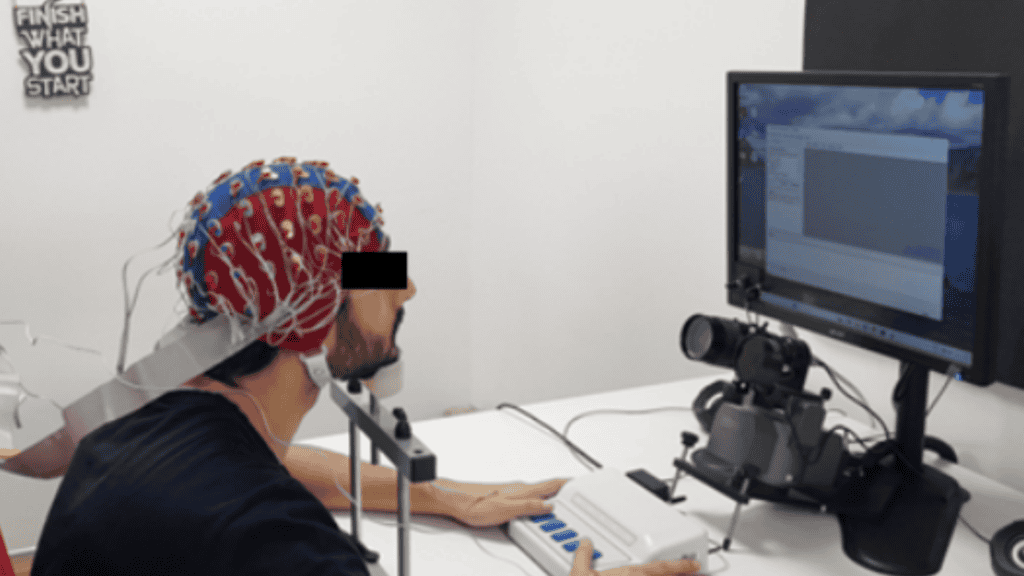
Under my supervision, Neetu Yadav, a Ph.D. scholar is working on heuristic “perceptual” decision-making, which warrants making a choice under intense time pressure based on what we see.
Understanding different categories of the decision making process has broad implications, helping to design better public policies, healthcare solutions, and business strategies.