





Modeling How Mpox Spreads in Low and Middle-Income Countries
Gautam Menon, Professor of Physics and Biology at Ashoka University, talks about his recently published study titled, “Simulating a potential mpox outbreak: Implications for control in non-endemic settings”. The research modelled potential mpox outbreak scenarios using BharatSim, a flexible agent-based simulation framework devised at Ashoka University..
 1
1 

Addressing Public Health Uncertainties
Mpox (formerly monkeypox), a virus related to smallpox, has historically been confined mostly to a few African countries. Since 2022, however, it has spread globally, with the World Health Organization (WHO) declaring it a Public Health Emergency of International Concern twice in 2022 and 2024 following the emergence of a more transmissible strain. Most documented cases worldwide have occurred among men who have sex with men (MSM), transmitted primarily through close sexual contact. Yet public health authorities remain uncertain how the disease might behave if it spreads beyond this network into households, workplaces, and the general population. This is a critical gap for countries like India, where mpox is not yet endemic (widely spread within the population) but where a future outbreak is plausible.
Professor Gautam Menon and Dr. Philip Cherian set out to build a realistic simulation tool that could help policymakers in non-endemic, low-resource countries anticipate how an mpox outbreak might unfold and which control strategies would work best. Rather than relying solely on abstract mathematical models, they wanted to make a tool flexible enough to represent real social structures like sexual networks, households, and workplaces. This would ensure vaccination and containment strategies could be tested in advance, before a large-scale crisis forces difficult decisions under uncertainty.
Modelling Mpox Using BharatSim
The researchers used BharatSim, an agent-based simulation framework built specifically for Indian population dynamics. BharatSim was devised by researchers at Ashoka University, led by Professor Gautam Menon and Professor Debayan Gupta, with the help of ThoughtWorks, a technology consulting company. They constructed a synthetic population of 100,000 individuals, with 1,000 designated as MSM, reflecting real-world estimates of 0.1–0.3% of the population. This MSM subgroup was embedded in a larger network of households (average size 4) and workplaces (average size 50), through which agents cycle in realistic 12-hour blocks.
Sexual contact networks among MSM agents were modeled using a “heavy-tailed” statistical distribution, meaning most individuals have few partners while a small number have many, calibrated to match empirical data from real Indian sexual network studies.
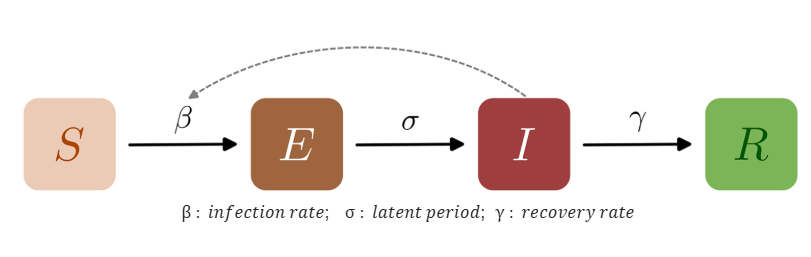
Each agent’s disease progression followed the standard Susceptible, Exposed, Infected, and Recovered (SEIR) framework with parameters (latent period, infectious period and transmission probabilities) drawn from published mpox literature. This framework divides the population into 4 different groups as the name suggests, with individuals moving between the different groups based on their exposure to a virus and their response to it (infected, recovered). The parameters describe the relationship between different SEIR groups. Latent period describing the time interval between virus exposure and infection, leading to an infectious period in which individuals may transmit the disease to others based on a transmission probability and either recover or be removed from the system.
The researchers ran hundreds of simulations, varying key parameters: the strength of household transmission, the probability of transmission per sexual encounter, and the presence or absence of weak workplace transmission. They also tested three vaccination strategies: random vaccination, risk-based vaccination (targeting people with the most sexual contacts), and reactive “ring vaccination” (vaccinating the contacts of newly reported cases).
The Outbreak Pattern
The simulations revealed several important patterns.
First, outbreaks are overwhelmingly driven by spread within the MSM sexual network. When this route was disabled, the disease simply died out, confirming that non-sexual transmission alone cannot sustain an epidemic.
Second, even very limited “leakage” of the virus into households and especially workplaces dramatically worsened outbreaks. A workplace transmission rate as low as 5% of the household rate nearly doubled the epidemic peak and created a long, lingering “tail” of infections that persisted even after the MSM network’s outbreak had subsided.
Regarding vaccination, targeting the highest-risk individuals (those with the most sexual partners) was more efficient than random vaccination when vaccine supply was limited though this approach raises ethical and practical concerns. Identifying “high-risk” individuals in a stigmatized community risks violating privacy and could deter people from seeking care. As an alternative, the study found that “ring vaccination” or reactively vaccinating the contacts of confirmed cases, could match or outperform random vaccination. This was contingent on cases being reported within approximately a week and contact tracing reached at least 40–50% of contacts.
Building a Framework for Pandemic Preparedness
This work offers non-endemic, resource-limited countries a practical, adaptable tool for outbreak preparedness rather than reactive crisis management. The key insight that even weak, “invisible” transmission through everyday household and workplace contact can quietly sustain and prolong an outbreak has direct implications for surveillance policy. Health systems cannot treat mpox as purely confined to one community, and must maintain long-term monitoring even after apparent containment. The finding that reactive ring vaccination can rival pre-emptive risk-based targeting is particularly valuable for lower and middle-income countries (LMICs), where stigma and privacy concerns often make identifying high-risk individuals both difficult and ethically fraught. More broadly, by making their code and synthetic population data openly available, Professor Menon and Dr. Cherian provide a template other countries can adapt to their own demographic and network data, strengthening pandemic preparedness for mpox and potentially other sexually- and socially-networked infectious diseases worldwide.
Edited by Simran Wadan for the Research and Development Office.
This blog has been adapted from the original research article,
Cherian P, Menon GI, PLOS Global Public Health 6(6): e0006630 (2026), available here: https://doi.org/10.1371/journal.pgph.0006630