








In Conversation with Prasenjeet Yadav, a Molecular Biologist Turned National Geographic Photographer and Storyteller, on His Journey, Storytelling, and Science Communication
Catch Prasenjeet Yadav in conversation with the Research and Development Office, sharing his journey, his take on science communication, his approach to storytelling, and how he communicates complex narratives to the larger public to drive change.
 3
3

Ashoka Global Research Alliances, Ashoka University hosted 𝐏𝐫𝐚𝐬𝐞𝐧𝐣𝐞𝐞𝐭 𝐘𝐚𝐝𝐚𝐯, a molecular biologist turned 𝐍𝐚𝐭𝐢𝐨𝐧𝐚𝐥 𝐆𝐞𝐨𝐠𝐫𝐚𝐩𝐡𝐢𝐜 𝐩𝐡𝐨𝐭𝐨𝐠𝐫𝐚𝐩𝐡𝐞𝐫, Storyteller and 𝐄𝐱𝐩𝐥𝐨𝐫𝐞𝐫, for his talk on 𝐒𝐭𝐨𝐫𝐲𝐭𝐞𝐥𝐥𝐢𝐧𝐠 𝐨𝐟 𝐒𝐜𝐢𝐞𝐧𝐜𝐞 𝐚𝐧𝐝 𝐄𝐜𝐨𝐥𝐨𝐠𝐲: 𝐒𝐞𝐞𝐢𝐧𝐠, 𝐃𝐨𝐜𝐮𝐦𝐞𝐧𝐭𝐢𝐧𝐠, 𝐚𝐧𝐝 𝐌𝐚𝐤𝐢𝐧𝐠 𝐏𝐞𝐨𝐩𝐥𝐞 𝐂𝐚𝐫𝐞. The immersive talk offered great insights into Prasenjit’s career journey, his approach to storytelling as a means of driving meaningful and positive social impact, and the challenges he faced along the way.
Prasenjeet’s story and photograph of Similipal’s rare black tiger grace the October 2025 cover of National Geographic, making it the first Indian story, written and photographed by an Indian, to be featured on the cover. He has also won the 𝐍𝐚𝐭𝐢𝐨𝐧𝐚𝐥 𝐆𝐞𝐨𝐠𝐫𝐚𝐩𝐡𝐢𝐜 𝐏𝐡𝐨𝐭𝐨𝐠𝐫𝐚𝐩𝐡𝐞𝐫’𝐬 𝐏𝐡𝐨𝐭𝐨𝐠𝐫𝐚𝐩𝐡𝐞𝐫 𝐀𝐰𝐚𝐫𝐝 in 2025. The Research and Development Office had the pleasure of conversing with him about the nitty-gritties of science communication, communicating complex and challenging stories to the public, involving them in the narrative, and driving the change.
You started your journey as a molecular biologist before transitioning into becoming a photographer and storyteller. Walk us through that shift.
To study molecular biology, I went to NCBS, where I was fortunate to have amazing mentors who have achieved remarkable things at national and global levels. Learning from them has transformed me into a better human being, and I’m so glad about it. But more importantly, what I’ve taken from academia and science is that I tell my stories in a similar way to how scientific research is done.
The scientists design a hypothesis around their research topic, while I have a story idea and a version of what that story would be. They collect data, and I go into the field to photograph. When they come back, they analyse their data, and I do post-production, pulling all those threads together. Scientists, based on their data, prove their hypothesis true or not. Similarly, I go in with my version of the story, and often I come out with a different one based on what I’ve seen and experienced. They write papers; I write stories. This is something I’ve borrowed from science and am applying to my storytelling.
Science’s language, complexity and perceived difficulty can often feel intimidating, making those outside the field hesitant to engage with it. Being a student of science and now a storyteller, how do you suggest making science approachable and welcoming to general audiences?
The language of science is technical and subject-specific, and it has to be that way. For example, I have studied molecular biology, ecology and for me it will take a while to make sense of a physics paper. We cannot expect general people to understand it because it is meant to be understood by your colleagues in science. But, at the same time, it is our responsibility as a researcher, as a communicator, to make it more accessible to the general public for multiple reasons. One being restoring people’s faith in science by communicating it better.
We want people to be able to differentiate between science and magic. We want people to understand that just because this is scientifically proven, it doesn’t mean that it’s the ultimate truth. For that, we have to simplify not just the language of science, we have to communicate it.
Scientists mainly work with their peers and are used to the language, terms, and jargon of their field. It’s difficult for them, as professionals, to take additional time to simplify and communicate their work to the public. We’re expecting way too much from academics and scientists. Collaboration should be the answer.
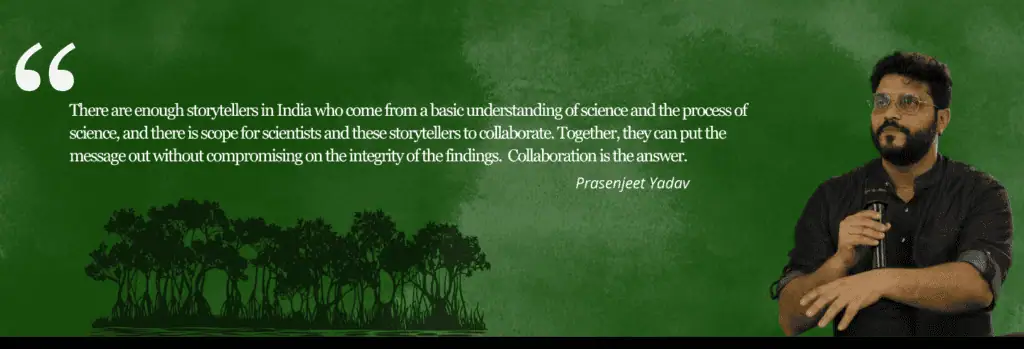
There are enough storytellers in India who come from a basic understanding of science and the process of science, and there is scope for scientists and these storytellers to collaborate. Together, they can put the message out for the larger public effectively, without compromising on the integrity of the findings. My message to scientists is that next time you are writing a grant, put a budget for storytelling in it and then collaborate.
In your view, can intentional, well-crafted science communication serve as a bridge between knowledge generation and its communication?
When we talk about science communication, the majority of people talk about the news that comes out of science. But that’s only one part of it; there’s much more to it than that. Science communication is when you break that research down and help people understand what it means. At the end of the day, we’re doing it for the people. For example, government institutes are publicly funded, and the research they support is indirectly paid for by the people. This makes science communication not just a hobby but a responsibility. People rarely see or understand the process behind how science actually happens, and a good science story highlights the process behind the conclusion. When you do that, people connect with and understand science in a more nuanced way, and not just as passive receivers.
In the present age of social media, where stories have been reduced to 15 seconds, how do you navigate the pressure of telling longer stories when people have shorter attention spans?
As storytellers, we need to understand the power of disruption and use it wisely. I don’t see those 15 seconds as a story but as a hook. Out of those million people, there would be a hundred or a thousand who would get hooked by those 15 seconds and would want to access a slightly longer version. Do we always need a Black Tiger to engage people with a story? Well, the idea is to keep trying to learn how I can tell stories that are more interesting and relevant. It’s worth the effort, and the challenge is something I really enjoy. There are times when the Black Tiger comes to the rescue, but most of the time it doesn’t, and that’s fine. Many times, the hook is the storyteller. So, when I don’t know how to tell a story, and I’m frustrated, that becomes the beginning of many stories until you actually come across the solution.
Is there a set framework you follow to tell your stories?
I don’t have a set method; it’s different for every story. If it had to follow a singular method every time, it would get monotonous. I am still excited about 50 more stories to be told because with each story, I am learning along the way how to tell it. Every story is so different, whether you’re focusing on telling a story at a microbe level or at an ecosystem level. It is similar to how every science research paper brings a completely different challenge, and you have to come up with a different method and approach. How I approach every story is by keeping these few things in mind: Is it making me curious and excited? Is it triggering my curiosity? Are there emotions involved, and can I connect with people emotionally? Why is it relevant, and how?
The Black Tiger picture, which became the cover story for National Geographic Magazine, came after 120 days in the field. What motivated you to keep going for 120 days? That’s a long time to be out there. What is your secret? What makes you keep going?
120 days was just for that one picture; 2 years in the field for that story. I started my fieldwork in October 2023 and finished in April 2025. I really enjoy being in the field. I grew up in the field and feel at home there. I’ve been one of those lucky, blessed people to have the responsibility to tell stories that most people do not get access to, and I feel a sense of responsibility in that regard. The fear of not messing up the story is what keeps me going.
Of course, there are days when I’m low, and I question everything I am doing. But then the next day, something interesting shows up in front of you, and you get back to it. You get tired, but then you get excited about life once again. It doesn’t matter what happens, good or bad; all we have to do is show up.
– Edited by Priyanka, Research and Development Office




Study at Ashoka
