





Reflect, Reexamine, Reimagine, Reconstruct
Chief Guest, Professor Shailaja Paik, at the 15th Convocation Ceremony of the Young India Fellowship, Ashoka University.
 1
1

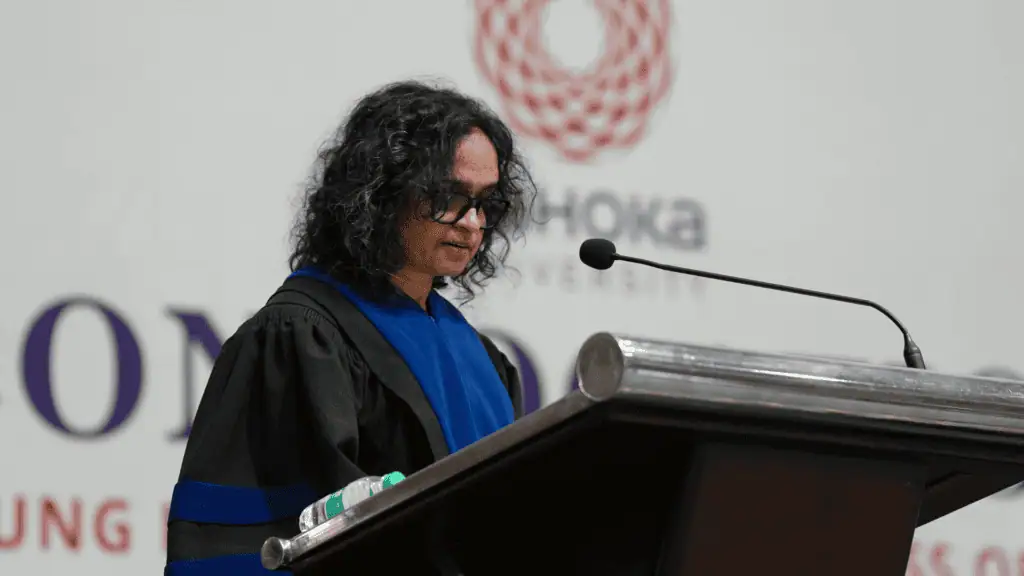
The Chief Guest at the 15th Convocation Ceremony of the Young India Fellowship was Professor Shailaja Paik. Professor Paik is a distinguished scholar of history who has done groundbreaking work on caste, gender, and structural inequality. Dalit Women’s Education in Modern India: Double Discrimination (Routledge, 2014) and The Vulgarity of Caste: Dalits, Sexuality, and Humanity in Modern India (Stanford University Press, 2022) are amongst some of the most pioneering works that examine the nexus between caste, class, gender, and state pedagogical practices among Dalit women in urban India. Her scholarship has been recognised by some of the leading grant-making foundations of the world like the MacArthur Foundation, the National Endowment for the Humanities, the American Institute of Indian Studies, the Ford Foundation, the American Council of Learned Societies, the National Humanities Center, and the Stanford Humanities Center. In 2024 she was named a MacArthur Fellow — widely regarded as one of the most prestigious honours for intellectual and creative achievement in the world.
On 27th June, as Professor Paik addressed the graduating class and other special guests in attendance, her words underlined the experiences and learnings that have shaped her work and her life beyond all her achievements and scholarly accolades. Through four important tenets, her speech urged the graduates to embrace a more humane approach in their endeavours, reflect on their shared histories with honesty and most importantly intervene with intent and courage.
We now share Professor Paik’s remarks as delivered during the session.
“I am absolutely thrilled to be here at Ashoka. Thanks very much, honorable Chancellor Rudrangshu Mukherjee, Vice Chancellor Somak Raychaudhary, Pramath Sinha Chairperson of the Board of Trustees and the Founding Dean of YIF, and Karan Bhola, Senior Director YIF for inviting me and thanks everyone graduates, parents, family members, faculty, and staff for joining us. Most importantly congratulations to the Young India Fellows for working hard, graduating, completing a fantastic journey! You did it, as everyone is saying to you! I am very happy that parents, friends, cousins, uncles, aunts who have supported you over this long year are here again to celebrate these young graduates. I was not able to participate in my convocation ceremonies in India or the UK. So, dear graduates, I am very happy to participate in your graduation celebration. It is an immense pleasure to deliver the convocation address to the 2026 class of YIF. When I was at Yale long years ago, I met Pramath who was touring the US learning about the curriculum and discussing his ideas for Ashoka. I was very intrigued by the idea of shaping a liberal arts education program of international standards in India—so here we come a full circle.
We certainly have left you a perfect world, haven’t we? What a world we are living in today! What a turbulent time! These are difficult but also defining times. We are witnessing wars, ecological crises, democratic fragility, growing inequalities, violence, displacement, polarization, and the rapid erosion of trust in institutions that once appeared stable. Many of our social, economic, political, and ideological systems seem increasingly fragile, and in many cases, incapable of addressing the anxieties and aspirations especially of the youth.
And therefore, this is not a time for indifference.
How can you YIFs, liberal arts graduates who have worked on a million group projects, presentations, field visits, filmmaking exercises and exhibitions, and other assignments engage with the outside world? To engage meaningfully with the present and to shape the future responsibly, you—YIF fellows—must remember the 4Rs—not the 3 like in the movie RRR. This is my movie you can script your movie. The four Rs you must remember–Reflect, Reexamine, Reimagine, Reconstruct. You must ask difficult and different questions: Why have our systems become so fragile? How does power operate within society? Who benefits from existing structures, and who continues to be excluded, silenced, or left behind? What kinds of futures are being imagined for us, and what kinds of futures do we ourselves want to build? How can you, as YIF fellows, drive social and economic change? What can you do—through your work, your scholarship, your institutions, your creativity, and your civic participation—to make the world safer, freer, more equal, and more livable?
Your responsibility is not simply to inherit the world as it exists, but to intervene in it thoughtfully, ethically, and courageously. Your disciplinary background and your YIF training oblige you to identify the mechanisms of our social, political, ideological systems—to understand how they produce inequality, fear, exclusion, violence, but also how they can be remade—this is how you can elevate your social analysis. Your training has equipped you not only with skills, but with intellectual depth, ethical responsibility, and the ability to think across boundaries and disciplines. Through innovation, creativity, public engagement, and moral courage, you now have the opportunity—and the obligation—to make a lasting contribution locally and globally.
Today, I want to share with you FOUR REFLECTIONS that have deeply shaped me, and which I, in turn, have had to shape within myself in order to become who I am today: through challenges, failures, hard work, tenacity, rigor, loss, uncertainty, and constant becoming. Drawing from my experiences as a teacher, mother, daughter, spouse, friend,historian, and a MacArthur Fellow, I want to share some habits, convictions, and ways of thinking that have helped me navigate obstacles, adapt to change, and continue moving forward even in moments of fear, exhaustion, and doubt. I offer these reflections as practices of endurance, courage, discipline, and hope.
FIRST REFLECTION
- Invest in people
You matter, people around you, relationships matter. We are living in a moment where everybody is encouraged to focus on the individual self—your personal brand, your personal success, your personal achievement, your personal visibility on social media and elsewhere. But your experiences and the liberal arts training here at Ashoka, and especially within the YIF program, have asked something different of you.During your program, you drew upon diverse fields of knowledge. You worked with fellows from STEM, the arts, humanities, and social sciences. In the 304 YIF main classroom and outside, you interacted with peers from different disciplines, while enjoying many mango shakes at Fuel Zone, late-night Maggi from KitKat, thaali at the Dhaba, Bun Omelettes at Chai 24. You worked on practical, grounded projects and engaged with people from different states, languages, social locations, economic backgrounds, cultures, and political experiences. This is central to a liberal arts education. The liberal arts are ultimately about understanding society: how it functions, how power operates within it, how inequalities persist, and how human beings can imagine more ethical ways of living together.And therefore, wherever life takes you—whether toward buildings, forests, water management, public policy, education, research, business, art, or technology—it is important that you center people: the people whose lives should improve because of your work. Not abstractions. Not institutions. People.
You can change the lives of many people through what you build, what you write,
what you research, and what you refuse to ignore. You will encounter difficult questions—of caste, gender, sexuality, labor, violence, exclusion, and belonging—and you must not turn away from them because they will be uncomfortable, politically inconvenient, or socially unpopular. Your liberal arts training has given you the intellectual tools to better understand how these structures evolved historically, how power reproduces itself socially and institutionally, and why inequality continues to persist even within democratic societies.
Use that training.
Ask difficult questions. Read deeply. Listen seriously to people whose experiences are different from your own. Understand how privilege operates, how marginalization works, and how silence itself can become a form of complicity. I know it is tough, right, but avoid AI shortcuts.
But understanding alone is not enough. You must also intervene.
Intervene through your scholarship, institutions, your art, your policies, your classrooms, your technologies, your businesses, your solidarities, and your everyday choices. Do not shy away from difficult social problems simply because they are complex or emotionally demanding or they may take a lot of your time. The purpose of education is not to protect you from the world. It is to prepare you to engage with it critically, ethically, and courageously. These questions have shaped the evolution of our society and continue to define who enjoys dignity, safety, opportunity, and voice. Your responsibility is not merely to succeed within society as it exists, but to ask how society itself can be improved, can be changed so we can shape our presents and futures. And YOU can change the narrative. And to do that, you must remember something very simple but very profound: We are each other’s business and bond.
SECOND REFLECTION
- Focus, effort, consistency
If you have a passion, that is wonderful. But passion or no passion—just work hard and be consistent. Make the effort. Every time you encounter an opportunity, throw your hat in the ring, chase after it regardless of the outcome. Sometimes you may feel it is beyond your worth, beyond your preparation, beyond your expertise. You may look around and be intimidated by intense competition, polished résumés, supreme confidence, power and privilege, networks that you may not possess. Still, make the effort. Stay focused. Stay consistent. Consistency is the key goal. Long years ago, I took an academic career to support my family. Later, when I encountered a unique fellowship opportunity, I threw myself into research completely. I gave it my heart, soul, labor, and my entire being and becoming. I learned, practiced, made mistakes, failed, started over again, and just kept plugging away through long years. That is what serious, real intellectual work often looks like. Not perfection. Not certainty. But lots of reading, thinking, organizing thoughts, organizing ideas and writing, repeating, disciplining, self-doubting, recovering, enduring, and revising. I did not pursue awards, money, or fame. I believed in myself, my work, in my research, and in my moral and social responsibility as a historian. That conviction kept me going during difficult moments when recognition was absent, when exhaustion was real, and when outcomes were uncertain. The awards came later. Fame came later. Those things cannot sustain you if the work itself does not matter to you.Bureaucratic hurdles tried to block my path, but I pursued my goals and persevered. It is important to know what deserves your focus and, equally important, to keep the poison out. By that I mean: be judicious about where you spend your energy. Not every argument deserves your attention. Not every distraction deserves your response. Not every space deserves your presence. Protect your mind, your time, your ethics, and your clarity of purpose. You will feel fearful, helpless, and overwhelmed at times. And it is okay. That is not failure—that is the test. Those are the moments when you must hang in there until things become clearer and you begin to see the light again. And once you see it, once conviction returns, it becomes very difficult for the world to stop you. You have already undergone intense intellectual and emotional training here, but learning does not end with graduation. This is merely the beginning! You must continue to practice consistency in the ordinary routines of life. If you exercise, exercise regularly—even for half an hour every day. It will change how you move through the world. If you are a writer, write regularly. If you paint or draw, keep at it. Some pages will disappoint you. Some paintings will fail. Some ideas will collapse. Some work will not become what you hoped it would become. But that too is part of the journey.
You learn, unlearn, and relearn to weather storms. Work hard at everything you do. Put your heart and soul into the efforts you make, and then let the work go without constantly measuring your worth through visibility or outcomes alone. And while you strive, remember this too: rest and restoration are necessary. Burnout is not a badge of honor. Wear the healthiest armor you can—emotionally, intellectually, physically—and stay strong.
THIRD REFLECTION
- Take risks. Be brave.
There are so many of you here, and each of you has arrived through a very different educational and social journey. Some of you studied in vernacular-medium schools, some in English-medium institutions, some in private convents, some in government schools. Some of you came from cities with access and resources; others came from places where educational opportunities were limited and unevenly distributed. Some of you are first-generation learners. Some of you belong to underprivileged or historically marginalized communities. Some of you have struggled against difficulties of language, region, caste, class, culture, accent, food, clothes, confidence, and belonging. Some of you have had to constantly prove that you deserve to occupy the spaces you are now entering. And here you are. You took the risk and you succeeded.
You have already demonstrated bravery and daring simply by making it here. At the same time, some of you have also moved through life with forms of privilege that protected you from certain realities. And that too must be reflected upon honestly. As you move ahead in life, it is important to understand how you arrived here and what structures enabled your journey.
It matters where we begin.
It matters what we inherit.
It matters what burdens we carry, and which burdens we are spared.
What role did your parents, grandparents, teachers, siblings, and other significant people play in shaping your education and your life journey? What forms of financial, emotional, social, or cultural support made things easier for you? And who, in contrast, did not have those forms of support? Reflect on these questions seriously, because they help us understand not only ourselves, but also society. The present and future you aim to build depends on your actions.
Why is it that some people enjoy the rights to a good life while others are systematically deprived of them? Why do some inherit confidence while others inherit fear? Why are dignity, equality, safety, and opportunity distributed so unevenly? These are not abstract philosophical questions. They shape everyday life in profound ways. We are all human beings, and none of us can fully enjoy the right to life unless all of us have equal rights to live—the right to resources, equality, dignity, liberty, and justice. It is a very popular statement and I repeat–None of us is truly free unless all of us are free.
And therefore, when you step out into the world with your degree, your training, and your convictions, I hope you will work toward change—not only personal advancement, but collective transformation. That will require much daring, bravery, and risk-taking. You will have to continue plugging away at what you believe in, even when the world becomes cynical or hostile. You will have to make important choices and stand by them. You must be able to look at yourself in the mirror and feel proud not only of your successes, but of your principles. There will be moments when you will be tempted to stay silent because you do not want to antagonize people, institutions, friends, or power itself. But those are precisely the moments that define who you are and what you are.
Those are the moments when you must ask yourself:
What do I stand for?
What are my principles?
What is my social and moral responsibility?
What is the change I want to bring about in the world?
You must take risks and accept responsibilities.
Because complicity has consequences too.
You must take the right side of history, of politics, of humanity.
And yes, sometimes this will mean burning bridges. Sometimes it will mean disappointing people or making enemies. But it will also lead you toward people of courage, generosity, and integrity—people who will stand by you, challenge you, nourish you, and believe in you. Hold on to those people. Invest in those friendships and solidarities. They will carry you through life. And always remain open—to new ideas, new people, new ways of thinking, and to life itself.
FOURTH REFLECTION
- Being and becoming.
Being and becoming are important.
Too often, we are taught only how to achieve, accumulate, compete, and perform. But life is not simply about becoming successful; it is also about becoming human—more thoughtful, more ethical, more generous, more compassionate, more alive to the world around us. Also know that being human is also different to people from a varied range of social and economic backgrounds. Pay attention to these details.
Today, the world is in shambles in many ways. We are witnessing wars, displacement, ecological destruction, democratic fragility, deepening inequalities, hatred, violence, and fear. In such a world, you—YIF fellows—have a major role to play. The question is not only: What career will you build? The deeper question is: What will you give? What can you give to make the world a better place? Because you have a great deal to give: your time, your honesty, your bravery, your friendship, your daring, tenacity, rigor, your intellectual training, your labor, your compassion, your love. What can you give—locally and globally—to make life more livable, more dignified, and more beautiful for many people? Do not allow the world to reduce your life merely to productivity, achievement, or professional identity. Life is bigger than your degree. I graduated with my Masters in India, Ph.D. in the UK and then moved on to opportunities in the US. Questions of visa always loomed large, and it was frustrating. During my initial years at my current institution, one of my colleagues asked me, “what are you going to do and with such hassles, how will you continue to work if you can’t stay in the US.” I paused, reflected, looked into her eyes and I responded, “I have been through many hardships in my life, and this is just a work visa. This is nothing. My life is larger than your tenure system, larger than the H1B visa and the green card.” My colleague was shocked at my answer. But I was clear of my path forward. If things did not work out in the US, I was happy to pack my bags and go to any place that respected me and my research. So, know your priorities. Bigger than the anxiety of figuring out your future. Bigger than jobs, salaries, fellowships, publications, awards, or administrative titles. Bigger even than the books and articles you may one day write.
Do meaningful work. Work hard. Dream ambitiously. But do not forget to live. Enjoy life. Live life fully. Love life—your own life and the lives of others too. Build friendships. Fall in love. Read. Draw. Paint. Dance. Cook for your friends, your people. Travel. Sit quietly sometimes. Mark my words—it helps! Watch the leaves, trees, fruits and flowers. Watch the sky and clouds like you watched the Sonepat skies at sunset. Walk the dog. Feed the dog and the cat. Listen to music. Stay curious about the world and humble before it. Protect your sense of wonder because the world will constantly try to take it away from you. And through all of this, continue becoming.
Becoming more courageous.
More rigorous.
More compassionate.
More intellectually honest.
More open to change.
More committed to justice.
More fully human.
That, ultimately, is the work of a lifetime. Congratulations, again graduates!
Thanks very much, again for having me here!