





Reimagining Healthcare in the Age of AI
AI is fundamentally reshaping how we approach interdisciplinary research by dissolving demarcated areas (sort of silos) and enabling new connections between diverse areas.
 1
1

Artificial intelligence is transforming the way we diagnose disease, design therapies, and understand human health. But as AI systems grow more powerful, so too must our commitment to ethical stewardship, interdisciplinary thinking, and scientific rigour.
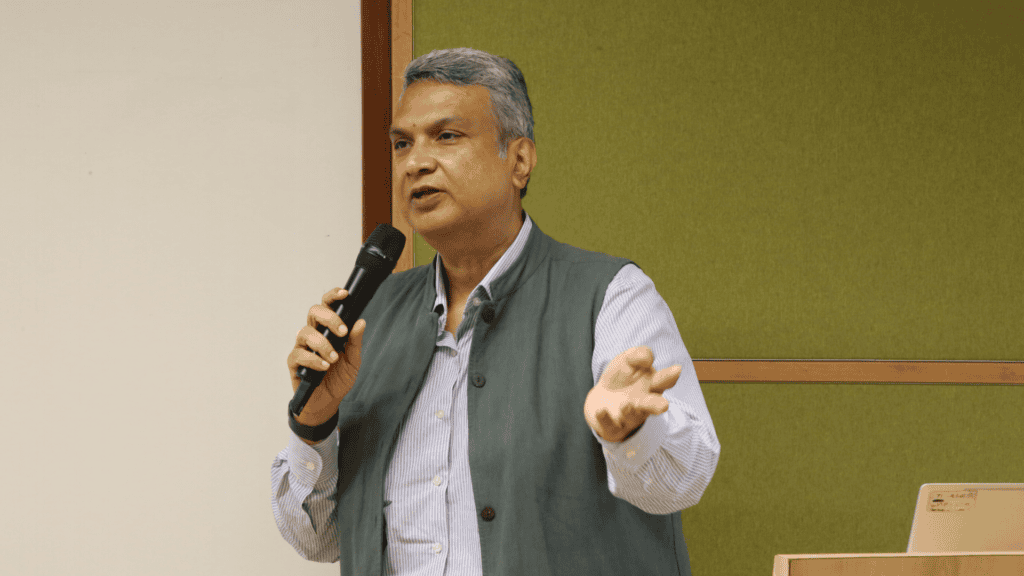
In this conversation, Professor Anurag Agrawal, Head of Koita Centre for Digital Health and Dean, BioSciences and Health Research at Trivedi School of Biosciences, Ashoka University, reflects on how universities can shape responsible AI, accelerate discovery across disciplines, and prepare the next generation of researchers to combine technological fluency with critical judgement.
What role can a liberal arts and sciences university like Ashoka play in shaping responsible AI in research and learning?
Ashoka is uniquely positioned to shape the ethical and responsible use of AI because it brings together social scientists, humanists, technical experts, and policy experts within a single academic ecosystem.
Ashoka’s interdisciplinary centres like the Koita Centre for Digital Health (KCDH-A), the Centre for Data, Learning and Decision Sciences (CDLDS), the Centre for Social and Behaviour Change (CSBC), and ICPP, enable AI to be examined not only as a technical tool, but as a social, ethical, and governance challenge. For example, AI in healthcare is supported by inputs from computer scientists, public health experts, social scientists and educationists to ensure transparency, fairness, and accountability.
Secondly, Ashoka can institutionalize responsible AI through structured dialogues and capacity building.
Initiatives such as webinar series on responsible AI, workshops on algorithmic bias, and stakeholder consultations that connect scientists with humanities scholars and science policy practitioners.
Third, KCDH-A’s engagement with WHO collaborations and global health diplomacy partners positions it to align AI research with international norms and public-interest frameworks. By integrating global principles with local deployment realities, the University can help shape AI systems. Moreover Ashoka can serve as a neutral and interdisciplinary space where AI is developed.
How is AI transforming interdisciplinary research, and where can it most meaningfully accelerate discovery?
AI is fundamentally reshaping how we approach interdisciplinary research by dissolving demarcated areas (sort of silos) and enabling new connections between diverse areas. In fields like health and the environment, AI acts less as a tool and more as an “integrative catalyst”. It allows us to see patterns across scales of data, connect genotype to phenotype, link climate signatures to health and wellness outcomes etc.
In health sciences as we move from population averages to individualised molecular landscapes, AI accelerates discovery by learning from complex multi-omics data, imaging, clinical records and wearable data to forecast patterns that inform diagnosis, prognosis, and therapy. Where AI’s potential is greatest is at the intersections, not just within STEM, but between science, society, and values.
Is AI changing how research is conducted?
AI is a catalyst that accelerates hypothesis generation and compresses the journey towards an output, especially manuscripts. However, just like a catalyst, it doesn’t change the final reaction product of new knowledge.
Quality research will remain governed by domain expertise, evidence, rigor, and reproducibility. The responsibility for judgment, validation, and ethical stewardship still rests with human scientists.
“Judgement is what allows us to decide which questions are worth asking, which outputs are trustworthy, and which decisions are ethically defensible.“
How can institutions such as Ashoka train students and young researchers not just to use AI tools, but to critically evaluate and question them?
Students and young researchers must learn to be the best versions of themselves, with and without AI tools. Their education must thus be interdisciplinary, with emphasis on critical thinking rather than reproduction of knowledge.
For example, students developing AI models in health, climate, economics, or social systems must simultaneously engage with science and public policy. They must understand responsible AI principles and understand the purpose, limitations, and impact of models. Another essential feature is an internship.
By working with hospitals, public health agencies, startups, policy think tanks, or international organizations, students learn about the actual problem needing solutions and gain real-world context for any proposed AI deployment.
Further, real-world exposure teaches them that deployment, governance, and accountability are all equally important. Finally, universities must cultivate an ecosystem of intellectual freedom where students are encouraged to question prevailing narratives and propose alternative solutions.
As AI advances, which human capabilities will become even more essential in science and leadership?
Judgement. AI can process vast datasets, detect patterns, and optimise predictions at a scale no human can match. But it does not understand context or consequences.