





“Remain Curious, Embrace Causes, and Remember to Laugh”: Nobel Laureate Sir Paul Nurse Addresses Ashoka’s Graduating Students
Nobel Laureate Sir Paul Nurse delivered an inspiring keynote address, celebrating the graduates’ hard work and encouraging them to embrace curiosity, passion, and humour.
 2
2

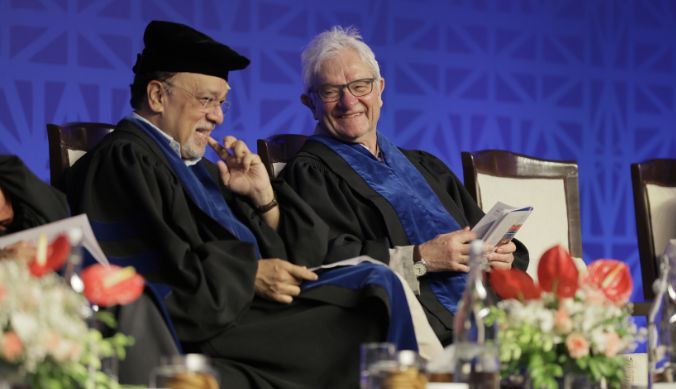
At Ashoka University’s 2025 Convocation Ceremony, Chief Guest Sir Paul Nurse, Director of the Francis Crick Institute, Chancellor of the University of Bristol, and recipient of the 2001 Nobel Prize in Physiology or Medicine, delivered a memorable keynote address. Speaking to the graduating students, he reflected on the significance of their achievements and offered valuable advice to guide them as they step into the next phase of their lives.
Sir Paul Nurse began his speech by saying, “Graduation ceremonies mark one of the most significant moments in the life of a university – a celebration of the students’ hard-earned achievements.” Acknowledging the dedication and hard work of the graduating students, he continued, “It takes a lot of work to do well studying for a degree. You should be proud of yourselves. You will have worked hard for this day. And from this day on and for the rest of your lives, you will be graduates of this university.”
He reminded the students that such milestones are rarely achieved alone. He specifically acknowledged all those who played a key role in helping the students reach this day, parents, relatives, friends, supporters, professors, and the staff who keep the university running. “They are also proud of what you have achieved. You should thank them for that,” he urged. He continued, “They have all contributed in their own different ways to you being here today, and we are all proud of your achievements and of who you have become during your time here,” adding, “You will be part of this university for the rest of your life.”
Touching on the bittersweet nature of farewells, Sir Paul Nurse acknowledged the emotional transitions ahead. “It may be a poignant time for some of you, leaving behind friends and colleagues. It’s a time of change, a time of transition, perhaps of nostalgia, even some sadness. But you are about to embark on a new phase of your life, one that will be exciting and full of possibilities. And wherever you go, whatever you do, remember what you have learned here. You will have been taught how to think, how to think critically, to value freedom of expression, and to challenge ideas and opinions.”
At the heart of his address was a powerful reflection on the purpose of education. Quoting Robert Hutchins of the University of Chicago, he said, “Education is not to reform students or to amuse them or even to make them expert technicians. It is to inflame their intellect, to teach them to think.” He continued, “You will have learned from your studies the importance of accuracy, honesty, and consistency in your work—the need to pursue truth wherever it may lead, however uncomfortable that may sometimes be. And that has never been more important than now.”
He further urged the graduates to appreciate the importance of thinking differently and being skeptical, especially of their own ideas and opinions. “Openness, permeability, tolerance, education, and the generation of knowledge are all crucial for an effective and productive society, and are increasingly needed to guide us through our uncertain times,” he said, referencing his experiences in war-torn Ukraine, where he witnessed firsthand the destruction of schools, buildings reduced to rubble, shattered classrooms and computers mixed with children’s desks and artwork.
In closing, Sir Paul Nurse addressed the challenging task of offering advice, humorously invoking Irish author and poet Oscar Wilde’s thought about advice, “The only thing to do with good advice is pass it on. It’s never of any use to oneself.”
His message was simple yet profound. He offered three key pieces of advice to the graduating students, beginning with, “Firstly, I recommend that you keep your curiosity. Curiosity is a feature of youth, but it can diminish as you get older. Resist this. Remain curious. The world is a wonderful place. It is endlessly interesting. It will enchant you all your life should you remain interested in it.”
Secondly, he called on the graduates to be enthusiasts, embrace causes, and pursue their interests. “Care about the world. Care about the people in it. When necessary, be passionate about these things. Keep a sense of urgency. Do not let grass grow under your feet,” he urged.
Thirdly, he encouraged the students to keep a sense of humour. He said, “There is a danger, while you’re busy being intensely curious, enthusiastic, and passionate, that you might begin to take yourself perhaps a little too seriously. The best way to counter the risk of pomposity is to remember to laugh, especially at yourself. And one of the best antidotes to the downs in life, and I’m afraid you will have downs, is humour. ‘A day without laughter is a day wasted.’”
Injecting a touch of humour and lightness, he concluded his speech with a quote from British scientist Max Perutz: “Never follow the advice of your elders.” To the graduating class, Sir Paul Nurse said, “This is your day. Congratulations on what you have achieved. Good luck in your futures, and thank you for listening.”