





‘Sky Was Never the Limit’: Group Captain and Gaganyatri Shubhanshu Shukla to Ashoka’s Graduating Students
Shubhanshu Shukla, the chief guest for the 2026 Convocation Ceremony, delivered an inspiring keynote address, urging graduating students to embrace uncertainty, stay curious, dream bigger, and never stop moving forward.
 1
1

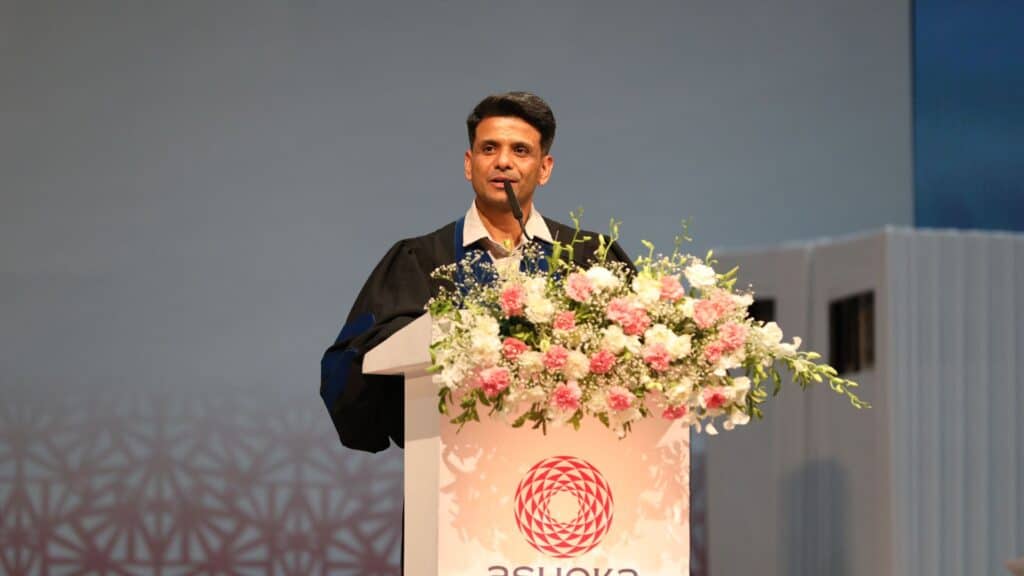
Group captain in the Indian Air Force (IAF) and Gaganyatri Shubhanshu Shukla, the chief guest for Ashoka University’s 2026 Convocation Ceremony, delivered a deeply personal and inspiring keynote address, urging graduating students to embrace uncertainty, stay curious, dream bigger, and never stop moving forward despite fear and self-doubt.
Beginning his address on a light note, Shukla spoke about this being the first-ever Convocation ceremony where he wore a graduation robe. ‘It had to happen at Ashoka University,’ he remarked.
He then introduced the audience to his philosophy of ‘Type A fun’ and ‘Type B fun’. While Type A fun is enjoyable both in the moment and in memory, Type B fun, he explained, only becomes meaningful in retrospect. ‘Life, as you graduate and move out is going to be both Type A and Type B, and you have to be okay with that,’ he told the graduating students. ‘You have to have the resilience to move through both and keep going. Eventually, it turns out life is mostly Type A if you choose to accept it.’
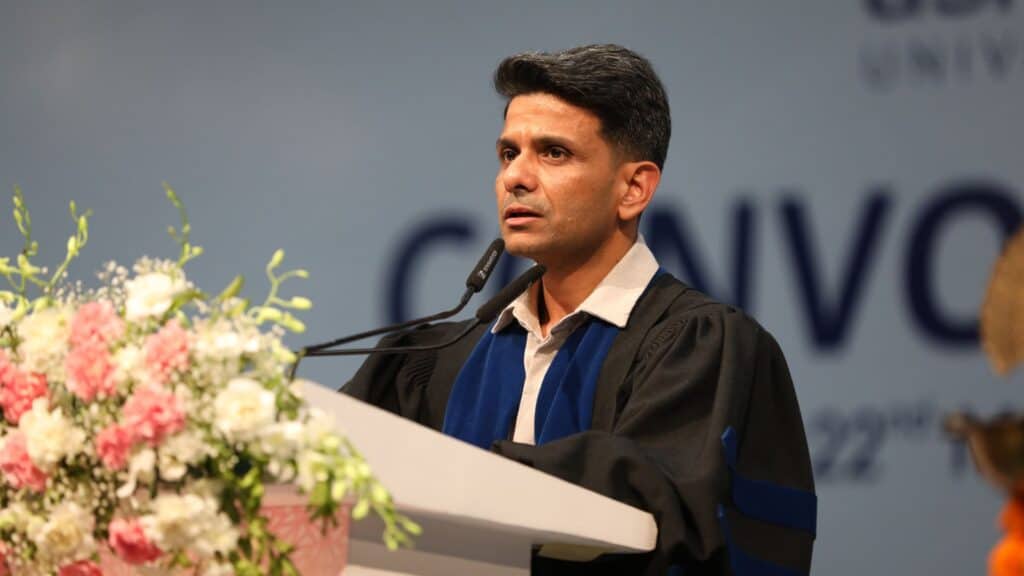
At the heart of his address were six deeply personal moments from his life, each carrying important lessons that he hoped the graduating class would carry with them into the future.
The first was a moment from his childhood when his parents and teachers enrolled him in a handwriting competition. Excited to participate, he spent the previous night preparing carefully, sharpening his pencils and packing them neatly into a box. But on the day of the competition, seeing thousands of other children entering the venue, he became overwhelmed with self-doubt and quit before even entering the building.
Shukla said it took him nearly 30 years to realise that ‘the only competition that you will lose is the one that you never enter’. He added, ‘I did not lose that competition that day. I simply did not write the test.’
Encouraging students to embrace uncertainty and self-doubt rather than retreat from it, he said, ‘People who do extraordinary things in the world are not separate species from the kids with sharpened pencils. The only difference is that they say yes. You walk into the building.’
The second lesson came from another childhood memory when Shukla visited an Air Force base as a sixth-grade student and witnessed fighter aircraft performing aerobatics during an air show. Mesmerised by the sight of fighter jets flying ‘so fast and so low,’ he spoke about standing behind the barricade after the show, wishing that he could sit inside a cockpit for ‘five or maybe ten minutes’ just once in his life.
Years later, after spending thousands of hours flying fighter aircraft himself, he realised what was ‘extremely wrong’ with that wish: he had measured his dreams in minutes rather than the years that could follow.
‘Your wishes will always be too small in life. Your job from today is to keep making these wishes, these dreams, bigger and bigger. There is nothing in the world that is stopping you from achieving what you want. You have to first believe it in your head,’ he said, urging the students to dream bigger and believe in their own potential.
He also shared a candid memory of struggling with chemistry as a student and freezing while attempting to solve even a simple equation on the classroom board. Speaking about how he ‘hated’ chemistry as a child, he recalled the embarrassment of being unable to balance what his teacher believed was the simplest equation in front of the class. It was only years later, during astronaut training, while studying the life cycle of stars and conducting precise chemical experiments aboard the International Space Station, that he truly understood the subject.
He told the students, ‘The point is never memorisation. It is curiosity. When you want to know something, you will know it, you will remember it, and you will keep it for life. Your degree today certifies that you have completed a programme. Your curiosity, if you keep it, will certify everything that happens after this in your life.’ Encouraging students to remain lifelong learners, he added, ‘Always be curious. Keep this alive for the rest of your life.’
The fourth lesson came from a memorable moment when Shukla described arriving at the International Space Station for the first time. Entering the unfamiliar environment of microgravity, he described attempting a carefully planned manoeuvre, flipping 180 degrees, turning towards the camera, and greeting the world with a namaste.
Instead, unlike what he had prepared for, he went headfirst and banged into equipment, losing balance completely in what he described as ‘the most disgraceful manoeuvre’ one could imagine. But before he could completely lose control, fellow astronauts reached out, steadied him, turned him around, and helped him complete the namaste the world eventually saw.
He told the students, ‘The lesson I want you to carry from this is you do not have to do this gracefully. You only have to push through the hatch.’ He reminded students that on the other side of almost every fear and threshold in life, there are people waiting to steady and support them. ‘The only thing required of you is to arrive in front of them and not be scared. Not be scared enough to not cross the threshold.’
Shukla also spoke about the emotional weight of representing India in space, especially as India had reached orbit after 41 years, a milestone he described as significant not just for him personally, but for the entire country. He shared that throughout the mission he deliberately avoided dwelling on the enormity of that responsibility because ‘the weight of the moment sometimes paralyses you.’
However, on the third day aboard the International Space Station, while preparing to speak with the Prime Minister of India from space, the significance of the moment suddenly overwhelmed him. As he entered the module, he saw the Indian flag in the background, the first time in history that the Indian flag had reached the ISS. Moments later, during the radio checks before the interaction, he heard Hindi being spoken, again for the very first time on the International Space Station.
Shukla said the full weight of the responsibility came ‘crashing down’ on him. Overwhelmed and unsure of how to handle the moment, he drifted towards the water station for what he described as ‘a small evasion, a tactic for buying a moment from a feeling that had become too powerful.’ It was then that he asked himself a simple question: ‘If not you, who?‘ Speaking about the impact of those four words, he said, ‘I was not crushed beneath it anymore.’
As the sixth lesson, Shukla spoke about the moments that followed his splashdown back on Earth after spending 18 days aboard the International Space Station. He described how his body had become so accustomed to the environment of space that, upon returning to Earth, it had ‘forgotten’ how much effort it takes to walk, sit down, or even stand up again. In his mind, being a fighter pilot, he believed he would simply be able to get up and walk on his own. Instead, every time he tried to take a step forward, he lost balance and began to fall.
After his third failed attempt, one of the rescue personnel politely requested him to allow them to carry him, and he eventually agreed. Looking back at the moment, Shukla told the students, ‘The strongest thing you will ever do is to let yourself be caught,’ urging them to seek help when needed and reminding them that strength also lies in vulnerability.
Towards the end of his address, Shukla shared a deeply personal story about a letter he had written to his future self at the age of 14. Filled with what he described as ‘small ambitions,’ the letter ended with a sentence that stayed with him for most of his career: ‘There are some people who are meant to do great things and some who are not.’ Looking back on those words now, after more than four decades of life experience, he called it ‘probably the most wrong statement’ he had ever written.
Addressing the graduating students, he said, ‘The people who do extraordinary things in this world are not a separate species.’ He stressed that they are ‘not braver, smarter, more talented, or more deserving’ than the people who once sat beside them in classrooms. ‘The only difference between them and the people they used to sit next to is that they kept going on the days they did not want to. That is the only difference,’ he said. Emphasising the importance of never giving up, he added, ‘Your ability to never give up in life is the only attribute that is going to decide how far in life you are going to go.’
In his concluding remarks, Shukla reminded the graduating students that they represented the future of Bharat. ‘Tomorrow you are going to go out and do things and change things that are eventually going to decide how India is going to look 10–20 years down the line,’ he said.
Congratulating the Graduating Class, he concluded his address with a message he had earlier delivered from orbit:
‘Sky was never the limit. Not for me, not for you, and not for Bharat.’