





South Asian Untranslatables
In this article, Eesha Kumar (Assistant Professor of English, Ashoka University) introduces her project ‘South Asian Untranslatables’, which appears in the journal Philological Encounters. This special issue, co-edited with Adhira Mangalagiri (Assistant Professor of Comparative Literature, NYU), interrogates and repurposes the philological and lexicographical tools that often render South Asia exotic, unknowable, and untranslatable through an interdisciplinary, collaborative effort.

 0
0

Eesha Kumar, Assistant Professor of English at Ashoka University, talks about “South Asian Untranslatables,” a recently published special issue (a book-length work with multiple authors) that has appeared in the journal Philological Encounters. Professor Kumar, who conceptualised and managed the project with collaborators over a period of three years (2022-2025), talks about her publication in detail for a wider audience.
Context
“Untranslatability” is an important concept in contemporary translation studies and comparative literature. In the work of Emily Apter and Barbara Cassin, “untranslatables” are to be understood not as terms that cannot be translated, but that typically travel untranslated between languages, such as polis, begriff, lieu commun, pravda; terms “we do not stop translating.” The idea of the untranslatable has generated two significant philosophical lexicons: Vocabulaire européen des philosophies (2005) and The Dictionary of Untranslatables (2015). These are collaborative, interdisciplinary, encyclopedic projects that are nevertheless creative, original, and make scholarly interventions (rather than simply representing a history of terms as static or stable). However, these projects are rooted conceptually and geographically in Europe and Anglo-America.
What Would a South Asian Dictionary of Untranslatables Look Like?
The project began by asking what a South Asian Dictionary of Untranslatables would look like. The team could have chosen, in response, to create a South Asian addendum to the existing Untranslatables lexicons they found so inspiring. But doing so would assume that the framework of the Untranslatable was seamlessly adaptable to South Asian texts, materials, and languages. They decided to approach this as a question rather than a given, and conduct the project in an experimental spirit.
It was decided at the outset that the project would approach “South Asia” in a self-critical manner, and carry out two simultaneous lines of questioning: one to do with South Asia’s untranslatability to its ‘occidental’ other, and another to do with South Asia’s opacity to itself. If South Asia is often made to perform a provincialising role vis-à-vis Europe (in a range of humanistic disciplines), this comes at the cost of ignoring South Asia’s internal complexity and exclusions. The framework of the Untranslatable allowed the collaborators to treat South Asia as an alternative site for theorisation while keeping in their sights on what remains untranslated and unrepresented in the category “South Asia.”
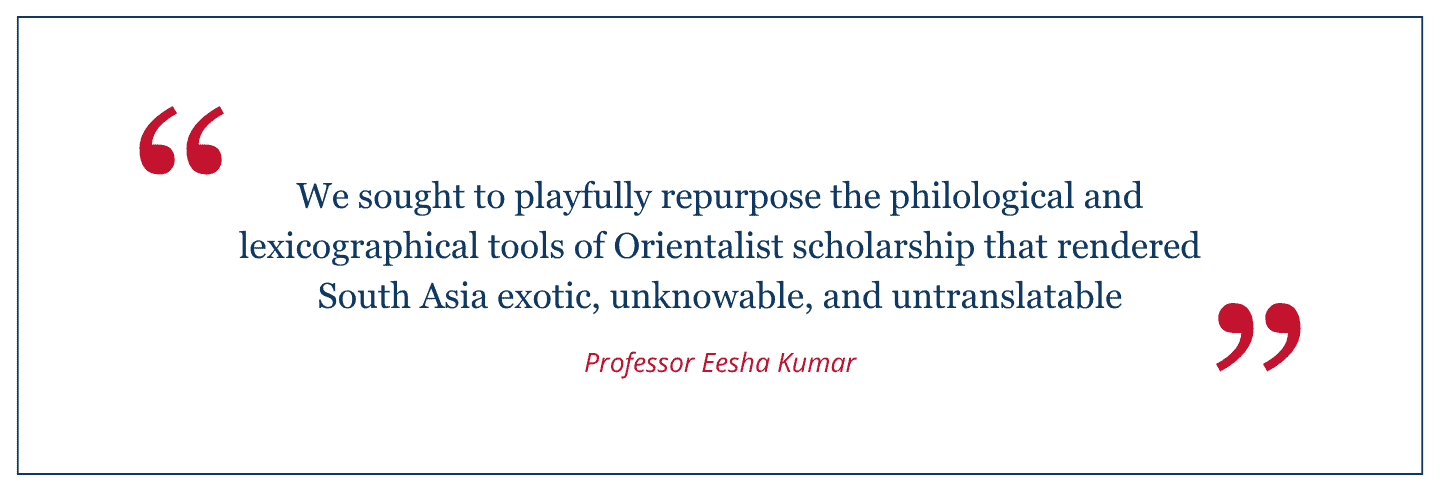
In the special issue, exciting methods from recent philosophical lexicons are brought to scholarship on South Asia: the spirit of collaboration across disciplinary lines; an attentiveness to primary languages in their specificity; a slow, thorough consideration of semantic expanse and complexity within terms; an openness and range that can bring together past and present, as well as different scholarly approaches and idioms that rarely enter into dialogue. “We sought to playfully repurpose the philological and lexicographical tools of Orientalist scholarship that rendered South Asia exotic, unknowable, and untranslatable”, remarks Professor Eesha Kumar.
How It All Began
After initial conversations in the summer of 2022, a seminar titled “South Asian Untranslatables” was organised at the 2023 conference of the American Comparative Literature Association (ACLA). A small, interdisciplinary working group workshopped an initial set of potential “entries” for a South Asian philosophical lexicon and discussed challenges, breakthroughs, and changes in direction. A few months later, the journal Philological Encounters accepted their proposal for a special issue. The researchers revised their respective contributions and workshopped them again in 2024 at Williams College in Massachusetts (where one of the collaborators is based). The special issue then went through extensive double-blind peer review and appeared in print in late 2025 (as issue 10.4 of Philological Encounters). Efforts were made to raise funds for Open Access, to ensure that this work would be widely accessible to readers in South Asia and beyond.
A Diverse, Collaborative Effort
The strength of this project lies in its diversity of approaches, with contributions from scholars of South Asia working in anthropology, psychoanalysis, religion, caste studies, history, aesthetics, and philosophy. The project offers nine articles corresponding to nine terms from the aesthetic, political and intellectual worlds of South Asia past and present: shoḳhī (caprice, rust, coquetry); jālī (lattice, web); rasa (flavour, juice, essence); yoga (union, yoking); ajeeb (weird, strange), chhāp (mark, impression, sign); mārggakār (convert, pariah); śṛṅgāra (adornment, erotic love); ākupeyar (metaphor, becoming-noun).
The articles in this special issue do not offer authoritative or exhaustive definitions. Instead, they use the framework of the Untranslatable to “unmake” meaning, generating new understandings of the terms they analyse. While each article makes innovative, critical contributions in its respective field, each is enriched by extended engagement within the interdisciplinary working group over the past 2-3 years.
Outcomes
While abundant scholarship exists on South Asian analogues to the English word “translation” (e.g. anuvād, rūpāntar, tarjuma, vivartanam), this project offers, perhaps for the first time, South Asian analogues (or conceptual rubrics) for untranslatability, through engagements with shoḳhī, jālī and rasa.
The final three articles of the special issue (on śṛṅgāra, mārgakkār, and ākupeyar) problematize the relationship of the Untranslatable to the lexicon form, a question of special relevance for scholarship on South Asia (which was rendered colonizable, at least in part, through the production of such lexicons).
The framework of the Untranslatable gave the contributors a model for collaborative work that feels rare in the humanities. The scholars found the Derridean ethics of Untranslatability — with its emphasis on multilingualism, plurality, openness — to be particularly important in the contemporary contexts in which they live and work (North America, Europe, South Asia).
Through this work, the scholars bridge a few gaps that are keenly felt: the lack of conversation between scholars of different linguistic registers (high and low, colloquial and abstruse). Even more crucially, the special issue positions itself in the epistemic breach between precolonial South Asia and postcolonial theory, reaching beyond blithe conceptions of the precolonial (both nationalist and postcolonial), as well as the effacement of the present in philological approaches to ancient and medieval materials.
Edited by Simran Wadan and Priyanka (Research and Development Office).
This blog has been adapted from the following research article:
Kumar, E., & Mangalagiri, A. (2025). South Asian Untranslatables. Philological Encounters, 10(4), 185-206. Available here: https://doi.org/10.1163/24519197-bja10074