





Translation Begins with Reading
In two extended conversations, Aalok Thakkar, Assistant Professor of Computer Science, spoke with Rita Kothari, Professor of English and co-director of the Ashoka Centre for Translation, and with Bhumika Mittal, a software engineer and recent Ashoka graduate. This article is a distillation of those dialogues.
 0
0 
There is a short story in Gujarati by Babu Suthar, published in the November 2014 issue of Mamata magazine, titled “Baa Na Math.” It opens at the edge of sleep and waking: the doorbell rings late at night, and the narrator, startled from his bed, finds a beast-like, horned creature at his doorstep. The visitor is a manmathiyu.
In the narrator’s childhood, the manmathiyu was a mythical being. When a child cried and refused to sleep, the mother would warn that the manmathiyu would come to demand one maund of math (moth beans, or matki). “Hush,” she would say, “or I will have to give away all our legumes.” This threat of scarcity was situated in the context of 1950s India, when fear could be measured in maunds and lentils.
By the time the story was published, this context had faded; the mythical being had grown distant and unrecognizable. Suthar builds on this historical distance and the slow erosion of shared memory. In his story, the manmathiyu returns to grieve its own erasure.
We turned to QuillBot, an AI-powered writing platform, to translate a portion of the text from Gujarati to English:
‘Literacy began to increase gradually in your people. As a result, the new generation was forgotten. Then if a child cries then instead of threatening him with maund mathiya give him medicine of kashaka. So we don’t need that. Our lives, believe it or not, revolved around certain things, but then as the consumption of certain things began to dwindle, so did the money.’
This output reveals some limits of automated translation. The original text described the importance of kehvat (adages and proverbs) in sustaining the existence of the manmathiyu. In QuillBot’s rendering, kehvat becomes the vague phrase “certain things.” Kashaka, which simply means “something,” is treated as a proper noun, while manmathiyu is mangled into “maund mathiya.”
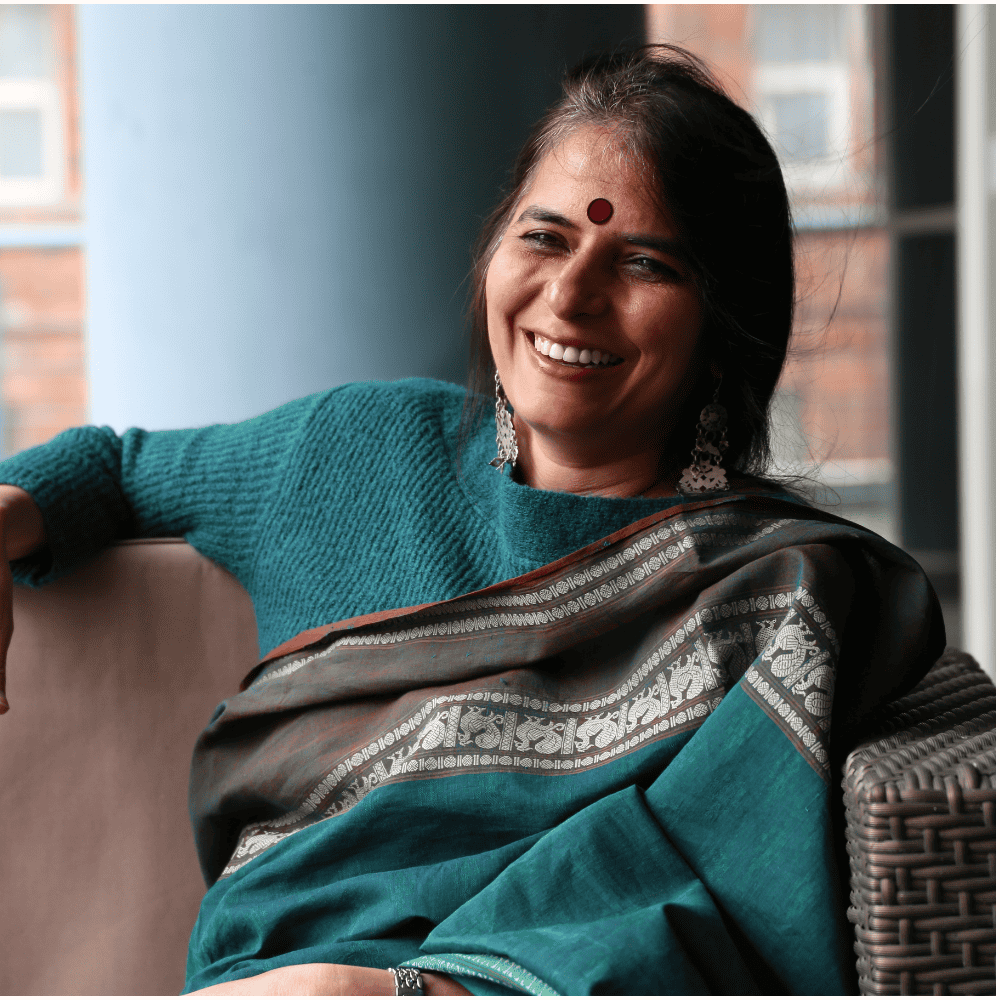
In conversation, Kothari suggested that the difficulty was not vocabulary but the ecology that sustains a word in the world. She translated the passage as:
‘You human beings became literate as times went by. As a result, the new generation began to forget old proverbs. If a child cried, the mother would not quote the old proverb, instead give some kind of medicine. We went out of use, you see. Our lives, whether you believe it or not, depended on these proverbs.’
~ Rita Kothari, Professor of English and Co-Director, Ashoka Center for Translation
While translating layered writing like Suthar’s story, where language carries folklore, historical memory, and shifting registers, is undeniably complex even for a skilled human translator. There is also a more serviceable side to translation: not all translation aspires to carry myth, memory, and metaphor across languages.
Translation is also a democratic act: it allows voices from across languages and communities to travel, and in turn brings distant worlds into one’s own language. In this sense, AI tools may expand access, making texts available more quickly and widely than any individual translator could manage.

Consider website development, where an engineer strives to make a webpage accessible to speakers of various languages. Beyond paragraphs of content, they must also translate buttons that say “Start,” “Skip,” “Undo,” or “Submit.” The task is mechanical: replace one word with its equivalent, and it is both convenient and sensible to automate it for efficiency.
Yet even here, the challenges of context persist. When Mittal used AI tools for Hindi, “Skip” was translated to chhalang lagao (take a leap), a phrase that does not indicate bypassing of a video segment, and “Undo” became purvavat, a formal noun meaning “as before,” instead of an actionable verb suited to a digital interface.
Examples of webpages in Indian languages carrying such mistranslations are plentiful. We, by contrast, came up with simpler and more intuitive alternatives: “Skip” as aage badhein (move forward) and “Undo” as hatayen (remove).
In its most basic sense, translation is the carrying over of meaning from one language to another. In many Indian languages, the word for it, anuvaad, implies something more layered: to retell, to say again, to echo in a different language. Translation, then, is not mere transfer but re-articulation.
Whether human or machine, a translator must navigate choices. These choices are most pronounced when dealing with dialects, registers, proverbs, and lexical gaps—those instances where one language possesses a word that another lacks. Sometimes a choice is an aesthetic judgment; other times, it is a socio-political decision. Often, this decision is shaped by who the translator is and who the intended reader is, as much as by the translator’s grasp of the context.
Our two examples represent opposite ends of the contextual spectrum. In the short story, there are too many layers: history, scarcity, and memory press in on every word. On the webpage, there are almost none. In both cases, we encountered limitations that verge on unusability: one collapses under the weight of excess context, the other under its near absence.
As AI and machine translation technology evolves, it may well improve this usability and utility. But whatever the output may be, its quality will depend on how the translator reads: how they inhabit a text, sense silences, and recognise what surrounds a word. The question is not whether AI has become, or can become, an efficient processor of language. The question is whether AI can read.