








Holistic Admissions
The Admissions criteria and processes are based on holistic principles and values held by Ashoka University. All applicants will be evaluated on their level of engagement with their academics, extra-curricular activities, interests, and potential within their unique journeys and personal contexts. Throughout their academic and residential life at Ashoka University, students work towards developing faculties and values such as: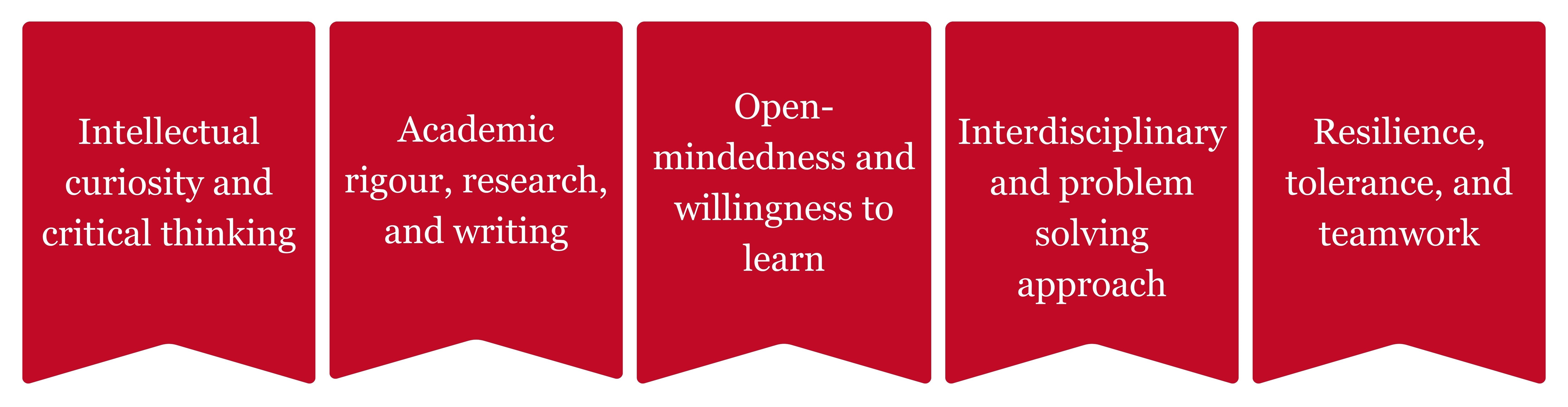
We ensure a strong focus on affirmative action based on social, personal, medical, geographical, and educational backgrounds, etc., and a merit-based admissions process. Our need-based scholarship process is open to students once they receive a firm offer of admission.
Admissions Process
Ashoka University’s holistic admissions process ensures that each application is evaluated in its unique context. Our admissions process is inclusive and has a strong focus on affirmative action. Upholding our long-standing commitment to diversity, we are mindful of applicants from various socio-economic and geographical backgrounds, learning needs, and physical impairments, along with their access to opportunities in both academic and non-academic spheres while processing applications and selecting students for the programme.
Stage 1: Application
Mandatory Application Requirements: Student and Family Details, Academic Scores (Classes X to XII), Non-Academic Engagement, Personal Essays.
Optional Application Requirements: SAT/ACT/CUET/JEE Mains/Additional Tests
Stage 2: Mandatory Admissions Assessments
All applicants are required to participate in the mandatory Ashoka University Admissions Assessments, which comprise of two components: the On-the-Spot Essay (OSE) and the Ashoka Aptitude Assessment (AAA)/Ashoka Mathematics Challenge (AMC).
These assessments are designed to evaluate your logical reasoning, critical thinking, problem-solving, and communication —key attributes that define an Ashoka student.
- On-the-Spot Essay (OSE) (30 minutes): The OSE requires you to choose one of two given prompts and write an essay in the English Language. The OSE will assess your ability to engage with the prompt, think critically and express ideas clearly. There is no word limit and no external resources are permitted. Please click here to download sample prompts for the On-the-Spot Essay. You can access sample essay responses here.
- Ashoka Aptitude Assessment (AAA) (90 minutes): The AAA comprises of 40 multiple-choice questions covering Logical Reasoning, Quantitative Reasoning and Critical Thinking. The AAA has no negative marking, allowing you to attempt all questions confidently. You will be allowed to use blank sheets of paper for rough work. No calculators will be allowed. You may find sample questions from the Ashoka Aptitude Assessment in Sample 1 and Sample 2
- Ashoka Mathematics Challenge (AMC): The Ashoka Mathematics Challenge (AMC) is a rigorous assessment for applicants who are certain they wish to pursue a major in Computer Science, Mathematics, or Physics at Ashoka University. The test evaluates conceptual understanding, quantitative reasoning, logical thinking, and problem-solving ability rather than rote memorization. The 90-minute AMC will be taken alongside the 30-minute On-the-Spot Essay, following which applicants will be given the opportunity to submit an Ashoka University Application form in a special early round. Post a holistic evaluation of their application form and assessments, candidates will be shortlisted for the interview round and will receive a final decision on their candidature before the regular admissions cycle commences. You can find more information regarding the Ashoka Mathematics Challenge here. AMC Scholarship recipients can opt for a major of their choice outside the disciplines mentioned above, but without the scholarship.For Rounds within the regular 2026-2027 Admissions Cycle, applicants may choose the AMC as an alternative to the Ashoka Aptitude Assessment (AAA), alongside the mandatory On-the-Spot Essay (OSE), after they have submitted their application form in the round of their choice
Preferred City for Taking the Assessments:
If you are a resident of India, you are required to take the mandatory assessments in person at a physical test centre. You will have to select your preferred city for taking the assessments from the dropdown menu in the application form.
If you are not a resident of India, please select “I am Not a Resident of India” on the application form, and the Office of Admissions will connect with you post your application form submission.
If you indicate any physical disability/mobility or locomotor issues/impairments in the Support Section, the Office of Admissions will reach out to you regarding your assessments.
Important Note: You are required to take the mandatory Ashoka Assessments in the same admissions round in which you submit your application form. All assessment dates and submission deadlines are published on the Ashoka University Admissions Page.
If you do not take the admissions assessments, your application will not be eligible for further evaluation. If you have any emergencies or concerns, please contact the Office of Admissions after you have submitted your application form.
Preferred City Options
- I am not a Resident of India
- Andaman and Nicobar Islands – Bamboo Flat
- Andhra Pradesh – Visakhapatnam
- Arunachal Pradesh – Basar
- Assam (Kamrup Metropolitan City) – Guwahati
- Assam – Tezpur
- Bihar – Patna
- Chandigarh (U.T.)
- Chhattisgarh – Raipur
- Dadra and Nagar Haveli and Daman and Diu – Diu
- Goa – Panaji
- Gujarat – Ahmedabad
- Gujarat – Surat
- Haryana – Gurugram
- Haryana – Sonipat (Ashoka University Campus)
- Himachal Pradesh – Solan
- Jammu and Kashmir – Jammu
- Jammu and Kashmir – Srinagar
- Jharkhand – Ranchi
- Karnataka – Bengaluru
- Kerala – Kochi
- Kerala – Malappuram
- Madhya Pradesh – Bhopal
- Madhya Pradesh – Indore
- Maharashtra – Gadchiroli
- Maharashtra – Mumbai
- Maharashtra – Nagpur
- Maharashtra – Pune
- Manipur – Imphal
- Meghalaya – Shillong
- Mizoram – Aizawl
- Nagaland – Dimapur
- New Delhi (U.T.)
- Odisha – Bhubaneswar
- Puducherry
- Punjab – Ludhiana
- Rajasthan – Jaipur
- Rajasthan – Udaipur
- Sikkim – Gangtok
- Tamil Nadu – Chennai
- Tamil Nadu – Coimbatore
- Tamil Nadu – Madurai
- Tamil Nadu – Tiruchirappalli
- Telangana – Hyderabad
- Tripura – Agartala
- Uttar Pradesh – Agra
- Uttar Pradesh – Allahabad
- Uttar Pradesh – Kanpur
- Uttar Pradesh – Lucknow
- Uttar Pradesh – Noida
- Uttarakhand – Dehradun
- Uttarakhand – Haldwani
- West Bengal – Kolkata
- West Bengal – Siliguri
Centre-Based Admissions Assessments- Official Guidelines
- As per the published admissions timelines (2027 intake), candidates are required to plan their availability for the mandatory in-person* assessments within the same admissions round in which they submit their application form
- Each candidate will receive a Hall Ticket containing critical information such as their Photograph, Ashoka Application Number, Venue, Scheduled Date and Time, Assessment Duration, and Emergency Helpline Numbers. The candidate will be required to show a printed or digital copy of their Hall Ticket to gain entry into the assessment centre. The hall tickets will be available on the student application portal as well as sent to the students’ registered email IDs before the assessment
- Candidates are required to show a recognised non-expired Government Photo ID Card (digital or hard copy) on the day of the assessments. Please ensure that the photograph is clearly visible and the name is correct
- Candidates are required to report to the assessment venue at least 30 minutes prior to the scheduled start time
- There is no guarantee of parking facility or seating availability at the assessment centres, so we strongly recommend planning your transit and arrangements accordingly. Parents/guardians/accompanying persons can plan to drop their ward off at the venue and pick them up as per the assessment schedule. Candidates traveling by personal vehicle are requested to make their own parking arrangements
- The total duration of the assessments will be 120 minutes (30 minutes for the On-the-Spot Essay and 90 minutes for the Ashoka Aptitude Assessment/Ashoka Mathematics Challenge). The total duration of the assessments for those eligible for extra/compensatory time will be 165 minutes (45 minutes for the On-the-Spot Essay and 120 minutes for the Ashoka Aptitude Assessment/Ashoka Mathematics Challenge)
- Once a candidate enters the assessment room, exit is not permitted until the candidate has finished the assessments
- Washroom visits are allowed only before or after the assessment. No bio-breaks are permitted during active assessment sections
- Note the following Restricted/Permitted Items:
- Personal belongings (mobile phones, smartwatches, earphones, or any electronic devices) are NOT allowed inside the assessment hall
- Personal stationery and rough paper are not allowed inside the assessment hall. They will be provided inside the hall
- Personal transparent water bottles are allowed inside the hall. Drinking water will also be provided at the centre
- Used rough papers will be collected after the assessments
- All personal items not allowed inside the assessment hall will be collected and returned after the assessment. Candidates are requested to carry a minimum of items with them
10. On the day of the assessment, candidates may contact the official Emergency Helpline Numbers printed on their hall ticket for any support or issues
Important Note: Presenting incorrect identification, or engaging in any form of prohibited practices and attempting malpractice or cheating during the assessments, will result in the annulment of the candidate’s application and assessment process. Compliance with all the above instructions is mandatory. Non-adherence may lead to disqualification from the assessment and admissions processes.
*Specific considerations regarding the mode of assessments are applicable for Non-Residents of India and Students with Physical/ Locomotor/Mobility issues and Hearing/Visual Impairments. The Office of Admissions will reach out to support them with their specific needs and ensure an inclusive assessment process for all. Candidates are requested to fill in the Support section in the application form with applicable information to communicate any additional requirements.
Stage 3: Shortlist for Interview
Select students are shortlisted for the interview stage once the Admissions Committee conducts a holistic in-depth review and evaluation of each application form and assessment.
The Ashoka Interview seeks to understand and get to know the candidate, their background and story. It also evaluates various parameters of the application form submitted by the candidate to gauge the candidate’s suitability to Ashoka University’s academic and residential life programme. The candidate will be interviewed by a panel. The time taken for the interview might vary depending on the interaction.
Stage 4: Decisions and Scholarships
All final decisions are declared by the Admissions Committee. Once a student receives a firm offer of admission, the need based scholarship form is enabled for them. The scholarship process is separate from the admission process and in no way impacts a student’s admission at Ashoka.
Students may receive a confirmed offer, or conditional offer, be put on waitlist (and might receive a confirmed offer upon availability), deferral of decision, or denial of admission. If a student fails to participate in any stage as per process, their application will be annulled.
Academic Bridge Programme
The Office of Admissions at Ashoka University seeks to support select students from each incoming cohort by offering them the chance to attend a fully-funded 3-week Academic Bridge Programme on campus prior to the start of the academic session. The Academic Bridge Programme aims to bridge the gap between their high school education and the Ashoka University classroom experience. The focus of the classes during the academic Bridge Programme is on the usage of the English language, academic reading and writing, thinking critically, synthesizing information, and presenting cogent arguments.
Classes are taught by tutors from Ashoka’s Undergraduate Writing Programme (UWP) and Centre for Writing and Communication (CWC). The Office of Admissions and the Office of Student Affairs co-host the residential life experience for the Academic Bridge Programme students, collaborating with the Office of Learning Support, the Ashoka Centre for Well Being, the Office of Academic Affairs, and the Career Development Office to offer workshops and special events to prepare and help students settle into their Ashoka journey.
