





Why Feeling the Right Amount Matters: Professor Nandini Chatterjee Singh on Her Recent Research into Balanced Empathy in Adolescence
In this article, Nandini Chatterjee Singh, Head of Department for Psychology and Cognitive Science, at Ashoka University talks about her recently published research paper titled Equilibrium in empathic concern and personal distress predict identification with all humanity (IWAH) in Indian adolescents. The study emphasises upon the importance of balanced empathy in adolescence.

 4
4

Professor Nandini Chatterjee Singh’s recent study of adolescents aged 11–16 in urban India suggests that what matters most is not simply how much empathy young people feel, but how balanced that empathy is.
Deep diving further, the study explains that if adolescents are scrolling through social media and they encounter a video of a child affected by natural calamity, say flood or earthquake, how they react to that video may vary for each adolescent. Some may feel concern “That’s really hard, I wish I could help” or distress “That’s too much to watch” or simply ignore, disengage and move on, scroll past. All of these responses reflect different emotional processes and they lead to different outcomes as well. When concern for others is accompanied by manageable emotional arousal rather than overwhelming distress, adolescents are more likely to respond constructively and connect meaningfully with others beyond their immediate circles.
The research underlines that Empathy is often treated as a single construct, but it comprises at least two distinct emotional components – cognitive empathy or empathic concern (EC) which refers to an understanding of others’ emotions and emotional empathy or personal distress (PD) which is being affected by others’ emotions. Both arise in similar situations depending on individual differences, yet often differ fundamentally in their motivational orientation. Empathic concern tends to promote prosocial action, whereas excessive personal distress can lead to withdrawal, avoidance, or emotional fatigue. While traditional models distinguish on the differences between cognitive and emotional empathy they often neglect how their interplay shapes individual outcomes. Understanding how these two components interact is critical for understanding adolescent social and emotional development.
In this study, Professor Nandini Chatterjee Singh and their collaborators examine EC and PD both individually and in combination influence adolescents’ sense of identification with humanity. Using validated measures including the Interpersonal Reactivity Index (IRI), and the Identification with All Humanity (IWAH) scale, the researchers collected self-reported responses from 634 adolescents in urban India. The IWAH scale assesses how individuals relate to three concentric social circles: their immediate community, their country, and humanity as a whole. “This allowed us to explore whether empathy shapes not only interpersonal relationships but also broader social identity”, says Professor Chatterjee Singh.
The findings reveal a nuanced picture. Adolescents who exhibited a balance between empathic concern and personal distress, experiencing care for others without being overwhelmed, showed a stronger identification with all humanity.
In contrast, simply having high levels of emotional intensity did not necessarily lead to better outcomes; in fact, very high distress appeared to diminish the positive effects of concern, likely due to emotional overload. Interestingly, an imbalance between concern and distress did not predict identification with humanity at a global level. However, such imbalance, particularly when concern exceeded distress, was associated with stronger identification with one’s community and country, suggesting that different configurations of empathy may operate differently across social scales.
These findings have important implications for adolescent wellbeing. Empathic concern is generally associated with positive outcomes, including greater prosocial behaviour, stronger relationships, and enhanced psychological wellbeing. Personal distress, on the other hand, can act as a risk factor when elevated, contributing to emotional exhaustion, burnout, and withdrawal. In this sense, empathy can function as a double-edged sword: while caring for others is beneficial, becoming overwhelmed by others’ suffering can undermine both wellbeing and the capacity to help. An optimal balance where concern is high but distress is regulated, appears to be key to healthy emotional functioning.
The results also carry significant implications for education. Adolescence is a critical period for identity formation, and in a world increasingly shaped by global connectivity and constant exposure to others’ experiences, the ability to engage empathically without becoming overwhelmed is essential. Educational approaches should therefore move beyond simply encouraging adolescents to “be more empathetic.” Instead, they should focus on helping young people understand and regulate their emotional responses. This can be achieved through reflective discussions, exposure to real-world scenarios such as social media content and peer interactions, and structured opportunities for perspective-taking and constructive action. It also emphasizes the need to build global citizenship early in education. Only too relevant is the dictum ‘vasudaiva kutumbakum’ (the world is one large family), a value and perspective that has assumed an urgent relevance in current times.
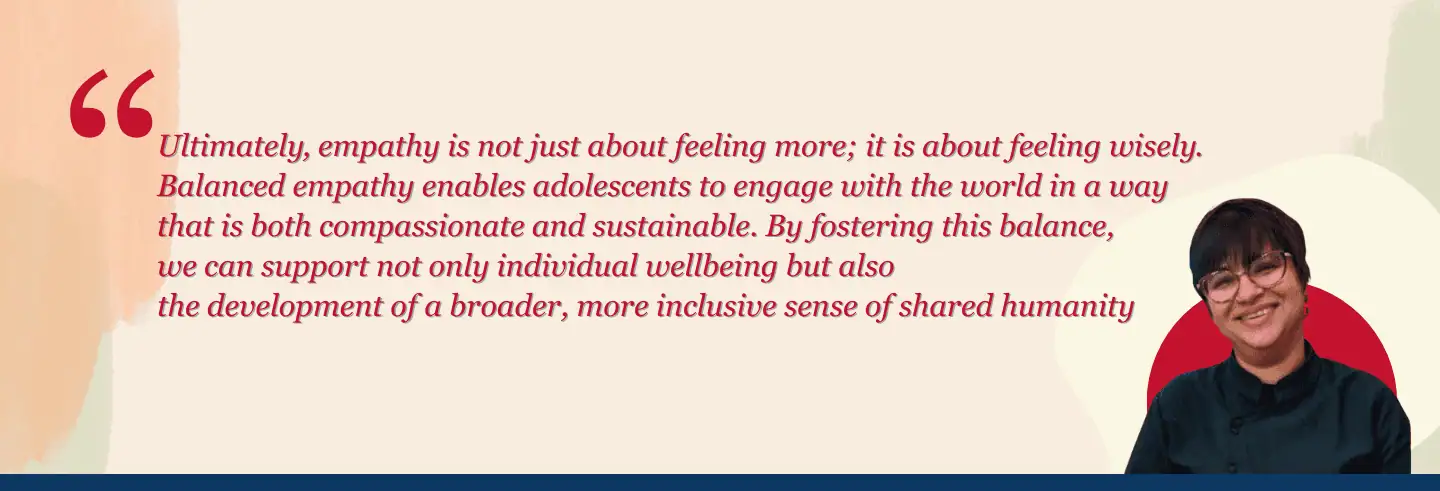
Concluding her recent study, Professor Singh notes, “ultimately, empathy is not just about feeling more; it is about feeling wisely. Balanced empathy enables adolescents to engage with the world in a way that is both compassionate and sustainable. By fostering this balance, we can support not only individual wellbeing but also the development of a broader, more inclusive sense of shared humanity”.
– Edited by Priyanka (Research and Development Office).
This blog has been adapted from the original article, available here.