





AI in Academic Writing and Critical Thinking
CWC is adapting to the scenario of increasing use of AI, by reaffirming the importance of critical and original thinking, a key tenet of a liberal education.
 0
0 
With writing and communication being formative to critical thinking, CWC is adapting to the scenario of increasing use of AI, by reaffirming the importance of critical and original thinking, a key tenet of a liberal education. Our instructors are developing methods during one-on-one sessions supporting students to think of AI, particularly chatbots as additional tools for their classwork, and not as a replacement for their learning. Our academic teaching and learning modules incorporate components that highlight the supplementary role of chatbots. These modules are for workshops, the 2026 Winter School on Research Writing in the Humanities and Social Sciences, English Language Teaching, and the co-taught Monsoon 2025 Research and Methodology (RME) Physics and Mathematics (PHY 6900 / MAT 5201) for doctoral students.
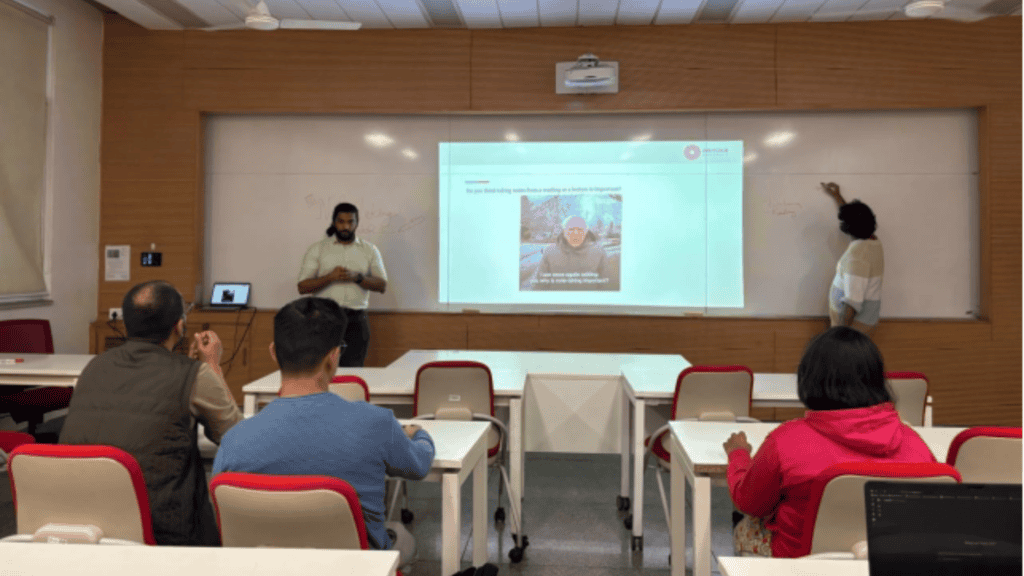
In the Winter School session on Writing with Data, for instance, participants considered how AI softwares can structure and organise datasets, detect patterns, and surface potential biases. A recent workshop, Note-taking in the Age of AI, offered a complementary lesson. Instructors showed that, even with careful prompting, AI tends to generate mind maps that remain uni-directional and conceptually thin. By contrast, students can foreground variables, develop creative linkages, and build interpretive architectures responsive to instruction and reading. The workshop emphasized that student-produced mind-maps, grounded in keywords drawn from the classroom and assigned texts, yield richer conceptual detail, stronger contextual anchoring, and greater analytic utility.
Additionally, we are discussing the use of AI in writing in CWC annual conferences. Our call for papers for A Song Called Teaching (2025) and Bridging Techne and Episteme (2026) asked how AI unsettles the university’s regimes of knowledge production: how it reconfigures teaching, redistributes expertise, and renders much intellectual labour invisible. Overall, the work at Centre for Writing and Communication (CWC) emphasises the need to intelligently work with chat bots to mitigate biases and limited scope of AI produced content. Through our varied academic pursuits, we aim to reaffirm the value of original thought, and confidence in student and researchers academic capacities at Ashoka and beyond.
Workshop on Taking Notes in the Age of AI
Tridib Mukherjee & Elloit Cardozo, Writing Tutors | 12 February
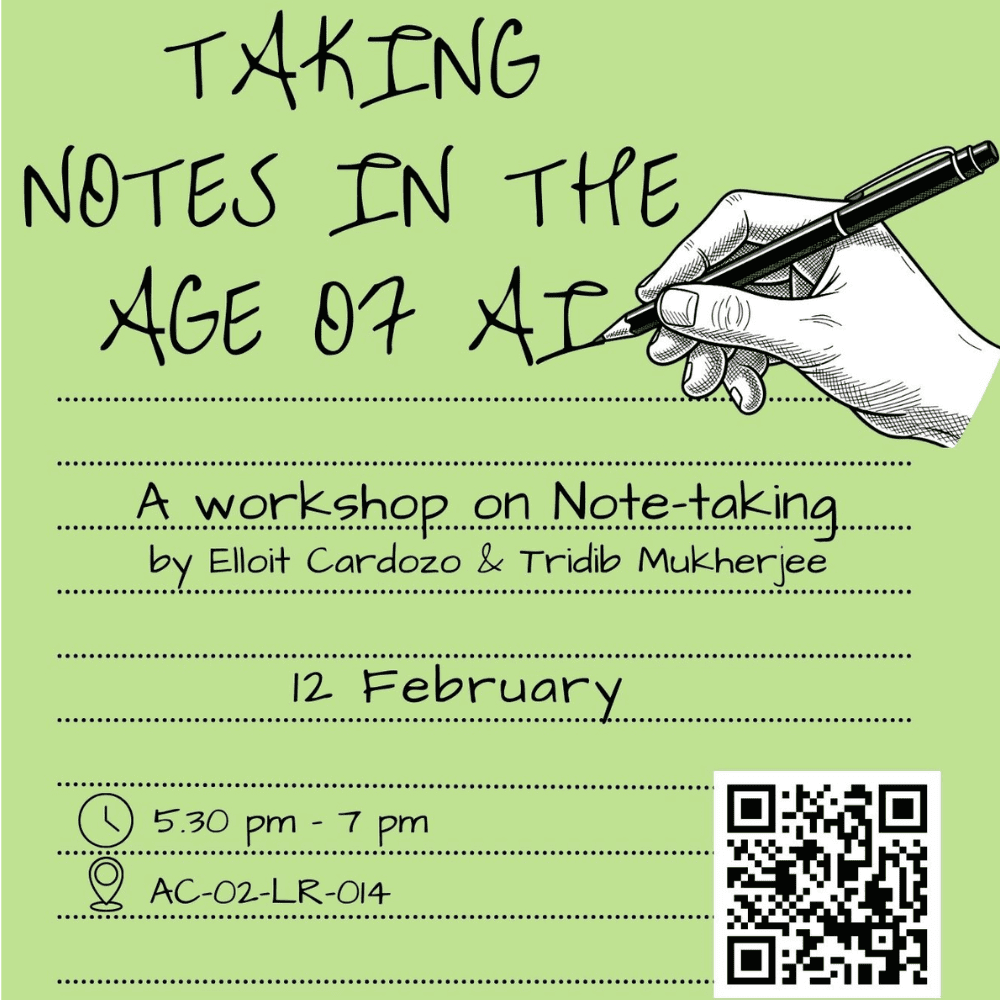
The workshop began with a discussion of the participants’ outlooks and individual note-taking practices, and the what and the why of note-taking. This was followed by a listening and a reading activity with demonstrations of note-taking methods such as scribbling, thematising, highlighting, jotting, and the Cornell method embedded throughout. Following the listening and reading activities, these texts were fed to Google NotebookLM with the generated summary and mind-map discussed at length. The focus here was on AI’s shortcomings when it came to critical thinking and interpretation, and its overreliance on buzzwords. In this, the workshop sought to demonstrate the importance of note-taking as an important, personal element of meaning-making that cannot be replaced by AI.
The workshop began with a discussion of the participants’ outlooks and individual note-taking practices, and the what and the why of note-taking. This was followed by a listening and a reading activity with demonstrations of note-taking methods such as scribbling, thematising, highlighting, jotting, and the Cornell method embedded throughout. Following the listening and reading activities, these texts were fed to Google NotebookLM with the generated summary and mind-map discussed at length. The focus here was on AI’s shortcomings when it came to critical thinking and interpretation, and its overreliance on buzzwords. In this, the workshop sought to demonstrate the importance of note-taking as an important, personal element of meaning-making that cannot be replaced by AI.
Project | Assessing AI Tools for Argumentation in Academic Writing in the Humanities and Social Sciences
This year-long project, conducted by the Centre for Writing and Communication (CWC) in collaboration with Mphasis Lab, offers a granular investigation into how AI tools mediate argumentative writing in the Social Sciences and Humanities (SSH) in an Indian university context. Rather than asking whether AI improves academic writing in general, we examine how AI intervenes in the construction of context and argumentative reasoning—core features of SSH scholarship.
Students produced short argumentative essays across six disciplines with and without AI assistance. Drawing on established writing assessment research for higher education in the global South, we developed complementary qualitative and quantitative frameworks to evaluate thesis clarity, claim–evidence relationships, structural coherence, academic style, and authorial voice. In contrast to the majority of scholarship on this question, we explicitly disclose our fine-grained metrics and the process of constructing argument graphs to map higher-order relationships between claims, evidence, and thesis statements.
Our findings point to a troubling pattern of linguistic and conceptual flattening in AI-assisted writing. AI optimises for fluency but lacks nuanced contextualisation and depth of reasoning. These sometimes contradictory indicators underscore the need for multidimensional assessment rather than single-score evaluation.
Methodologically, the project contributes a transparent model for studying AI-mediated writing through controlled comparison and detailed annotation. In the future, the study can be scaled to larger and more diverse cohorts, analysing drafting processes and revision patterns, and examining how AI use intersects with English language learning and the development of reasoning skills at the undergraduate level. In a rapidly evolving landscape, this work aims to inform pedagogical practice with evidence rather than assumptions. The project report is available at https://zenodo.org/records/18619345
‘Report presentation and Panel Discussion for AI Project’ and ‘AI and Academic Integrity Workshop’
Neerav, Sampurna, Archishman | 7 February
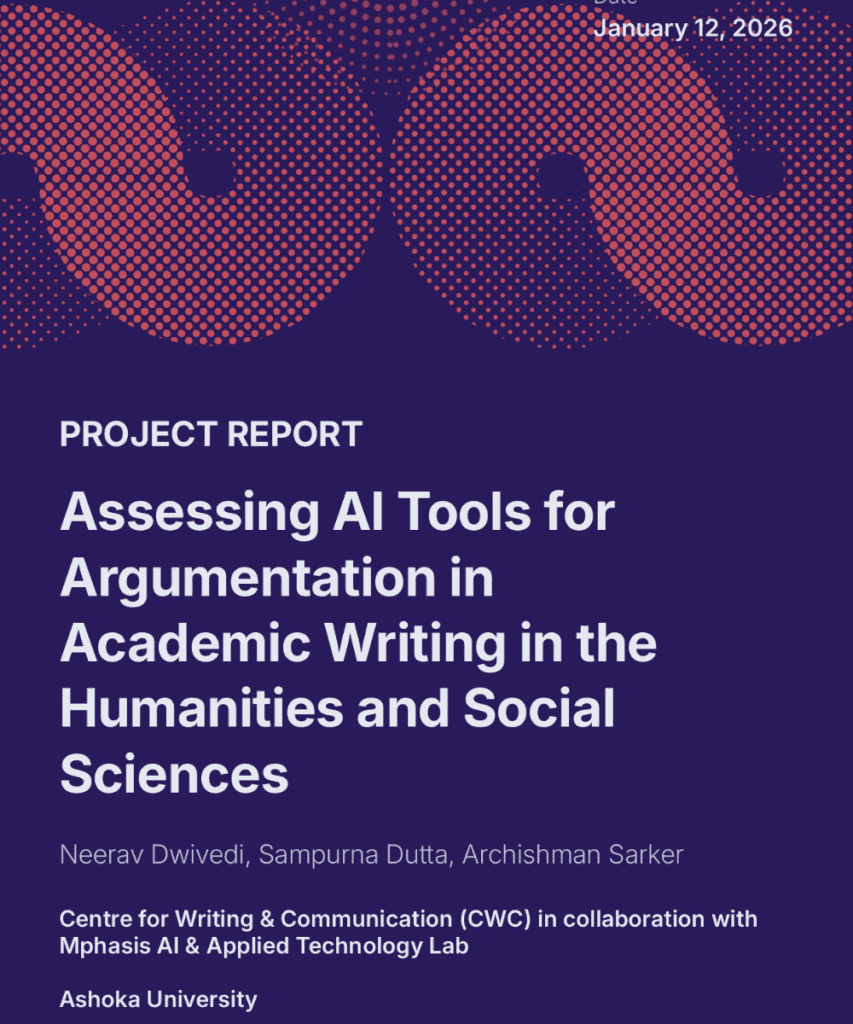
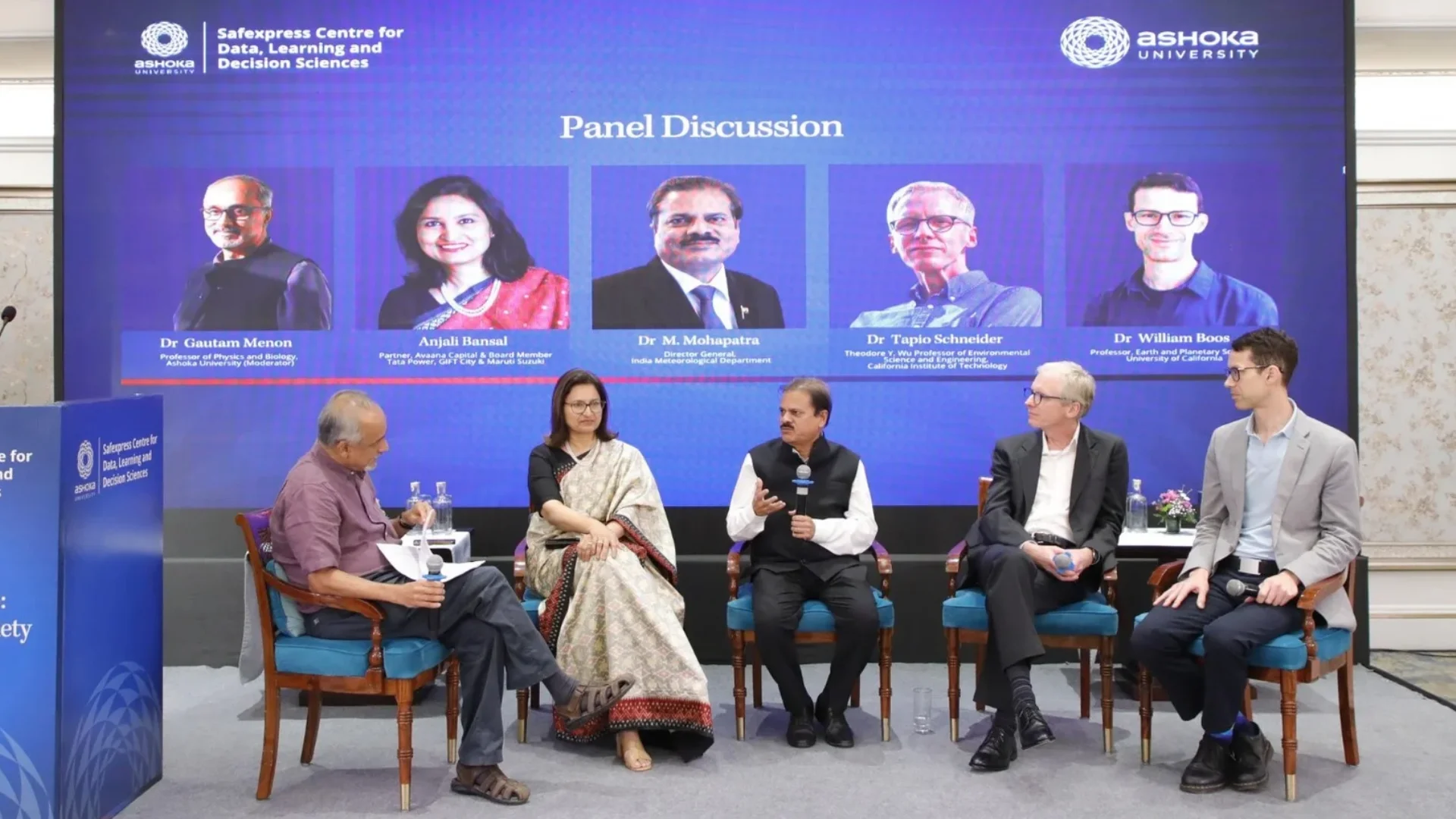
The project report of the CWC-MPhasis “Assessing AI Tools for Argumentation in Academic Writing in the Humanities and Social Sciences” was launched on 7th February (Online). It included a panel discussion with three panelists: Professor Partha Pratim Chakrabarti, Professor Lipika Dey and Professor Ashwini Vaidya. This was followed by a 2.5-hour workshop, which was designed to help participants critically engage with AI tools in academic contexts, with a focus on ethical use, academic integrity, and fair integration across different stages of research and writing.
The workshop combined conceptual discussion with hands-on activities, centring on an evolving, practice-based understanding. Part 1 focused on ethical concerns surrounding AI use in academic work, with the second part shifting to practice focusing on how AI can be used thoughtfully at different stages of academic research and writing.
There was a substantive focus on literature review, highlighting the use of AI for keyword expansion and topic mapping, summarisation, trend detection, and organisation and structuring.
In highlighting thinking with AI as a positioning lens, facilitators discussed AI’s limited judgment in evaluating sources and the dangers of fabricated or shallow synthesis through two long examples