








Ashoka University Strengthens the Indo-French Scientific Corridor at R.U.S.H. 2026
The summit was officially inaugurated by Dharmendra Pradhan, Minister of Education, Government of India, and Clara Chappaz from the French Ministry for Europe and Foreign Affairs, who highlighted AI’s growing influence on how societies think and how institutions function, stressing that it is not merely a tool but a force shaping the future.
 1
1

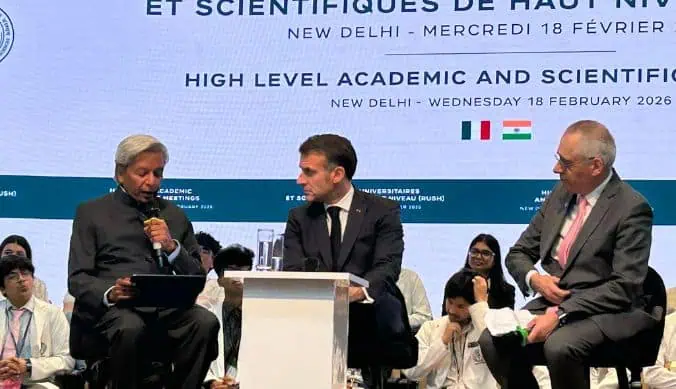
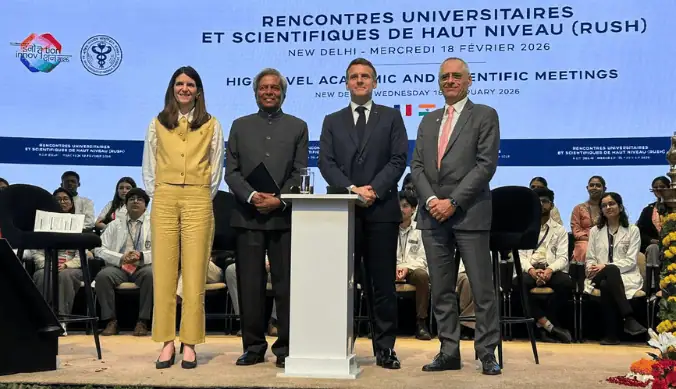
The R.U.S.H. (Rencontres Universitaires et Scientifiques de Haut Niveau) High-Level Academic and Scientific Meetings brought together leading institutions and policymakers on 18–19 February 2026 at AIIMS, New Delhi, to shape the future of Indo-French cooperation. Organised with the support of the French Embassy in India and key academic partners, the summit set the stage for deeper collaboration in science, health, and emerging technologies. Against this backdrop of strengthening bilateral ties, the sessions examined how AI is redefining higher education, research ecosystems, and global partnerships.
Thierry Coulhon, Institut Polytechnique de Paris, spoke on “Higher Education, Innovation and Geopolitics in the Age of AI,” arguing that artificial intelligence is reshaping global power structures through science and technology. He emphasised that AI grants strategic autonomy and that nations leading this transformation are those making sustained investments in higher education and scientific infrastructure. Citing a 60 percent increase in international student mobility from India and noting that France hosts around 9,000 Indian students, he posited the importance of strong international partnerships and early integration of computational thinking in education. He described AI as a direct product of educational systems and deliberate scientific choices, stressing that while AI scales intelligence, it does not eliminate human responsibility. Trustworthy AI, he asserted, rests on trustworthy science, and countries that train, attract, and retain top talent, while choosing their partners wisely, will shape the future geopolitical order.
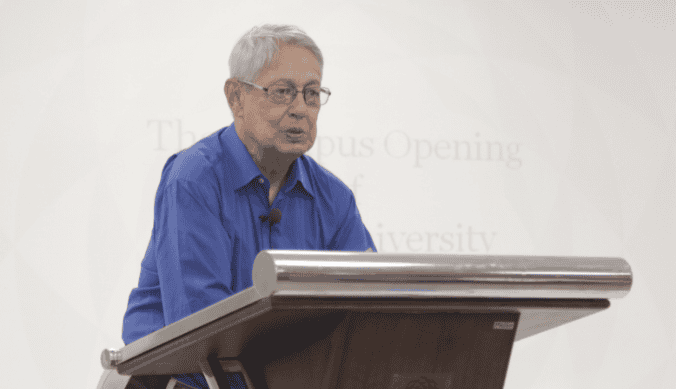
Building on this theme of responsibility and global cooperation, the address by K. VijayRaghavan, Science Advisory Council, Ashoka University, titled “Managing Promises and Perils of AI in Biotechnology and Health: Global Partnerships in Developing Standards,” shifted the focus to health and biotechnology. He began by invoking the legacy of François Jacob, Jacques Monod, and André Lwoff to remind the audience that profound science often emerges in times of global uncertainty. He argued that while AI enables unprecedented scale in biotechnology and health research, it also demands conceptual clarity, rigorous data standards, and strong ethical governance. Emphasising Indo-French collaboration, he called for shared cohorts, harmonised frameworks, and long-term investment in people and institutions. Above all, he stressed that as AI grows more powerful, human judgement, responsibility, and trust become more, not less, essential.
The summit was officially inaugurated by Dharmendra Pradhan, Minister of Education, Government of India, and Clara Chappaz from the French Ministry for Europe and Foreign Affairs, who highlighted AI’s growing influence on how societies think and how institutions function, stressing that it is not merely a tool but a force shaping the future. Pradhan spoke about securing an AI-driven future rooted in human dignity and long-term prosperity through sustained Indo-French cooperation, and referred to the Sorbonne–AIIMS Centre of Excellence as a significant step forward. Bringing together over 600 participants from 200 universities, the summit reflected shared priorities in green hydrogen, space, healthcare, applied mathematics, and AI. Marking the 40th anniversary of CEFIPRA, the speakers recalled the early strategic decision to invest in knowledge and youth, emphasised the importance of building resilience with trusted partners at a time when science faces growing scrutiny, welcomed researchers to France, and called for ambition rather than complacency in advancing collaboration.
Translating these commitments into concrete institutional partnerships, Ashoka University was showcased as a consortium partner in the Franco-Indian Campus for Life Sciences for Health, a collaboration bringing together Université Côte d’Azur, Indian Institute of Technology Delhi, Indian Institute of Science, and Ashoka University under SHIELD (Synergies for Health Innovation and Education in Life Sciences and Digital Health). The outcomes presented covered the 2023–2026 period, including 2026 projections, and highlighted a double Master’s programme in computational biology, four winter schools, three Sophia summits, a microscopy workshop, a symposium on computational biology, and a longevity seminar.
The consortium also reported six fully funded Master’s exchanges from India to France and eleven from France to India, thirteen PhD exchanges, twenty-eight faculty exchanges from France to India, and nineteen from India to France. With nearly 250 international mobilities implemented and over €3.2 million mobilised during 2023–2025, the initiative reflects substantial progress in advancing sustained Indo-French collaboration in health, life sciences, and digital innovation.
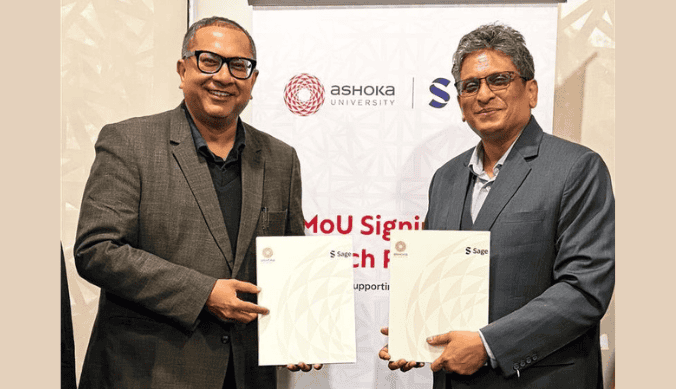
The summit further strengthened bilateral academic ties with the signing of a Memorandum of Understanding between Ashoka University and École Normale Supérieure – PSL, marking a new chapter in strategic cooperation in research and higher education. Ashoka University’s Memorandum of Understanding with École normale supérieure – PSL establishes a deep, long-term partnership spanning joint research, faculty and student exchanges, and collaborative academic programmes in the sciences and humanities.
The MoU was formally signed by Somak Raychaudhury, Vice-Chancellor, Ashoka University, Delhi-NCR, and Frédéric Worms, Director, ENS-PSL. This MoU will create shared research ecosystems, foster co-taught courses and workshops, and open opportunities for Ashoka students and scholars to engage with ENS–PSL’s renowned scientific community in Paris. Together, the two institutions aim to build a vibrant Indo-French intellectual corridor that advances fundamental science, interdisciplinary inquiry, and innovation with global impact.
France and India are already closely linked in science through bilateral structures such as the Indo-French Centre for Applied Mathematics (IFCAM), DST–India programmes in digital science and technology, and joint initiatives in neuroscience and engineering. Most recently, both countries have expanded this cooperation through new initiatives in AI, health, and digital science, including plans for Indo-French centres for AI in health and digital science and technology under the 2026 Year of Innovation.
– Written by Dr. Ankita Rathore, Ashoka Global Research Alliances

Study at Ashoka
