








Decoding the Hidden ‘Behaviours’ of Cancer: How AI is Helping Us Understand Tumours Better
In this article, Professor Debayan Gupta, Assistant Professor of Computer Science, Ashoka University, talks about his recently published research paper 'OncoMark: A high-throughput neural multi-task learning framework for comprehensive cancer hallmark quantification'.

 0
0

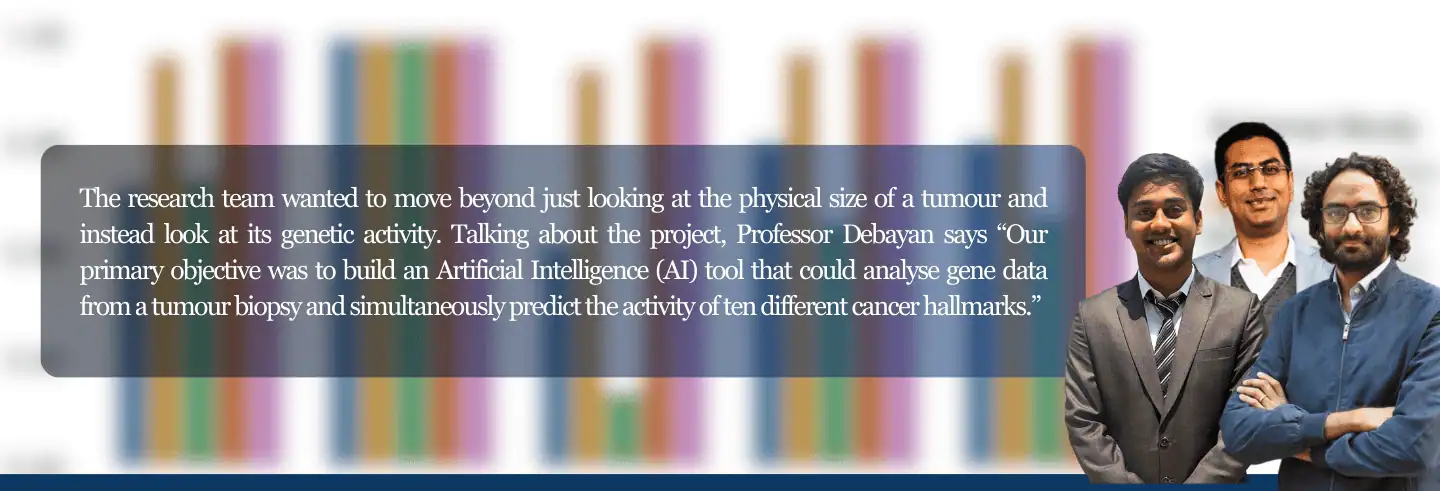
Professor Gupta’s recent publication presents a high-throughput neural multi-task learning framework for comprehensive quantification of cancer hallmarks. The paper is co-authored with his research fellows, Shreyansh Priyadarshi, a Pre-Doctoral Research Fellow at the Mphasis AI & Applied Tech Lab, Ashoka University, and Bhavesh Neekhra, a graduate student at Ashoka University. It underscores the development of a framework for AI-driven prediction of Cancer Hallmarks.
They begin by setting up the background on how cancer is often viewed as a single disease by laypersons, but in reality, it is a complex collection of cells behaving abnormally – something that encompasses a wide range of things.
For decades, scientists have known that for a tumour to grow and spread, it must acquire specific ‘superpowers’, i.e., anomalous biological capabilities known as the Hallmarks of Cancer. These include the ability to grow uncontrollably, evade the immune system, resist cell death, and establish its own blood supply. However, currently available tools in hospitals rarely measure these hallmarks directly. Instead, doctors must rely on staging systems (such as TNM) and grading scales that assess the tumour’s physical size and microscopic appearance. While useful, these methods are blind to the molecular processes that drive tumour growth.
This explains why two patients with the same cancer stage often have vastly different outcomes.
Key Objective:
Professor Gupta’s project was motivated by a critical gap in cancer care: the absence of a unified method to measure the biological “behaviour” of a tumour. The research team wanted to move beyond just looking at the physical size of a tumour and instead look at its genetic activity.
Talking about the project, Professor Debayan says, “Our primary objective was to build an Artificial Intelligence (AI) tool that could analyse gene data from a tumour biopsy and simultaneously predict the activity of ten different cancer hallmarks.”
This approach aimed at a detailed molecular ‘ID card’ for each tumour, helping researchers and doctors understand exactly which biological mechanisms are driving a specific patient’s disease.
Methodology and Approach:
To solve the challenge mentioned above, the team developed a framework called OncoMark.
The biggest challenge was that there is no existing dataset of tumour biopsies that are perfectly labelled with their hallmark activities. To overcome this challenge, the team implemented an innovative workaround:
- Synthetic Training Data: The team used detailed data from single cells (single-cell RNA sequencing) to create computer-simulated ‘synthetic’ biopsies. This allowed them to train the AI on accurate, noise-free data.
- Multi-Task Learning: Cancer hallmarks are interconnected; they don’t occur in isolation. They used a ‘Multi-Task Learning’ approach. Imagine teaching a student to solve ten related math problems simultaneously rather than one by one – they learn the underlying logic more effectively. Similarly, the AI developed by the team learns to predict all ten hallmarks simultaneously, thereby understanding the hidden patterns that connect them.
The team trained the model on gene profiles from 941 tumours across 14 tissue types and tested it on independent datasets to ensure it generalises to real-world patients.
Results and Conclusion
The results were highly encouraging. OncoMark predicted the presence of cancer hallmarks with over 99% accuracy during testing. Key discoveries included:
- Accuracy: The tool consistently performed well across five independent datasets, demonstrating robustness.
- Distinguishing Cancer: OncoMark clearly separated healthy tissue from cancerous tissue. Healthy tissues showed stable, balanced activity, while cancer samples showed ‘noisy’ and elevated signals in specific hallmarks.
- Staging Connection: The team found that hallmark activity increases as cancer progresses. A Stage IV tumour (advanced) has much higher hallmark activity than a Stage I tumour. This confirms that the Oncomark tool is correctly identifying the biological drivers of aggressive cancer.
- Drug Insights: The team was also able to link specific drugs to the hallmarks they suppress. For example, the team could observe that certain chemotherapy drugs specifically reduced the activity of the ‘Resisting Cell Death’ hallmark, confirming that the treatment was working as intended.
`
Bird-eye View: Key Takeaways & Impact
OncoMark represents a significant step toward Precision Oncology, that is, treating the patient rather than the disease category.
By moving beyond simple physical staging, this technology allows one to visualise the “engine” beneath the tumour’s hood. This could help physicians identify aggressive tumours that appear harmless under a microscope but are biologically dangerous. Furthermore, by determining which hallmarks are active (e.g., whether the tumour is feeding itself via new blood vessels or evading the immune system), clinicians could select treatments that target those specific vulnerabilities.

Study at Ashoka
