








From Sonipat to Switzerland: A Journey of Impact, Art and Advocacy
Omera Yusuf (UG 2023) pens a reflective journey of a classroom project to policy advocacy at the UN in Geneva.
 1
1

On 7 November 2025, I had the honour of representing Ashoka University & India at the 1M1B Impact Summit at the United Nations Office at Geneva. What began as a classroom project in my Monsoon 2024 semester slowly transpired into a research journey, an internship, a trip to Switzerland, and finally, a moment where I could speak about the role of art in participatory decision-making and community representation in a room full of changemakers from across the world.
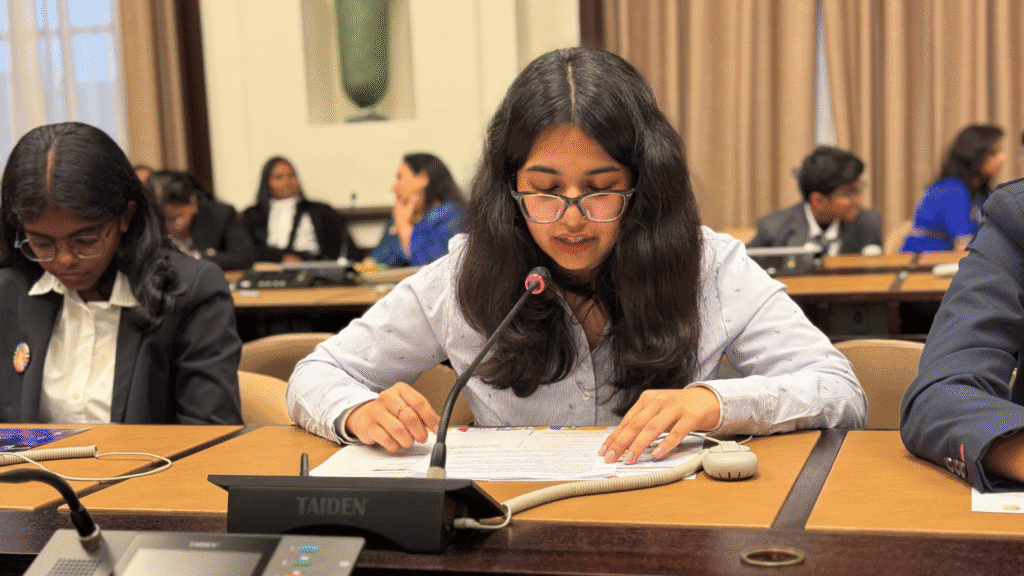
This blog is my attempt to capture that journey and to vicariously take you along with me.
Part 1: From Classroom Case Study to Global Impact
It all started with my course “Social Entrepreneurship and Impact” with Professor Advaita R. in the Monsoon 2024 semester. This course sat at a fascinating intersection of enterprise-building and social impact, putting profit and purpose in the same frame. We looked at multiple case studies and had stimulating discussions about equity, justice, and what it means to “do good” responsibly.
For my final project, I intended to study a social enterprise through a case study, and decided to focus on the 1M1B Foundation – more specifically, on the scaling of a social enterprise, after some secondary research. That decision marked the beginning of my formal association with 1M1B.
The project gave me an incentive to really dig deeper. I interviewed multiple stakeholders along the chain: from Manav Subodh, the founder of 1M1B, all the way to a student beneficiary, Manya Joshi, who is one of the student initiative leaders in her college chapter of 1M1B. Listening to their stories and experiences helped me gather a true 360-degree view of the organisation.
I was particularly intrigued by one question: How does a social enterprise scale without losing its goals – especially when it’s not profit-seeking? That became the core of my case study: focused on scaling, but with attention to ethics, community, and impact.
Over the following months, I wanted to go the extra mile with my qualitative case study. With the kind support and co-authorship of Ekanto Ghosh, Deputy Director at the InfoEdge Centre for Entrepreneurship, I began working on the quantitative aspect of my research using the TISM (Total Interpretive Structural Modelling) framework. The idea was to move beyond narrative and intuition, and map out the complex relationships between critical success factors that influence the scaling of a social enterprise.
Around the same time, I also applied for and joined the 1M1B Green Internship in collaboration with Salesforce. The internship pushed me to think in terms of real, tangible impact. It also nudged me to endow myself with some technical skills.
As a capstone project for this internship, I chose to research the role of art in participatory decision-making. It was interdisciplinary in nature, critical, and deeply reflective of the last two years of my education at a university that espouses the above values.
Part 2: The travel to Switzerland and the Conference
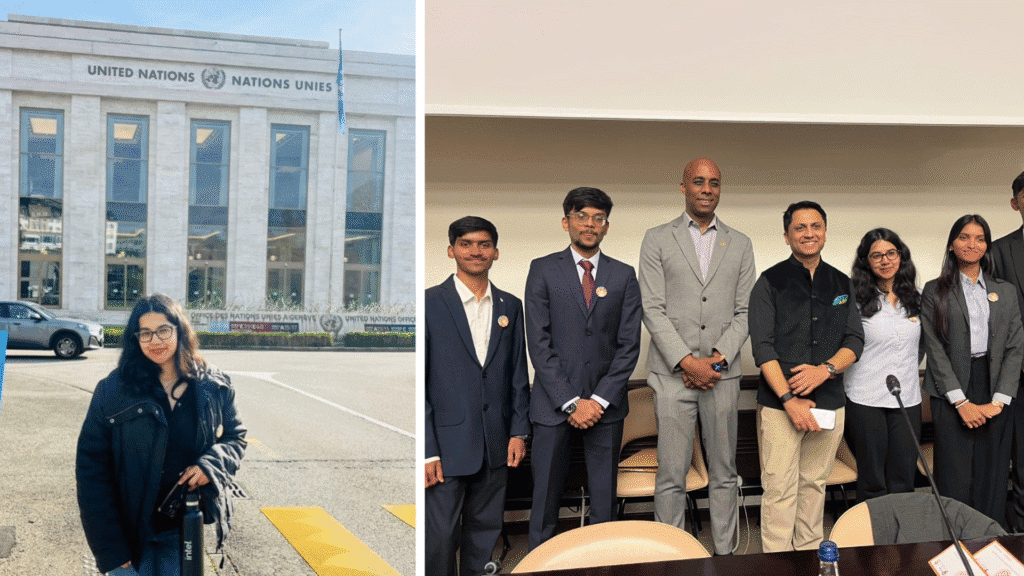
Standing inside the UN, surrounded by changemakers, innovators, and youth leaders from around the globe, was humbling and electrifying all at once. Every story I heard of young people working on sustainability, inclusion, and climate action added another layer of hope to my understanding of the future.
My presentation focused on the longstanding challenge of technocratic and exclusionary decision-making, and how inclusive art can serve as a powerful medium of expression, evidence and recognition.
I emphasised two key messages:
- Art and the humanities must be recognised as legitimate forms of evidence and expression within policymaking spaces.
- Policy must be genuinely participatory, inclusive and representative, with greater accessibility and co-creation for communities whose lives are shaped by global decisions.
(You can listen to my speech here)
Beyond the UN conference room, Geneva itself was a fantastic teacher.
This Summit happened to be my first-ever solo international trip with the generous support of the InfoEdge Centre for Entrepreneurship, and it happened to be to one of the most gorgeous, picturesque countries I could imagine. I wandered through the town and tried to absorb as much as I could in those few days. I admired the way of life, the pace of the city and the people, the cafés, and my favourite of them all, the lake.
I walked by the water, watched it change colours with the light, talked to locals, and kept looking up to see the mountains framing the city like a painting.
As someone who enjoys collecting experiences, this felt like the perfect destination but more importantly, it had a strong purpose behind it, which made it even more special. I am grateful for this journey of learning, sharing, and growing!


Study at Ashoka
