








Inside the Modern Sales Playbook: Lessons from Startup Leaders
Tejasdeep shares his insights from attending a star-studded TiE Delhi-NCR panel on sales.
 0
0

I recently attended a session titled “Modern Sales Playbook: How High-Growth Startups Are Closing Deals, Fast,” a TiE Delhi talk that brought together the top sales leaders of India through the Info Edge Centre for Entrepreneurship. The session left me thinking about sales in a completely different way.
We often assume sales is about being persuasive, knowing the right lines, or closing fast. But what I took away from this session was that the best salespeople in high-growth startups are doing something different. They’re asking better questions, building trust faster, and thinking more like problem-solvers than pushy closers.
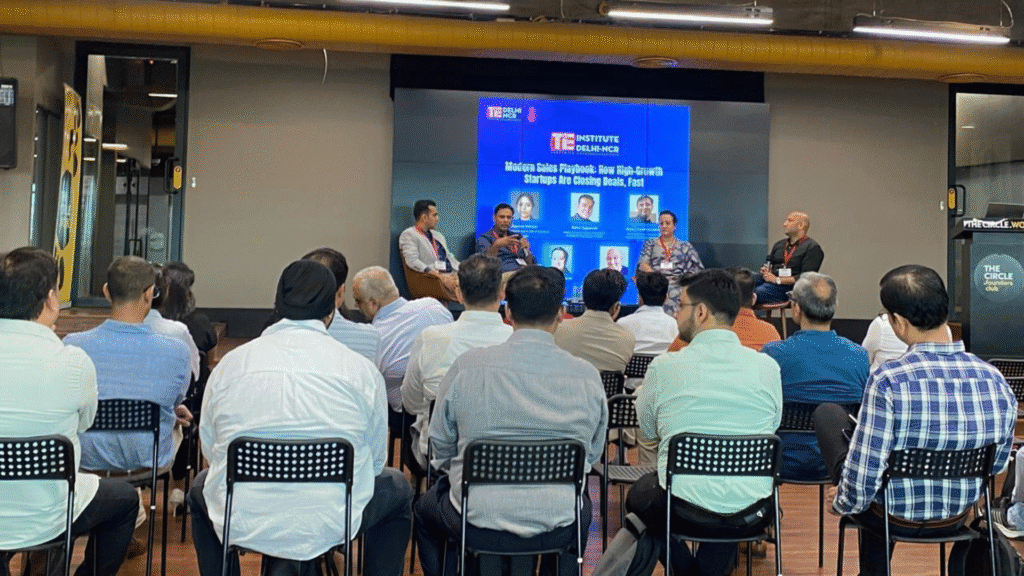
The conversation started with hiring. And not in the traditional “who has the best track record” way. Founders and sales leaders are increasingly focused on hiring for attitude, not just skill. The question isn’t “can they sell?” It’s “why do they want to sell this product?” Motivation is the signal. If someone understands the problem the product exists to solve and genuinely cares about that, the skills can be taught. What can’t be taught is belief. Once the right people are in place, trust becomes the engine. Micromanaging kills performance. The most effective teams are led by people who know when to get out of the way. When people are trusted, they take ownership. And when clear incentives are aligned with that ownership, execution naturally follows. It’s not about pressure, it’s about autonomy paired with purpose.
One of the more refreshing ideas from the session was that sales today often looks more like consulting than selling. Buyers, especially in B2B, are overwhelmed. There are too many options, too many buzzwords, and not enough clarity. The role of the salesperson is to simplify and cut through the noise, ask the right questions, and guide the buyer toward a decision that solves a real problem. That doesn’t mean being passive; it means being informed.
Reading annual reports, understanding how the company operates, and knowing where the gaps are, all of this build credibility. When you speak their language, they listen. That led to another insight: the type of selling matters. There’s mass selling: quick, transactional, scale-driven. There’s value selling: focused on justifying ROI. And then there’s consultant selling: slow, deep, and trust-driven. Startups need to be clear about which one they’re doing. Consultant selling may not deliver results overnight, but it builds relationships that last, and often, that’s the difference between one deal and a long-term customer.
Technology, of course, plays a big role too. AI is changing how teams sell, but not in the way you might expect. It’s not replacing salespeople, it’s making them sharper. From predicting which leads are most likely to convert to helping teams prioritise their time and resources, AI is becoming a quiet but powerful advantage. Tools like Gamma for building pitch decks, Notebook LM for fast, reliable research, and Napkins for mapping out workflows are already streamlining how modern sales teams operate. In this new landscape, being AI-literate isn’t just a nice-to-have. It’s quickly becoming part of what makes someone a strong hire.
But perhaps the most interesting idea of the day was that the best salespeople don’t just respond to need, they create it. Think of smartphones. No one asked for one. Now we can’t live without them. The same applies in startup sales. You’re not just offering a product, you’re helping people recognise a problem they didn’t realise they had. And once they see it, your solution becomes not just valuable, but necessary. The session gave me a perspective that sales, at its core, isn’t about closing. It’s about connecting and about solving real problems with the right mix of insight, empathy, and execution.
Written by Tejasdeep Singh (UG25)


Study at Ashoka
