Ashoka University



Other links:


Other links:




Artificial Intelligence promises to revolutionise everything from medicine to finance, and is shaping decisions of profound societal importance. But how much of this is transformative power, and how much is just snake oil? Amidst the excitement, there’s a growing need to distinguish between what AI can truly deliver and what is marketing hype or misunderstood science.
If you are interested in exploring the promise of AI’s potential with clarity and precision, guided by the tools of computational mathematics, then this course is for you.
Harnessing Your AI Superpower will uncover the mathematical foundations that power modern AI: Bayes’ Theorem and the bias-variance tradeoff, linear algebra and the basics of calculus that make large-scale computation possible. With these ideas in hand, we will examine how AI is applied in healthcare, criminal justice, and autonomous systems, developing the capacity to understand technical reports, evaluate statistical evidence, and participate in the socio-technological conversations that define our AI-driven future. You will study why models that perform well on training data can fail spectacularly in practice and how statistical trade-offs are not just technical problems, but deep ethical challenges. You will learn to ask questions such as: What assumptions do models rely on? What data is it trained on? Who benefits from its deployment — and who may be harmed? Through these, you will develop a critical lens to understand the systems that are increasingly shaping our lives.
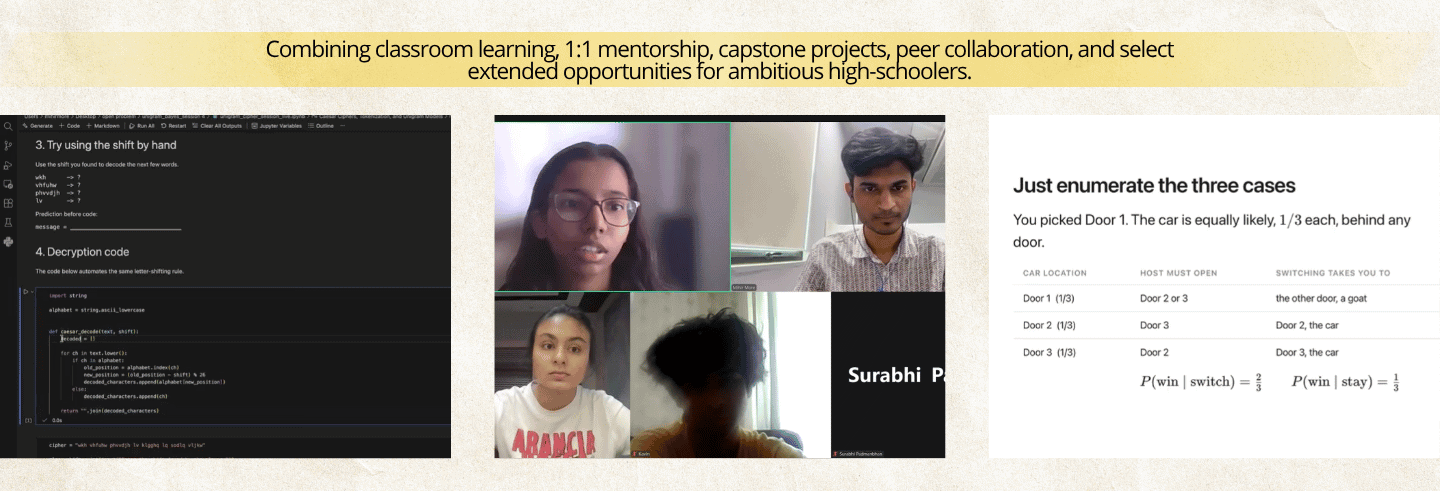
The course will culminate with a capstone project bringing together the technical and critical tools developed throughout the course. You will have the opportunity to either complete a final refinement and evaluation of their N-gram model with a statistical analysis of its assumptions and limitations, or conduct a rigorous audit of a real-world AI claim, assessing its evidence, biases, and validity through the principles learned in the course. You will emerge as a builder of models and an informed and confident critic of AI: equipped with the mathematical insight to separate signal from noise, promise from exaggeration, and innovation from illusion. This is the essential literacy for the next generation of scientists, technologists, policymakers, leaders, and engaged citizens.
What’s more? Top students will also achieve an extended opportunity for a research project on citizen-facing AI deployments by the government, which contributes to policies around AI for education, agriculture, health, and manufacturing.
“The project sessions were a huge highlight—we got to brainstorm as a team, tackle bugs together, and slowly figure out the logic behind building a poker bot. This course really shifted my perspective. Using math to give meaning to code made CS way more interesting to me.”
– Harshita, Grade 11, KC High International School
This course is designed for high schoolers from varied disciplinary backgrounds (humanities, social sciences, natural sciences) who want to move beyond the headlines and develop a rigorous, quantitative understanding of how AI works and its impact on society.
No prior programming or advanced mathematics experience is required. A willingness to engage with quantitative concepts is essential. Basic familiarity with mathematical principles is assumed.
By the end of the programme, you will:
| Week | Lecture Module | Project Module |
|---|---|---|
| Week 1 | The Language of Uncertainty
Get introduced to “probability” as the language of Intelligence.
|
Case Study: Medical Diagnosis
Practice concepts such as sample space, conditional probability, and Bayes’ Theorem through the case. Build a unigram language model to experience firsthand how prediction emerges from probability. |
| Week 2 | From Probability to Prediction
Develop the chain rule of probability and the Markov assumption to construct the bigram model, while examining how AI systems fail through:
|
Case Study: Predictive Policing
Practice concepts such as accuracy/recall, overfitting, sampling bias, and the multiple comparisons problem, through the case. Reflect on how small/biased samples lead to unreliable generalisation. Implement and evaluate the bigram model using log-likelihood and perplexity. |
| Week 3 | Confronting Tradeoffs: From Bigrams to N-grams
Extends bigram models to N-grams, introducing smoothing techniques and the bias-variance tradeoff to show how increased model complexity creates statistical tensions. |
Scaling Context
Students refine their bigram implementation, generalise it to an N-gram model, and compare performance across model sizes to diagnose overfitting and data sparsity. |
| Week 4 | Becoming AI-Literate
Explains the conceptual foundations of attention-based Transformer architectures, contrasting them with N-grams to reveal how modern AI scales probabilistic reasoning through representation and adaptive weighting. |
Demo Day
Students compare their N-gram outputs with modern language models, critique real-world AI performance claims, and demonstrate statistical judgment as their core AI superpower. |
| Counseling:
Get a chance to ask questions to the faculty and the mentor and get their answers and perspective. You are encouraged to ask questions to the faculty around the following aspects: ● What are some related fields that can be explored based on this course topic? ● What are the future trends in the related fields? ● How can the course learning help the student enhance their college applications? |
Mentoring:
You are encouraged to ask questions to the mentor around the following aspects:
|
For the hands-on capstone project, students will either:

Aalok Thakkar is an Assistant Professor of Computer Science at Ashoka University. His research is situated at the intersection of formal logic and artificial intelligence, with a particular focus on trustworthy AI. He is especially interested in developing large-scale AI systems that are robust and fair by construction. In addition, he pursues work in computational sustainability and computer science pedagogy. In 2025, he was awarded the Alt Carbon Darjeeling Revival Fellowship and the EkStep AI and Data Adoption Fellowship in recognition of his research contributions.
Prof. Thakkar earned his PhD in Computer and Information Science from the University of Pennsylvania in May 2023. His dissertation, titled “Example-guided Synthesis of Relational Queries,” was supervised by Professors Rajeev Alur and Mayur Naik. Before his academic appointment, he was a research scientist at Aptos Labs. He has also worked at Amazon Web Services, Bell Labs, and Adobe Systems on various aspects of automated verification and program synthesis.
Ashoka Horizons Achievers Programme offers a certificate on satisfactory completion of the course.
Class participation will be assessed based on your active engagement in live sessions, contributions to discussion forums, and involvement in Teaching Fellow-led activities.
Achieve More…with Horizons Achievers Programme:
*For select students, subject to discretion of the faculty
This programme is administered through an online platform. Students are expected to have a foundational understanding of computer usage, including but not limited to sending emails and conducting Internet searches. Consistent access to the Internet and a computer that aligns with the recommended minimum specifications are also requisite for participation in the programme.
Have a question about Ashoka Horizons Achievers Programme? Write to us on horizons@ashoka.edu.in
Of course, having completed an Ashoka Horizons course will be of great value when filling out an application to college. It has given me relevant skills and knowledge in data science and shown me to be a learner and capable of handling alternative subjects. This will greatly enhance my application and place me in a league of my own for consideration.
Yes, the Horizons course will definitely help me with my college applications. Many universities abroad, particularly in the US, value students who demonstrate a strong interest in their chosen majors.


Prof Debayan Gupta
Assistant Professor of Computer Science, Ashoka University
PhD, Yale University
Schedule:To be announced

Rintu Kutum
Faculty Fellow of Computer Science, Ashoka University
Ph.D. CSIR-Institute of Genomics & Integrative Biology, New Delhi
Schedule:To be announced

Prof. Parush Arora
Assistant Professor of Economics, Ashoka University
Ph.D. University of California, Irvine
Schedule:To be announced