


Other links:


Other links:




Mathematics is not just a tool. It is a language, and a way of thinking and engaging with the world. Mathematical Thinking introduces students to the history, power and creative potential of mathematical and quantitative thinking and familiarizes students with some basic problem solving strategies. This course aims to give students an experience of contemporary Mathematics. One can see that Mathematics is driven by ideas, not by calculations. It is both beautiful and powerful, and it combines precision with the greatest creativity. En route, students develop a set of broadly useful problem-solving skills, gain experience in precise thinking and writing, and encounter some of history’s landmark ideas.

Code: FC-0306-1 | Semester: Monsoon 2025
These courses will introduce students to the basics of mathematical and logical reasoning, algorithmic thinking, and data-driven analysis. The course will use examples from diverse fields to highlight the importance of these in a problem-solving approach. The offerings from the Department of Computer Science will have two versions: one for the more-mathematically-inclined and the other for the not-so-mathematically-inclined. Both versions will roughly have the same coverage, but the depth of treatment and the examples will be different. This version (with Prof. Debayan Gupta) is the more-mathematically-inclined vesion.

Code: FC-0306-2 | Semester: Monsoon 2025
The course will begin with pre-requisite tools of quantitative thinking vis-a-vis the number system, set theory, logic, proofs, probability and statistics. We will then learn how to use some of these tools to study (i) fairness in division of scarce resources, (ii) collective decisions in committees and democracies around the world (voting methods), and (iii) how to act optimally in competitive social interactions, i.e. game theory. By the end of the course, students would have a basic understanding of the most widely used mathematical tools in the liberal arts. They will learn how to approach different economic problems- by reducing them to their bare essentials (via modelling) and to mathematically analyse their underlying structural and logical patterns.
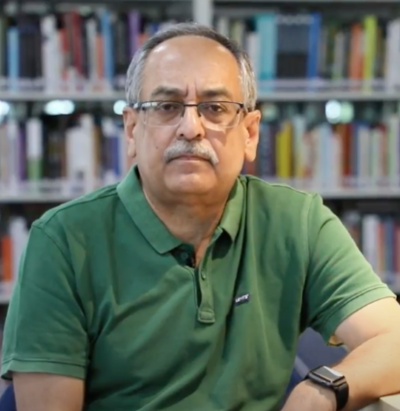
Code: FC-0306-3 | Semester: Monsoon 2025
This course will introduce students to the basics of mathematical and logical reasoning, algorithmic thinking, and data-driven analysis. The course will use examples from diverse fields to highlight the importance of these in a problem-solving approach.
The offerings from the Department of Computer Science will have two versions: one for the more-mathematically-inclined and the other for the not-so-mathematically-inclined. Both versions will roughly have the same coverage, but the depth of treatment and the examples will be different. This course will be aimed at the not‑so‑mathematically‑inclined.
Please see the course web page for an overview of the coverage.
Code: FC-0306-4 | Semester: Monsoon 2025
Faculty: Abheek Barua
This course is meant for students who are either intimidated by mathematics or those who like mathematics but want to find ways of applying mathematics to the real world. It will be split into two sections. The first will build data literacy, the process of starting with raw numbers and using simple but powerful methods of interpreting the stories that the numbers tell. It will enable students to follow a systematic approach in building a toolkit to analyse numbers. The approach would be to draw constantly on real world examples to illustrate how simple quantitative tools are used to analyse and address complex problems.
How for instance, is standard deviation used to understand financial market behaviour? How can it be used to have a deeper insight into cost-of-living challenges for communities? Does ice-cream consumption actually drive up the crime rate in American cities as the data seems to suggest? What does a car-buyer’s choice of colour tell us about dependent, independent and control variables? Students will be asked to process raw data (cricket scores, monthly expenditures of classmates etc) to arrive at interesting insights and hypotheses.
The second section will focus on the intuition behind key ideas in mathematics. We will look at shapes of curves and optimization, set theory, game theory and Nash equilibrium, voting models and fair division as well as the mathematics of networks as well as financial mathematics. Here again, the focus will be on applications of these ideas in the real world. For example, why do countries find it difficult on agree on climate change measures even when it appears to be a good thing for everyone? When does it make sense to rent a house instead of taking a loan to buy one? What was the intuition behind ranked-choice voting used in the elections for New York city mayor? What do tangents tell us about Usain Bolt’s running style?
We will also look at some of the contemporary issues in mathematics and statistics such as the use of “ Big Data” and “Black Swans” and tail risks.
A diverse set of resources including videos, blogs, number games along with a textbook will be used.
Code: FC-0306-5 | Semester: Monsoon 2025
Faculty: Abhishek Khetan
Course description to be updated.
Code: FC-0306-6 | Semester: Monsoon 2025
Faculty: Chandan Singh Dalawat
Course description to be updated.

 debayan.gupta@ashoka.edu.in