Ashoka University



Other links:


Other links:




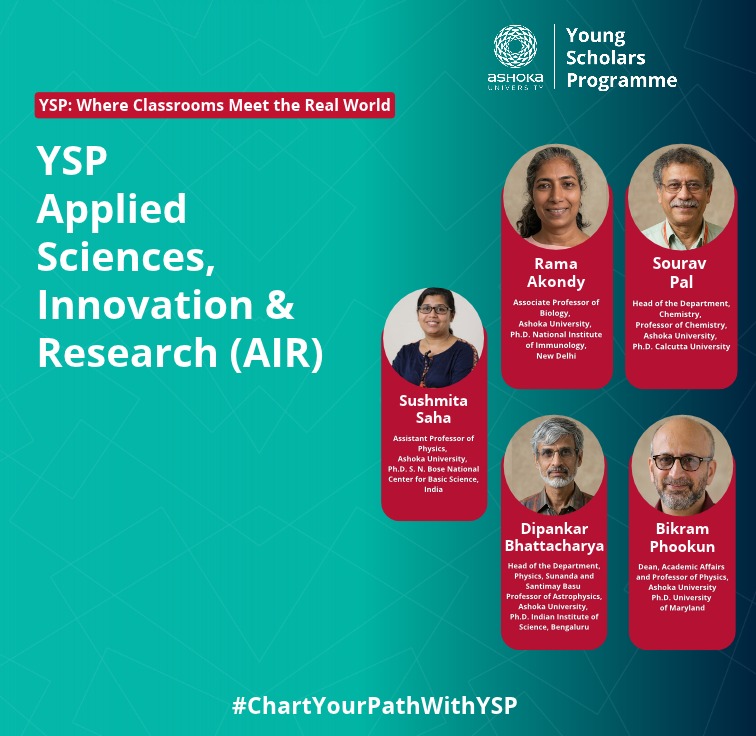
YSP Applied Sciences, Innovation & Research (YSP AIR) is a 10-day certified, residential, summer programme for students entering Grades 9 – 12.
Forward-looking and laboratory-led, the programme invites participants to explore the breadth and depth of the natural sciences, from the physical, life and earth sciences to the emerging fields where they meet.
Throughout, the emphasis falls on the real-world application of research.
Through lecture-demonstrations and seminars with leading scientists and industry practitioners, students see how discovery matures into innovation, and how innovation in turn shapes industry and society.
They may learn, for instance, how a question about the behaviour of RNA became a vaccine or how research in lithium in chemistry came to power the phone in their pockets.
They come to grasp the defining questions of each field, and become better informed about the careers that lie beyond the traditional disciplines.
Students may learn alongside leading researchers such as Prof. Anurag Agrawal, Prof Sneha Shashidhara, Prof. K. VijayRaghavan, Prof. Somak Raychaudhury, Prof. V. Chandrasekhar, Prof. Rama Akondy, Prof Kedar Natarajan, Prof. Bikram Phookun, Prof. Gautam Menon, Prof. Dipyaman Ganguly and Prof. Dipankar Bhattacharya.
These sessions also reveal the lives behind the science and students hear first-hand how they pursued the laws of nature through years of persistence, and how that pursuit has bettered the world.
Their stories invite students to take part in humankind’s long endeavour to understand the universe.
Students will try out four laboratories (Biology, Chemistry, Physics and the Makerspace) and see how scientists and researchers in each one think and work.
Then they will go deep into one of them, working in a group with instructors.
A career in science today joins discovery, technology and societal impact. Through sessions with Ashoka faculty, industry experts and practising scientists, YSP AIR introduces students to the pathways open to them.
By engaging with fundamental inquiry and applied innovation, students at YSP AIR begin to envisage the many careers open to them, and the ways in which they might contribute to the scientific challenges of the future.
A Holistic College Experience
Beyond academics, YSP AIR offers a glimpse of life at Ashoka University. Students live on campus, enjoy a variety of dining options, and take part in evenings such as Talent Night, Chaat and Chat Night, etc . They meet peers who share their curiosity from across India and around the world, and form friendships that broaden their outlook long after the programme ends.
Applications for Ashoka Young Scholars Programme (YSP) – Campus 2027 will open on December 1, 2026.
Stay tuned for updates on the upcoming cycle, follow us on social media and check our website for announcements.
Connect with us: LinkedIn | Instagram
Knowledge:
– Gain a foundational understanding of the natural sciences, from the physical, life and earth sciences to the emerging fields where these disciplines meet, through laboratory-led learning.
– Recognise the importance of interdisciplinary collaboration in advancing scientific discovery and addressing complex global challenges like climate change and pandemics.
– Learn how the scientific method works in practice: framing a question, designing an experiment and testing a hypothesis.
– Understand how emerging technologies (AI, CRISPR, quantum computing) intersect with ethical, societal, and environmental considerations in solving real-world problems.
Skills:
– Build foundations in the natural sciences through hands-on work in the Biology, Chemistry, Physics and Makerspace laboratories, from foundational experiments across all four in the first week to sustained work in one laboratory in the second.
– Develop critical thinking and analytical skills by investigating real-world applications of research. .
– Gain practical experience of the research process under the guidance of instructors who are active researchers, from framing a question and designing an experiment to analysing results and reaching findings
– Enhance collaborative and communication skills by working in groups and presenting findings to peers, faculty and instructors at the Demo Day.
Attitude:
– Developing a strong sense of identity and belonging within the world of science and research.
– Foster a lifelong passion for science and a curiosity-driven approach to learning and exploration
– Develop a responsible and ethical mindset towards scientific research.
– Embrace and appreciate the value of an interdisciplinary perspective in solving scientific problems and addressing global challenges.
Applications:
– Undertake guided laboratory investigations to examine scientific concepts.
– Apply scientific concepts to investigate questions and solve problems through structured laboratory experiments.
– Interpret experimental results and communicate scientific findings through demonstrations, visualisations and presentations.
– Connect scientific discoveries to their real-world applications across fields such as healthcare, biotechnology, sustainability and emerging technologies.
YSP AIR curriculum provides students with a novel way of looking at various scientific disciplines, highlighting the power of an interdisciplinary approach to science, while encouraging active student participation in discussion sessions, lab rotations and practical applications of their learning in state-of-the-art lab & research facilities.
A sample schedule for YSP AIR is given below. (tentative schedule, subject to change)
YSP IST Programme ScheduleHave questions about YSP AIR ?
Know More
YSP has been such a great experience. One thing I really liked about YSP was that when I saw the schedule and everything, I thought it would be very academically rigorous. For example, if there’s a session on DNA, then they’re probably going to teach about DNA, DNA sequencing, etc. But what made it different, and even more fascinating and engaging, was that it was not really about getting to know about DNA. It was about getting to know the people who have worked in that field, the experts of that field. They were telling us how their life journey was shaped, what led them into their work, what they were into, and everything about how they became who they actually are today. And that, I believe, is far more interesting, because if I want to learn about DNA, I can simply go to YouTube and search for a video about it. But what YSP is offering is something that is unavailable.
In school, we also have lab work, but here at Ashoka, they were focusing on practical concepts rather than theoretical ones. They were not “just” explaining the concepts. For example, with a simple pendulum, we all know how it works and what experiments are carried out on it, but here at Ashoka, the professors literally taught us how to draw conclusions and how to carry out research on it. We were also shown the graph, so we were able to visualize how it really worked.
YSP has been a memorable experience. Last year, I became interested in getting into an Ivy League university and discovered summer school programs. I applied to several and chose YSP because I thought it would be good – but it’s way better than my expectations and I’ve learned a lot. I’ve even made a lot of friends even though I’m usually shy and don’t talk to anyone easily – but I’ve started to socialize here a lot. YSP has made me learn how to make great contacts, how to make good friends easily, so I am not that introvert or shy person like I was before. It has taught me a lot of things, and I even met a Nobel laureate and it was such a good experience.
YSP has really helped me figure out what I want to do, thanks to the kind of interdisciplinary courses we’ve had. Exploring subjects like astrophysics and biochemistry helped me narrow down my career path. When I chanced upon YSP during my boards, it felt like the best Science and Tech course I could pursue in India. I already knew I preferred pure sciences over computer sciences, which helped me focus on IST. We’ve had so many decorated professors from amazing colleges, but my favourite moment was the session with a Nobel prize winner.
My experience at YSP has been intriguing, interesting, and eye opening. The labs were especially memorable – I got to do experiments with lava lamps, esterification, and elephant toothpaste, which we never get to do in school. The program really offered the chance to have fun and experiment with chemicals in ways that were completely new for me.